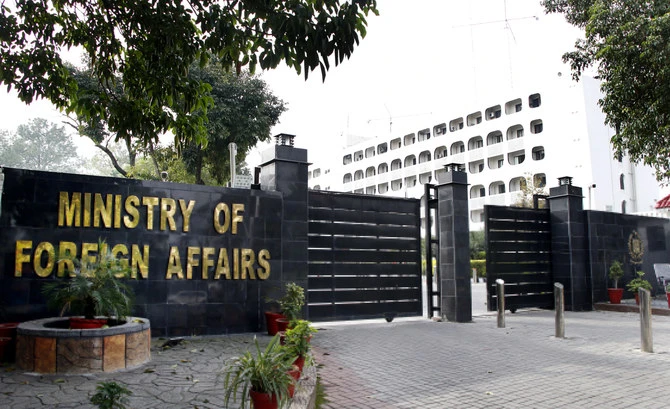
ISLAMABAD: Pakistan’s foreign office denied on Sunday that its country’s envoy to Washington had said India should engage with the Taliban, after Reuters quoted Ambassador Asad Khan in a news report.
On Saturday, a Reuters report headline stated: ‘India should talk to Taliban if Delhi feels it will bolster peace push,’ and attributed the statement to the Pakistani ambassador.
“The ambassador did not say what the news headline implies. Pakistan’s views on India’s role are well-known,” foreign office spokesperson, Aisha Farooqui, told Arab News.
Pakistan and India have been to war three times since they won independence from the British in 1947. Over the years, Pakistan has gained influence over the Taliban.
“Pakistani envoy has not said that they [India and Taliban] should engage. Rather, he was saying it is their [India’s] decision,” the spokesperson continued. “Even the Taliban have expressed their viewpoint on the subject.”
“This is the time to focus on earliest commencement of intra-Afghan negotiations rather than dwell on any extraneous issue,” she said.
Earlier, in an interview with Indian newspaper, The Hindu, US Special Representative for Afghanistan, Zalmay Khalilzad, had said an India-Taliban engagement would be "appropriate.”
When asked to respond to the statement, Ambassador Khan told Reuters: “It is for India to respond to that suggestion.”
"If India feels that their engagement is going to help the peace process, then we would defer to their judgment. But it's not for us to sit in judgment on what they should do or they shouldn't do,” Reuters further quoted the ambassador.
Pakistan’s former ambassador to Washington, Aizaz Ahmed Chaudhary, told Arab News that New Delhi had no constructive role to play in the Afghanistan peace process.
“India has no political role in Afghanistan. They have played negative role there to harm Pakistan,” he said.
“Americans want to give India some role but it is hard that Taliban will accept it in any capacity.”
Pakistan denies its envoy to US said India should engage with Taliban
https://arab.news/w2r8t
Pakistan denies its envoy to US said India should engage with Taliban
- A Reuters news report attributed the quote to Ambassador Asad Khan on Saturday
- ‘India has no constructive role in Afghanistan,’ says former Pak envoy to Washington
UN torture expert decries Pakistan ex-PM Khan’s detention
- Khan’s party alleges government is holding him in solitary confinement, barring prison visits
- Pakistan’s government rejects allegations former premier is being denied basic rights in prison
GENEVA: Pakistan’s former prime minister Imran Khan is being held in conditions that could amount to torture and other inhuman or degrading treatment, the United Nations’ special rapporteur on torture warned Friday.
Alice Jill Edwards urged Pakistan to take immediate and effective action to address reports of the 73-year-old’s inhumane and undignified detention conditions.
“I call on Pakistani authorities to ensure that Khan’s conditions of detention fully comply with international norms and standards,” Edwards said in a statement.
“Since his transfer to Adiala Jail in Rawalpindi on September 26, 2023, Imran Khan has reportedly been held for excessive periods in solitary confinement, confined for 23 hours a day in his cell, and with highly restricted access to the outside world,” she said.
“His cell is reportedly under constant camera surveillance.”
Khan an all-rounder who captained Pakistan to victory in the 1992 Cricket World Cup, upended Pakistani politics by becoming the prime minister in 2018.
Edwards said prolonged or indefinite solitary confinement is prohibited under international human rights law and constitutes a form of psychological torture when it lasts longer than 15 days.
“Khan’s solitary confinement should be lifted without delay. Not only is it an unlawful measure, extended isolation can bring about very harmful consequences for his physical and mental health,” she said.
UN special rapporteurs are independent experts mandated by the Human Rights Council. They do not, therefore, speak for the United Nations itself.
Initially a strong backer of the country’s powerful military leadership, Khan was ousted in a no-confidence vote in 2022, and has since been jailed on a slew of corruption charges that he denies.
He has accused the military of orchestrating his downfall and pursuing his Tehreek-e-Insaf (PTI) party and its allies.
Khan’s supporters say he is being denied prison visits from lawyers and family after a fiery social media post this month accusing army leader Field Marshal Asim Munir of persecuting him.
According to information Edwards has received, visits from Khan’s lawyers and relatives are frequently interrupted or ended prematurely, while he is held in a small cell lacking natural light and adequate ventilation.
“Anyone deprived of liberty must be treated with humanity and dignity,” the UN expert said.
“Detention conditions must reflect the individual’s age and health situation, including appropriate sleeping arrangements, climatic protection, adequate space, lighting, heating, and ventilation.”
Edwards has raised Khan’s situation with the Pakistani government.