

Islamabad reaffirms position on 'illegal annexation' of West Bank as Pompeo visits Tel Aviv

This undated file photo shows Pakistan's foreign ministry spokeswoman Aisha Farooqui speaking during a press briefing. (Supplied)
Short Url
Updated 15 May 2020
Follow

Islamabad reaffirms position on 'illegal annexation' of West Bank as Pompeo visits Tel Aviv

  • Islamabad supports the establishment of Palestinian state with pre-1967 war borders
  • Says West Bank is Palestinian territory illegally occupied by Israel

ISLAMABAD: Pakistan has reiterated its opposition to Israeli annexation of the West Bank, following US Secretary of State Mike Pompeo’s recent meeting with Israeli Prime Minister Benjamin Netanyahu, which has been seen as Washington’s approval of Israel’s plans to seize the occupied territory.
“Pakistan is opposed to any move for annexation of the occupied Palestinian territories as it would be a serious violation of international law and a dangerous escalation in an already volatile situation,” Foreign Office spokeswoman Aisha Farooqui said in a press briefing on Thursday.
“The West Bank and Jordan Valley are Palestinian territories, illegally occupied by Israel since 1967,” Farooqui said, adding that Pakistan supports the position adopted by the United Nations and Organization of Islamic Cooperation on the issue of Palestine and calls upon the international community to uphold and support the rights of the Palestinians.
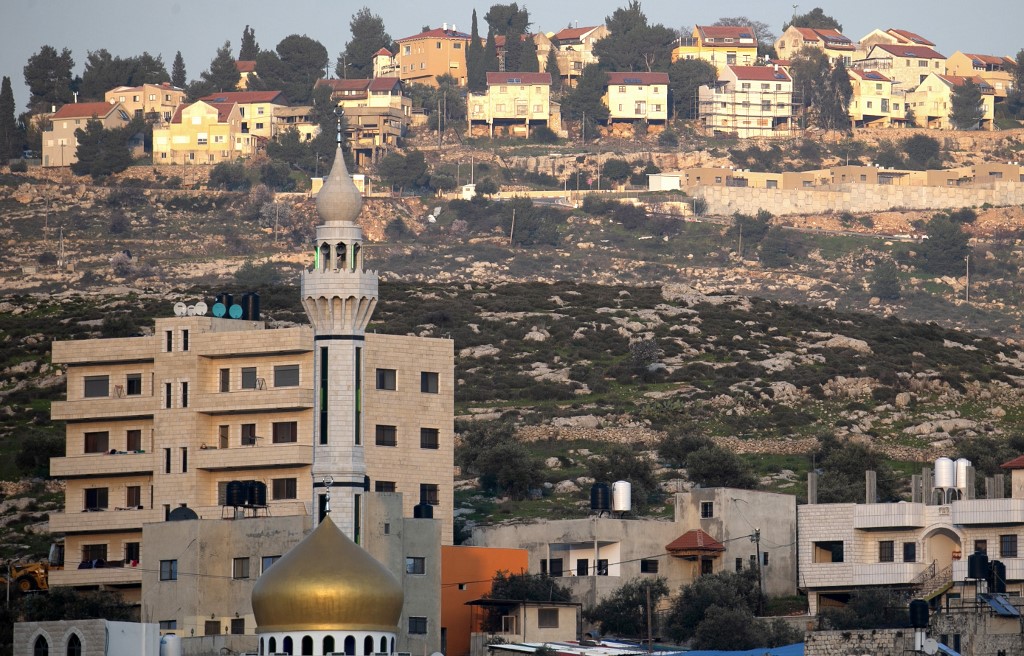


This picture taken on Feb. 22, 2020 shows a view of the Palestinian village of Azmut east of Nablus in the occupied West Bank, with the Israeli settlement of Alon Moreh seen in the background. (AFP)

Pompeo was in Israel on Wednesday on a one-day trip that included meetings with Netanyahu and his coalition partner Benny Gantz.
The US secretary told Israel Hayom newspaper that they had discussed annexation “but also many other issues related to it — how to deal with all the factors involved, and how to make sure the move is done properly to bring about an outcome in accordance with the vision of peace.” He said the West Bank territorial moves were an Israeli decision that Netanyahu and Gantz have a right to make.
The “vision of peace” is a reference to US President Donald Trump’s controversial Middle East peace plan, under which the vast majority of West Bank would be incorporated into Israeli territory. 
On Jan. 29, a day after the plan was announced, Pakistan rejected it and repeated its call for the establishment of a “viable, independent and contiguous State of Palestine, on the basis of internationally agreed parameters, the pre-1967 borders, and with Al-Quds Al-Sharif as its capital.”
Pakistan does not recognize the state of Israel and has repeatedly supported UN resolutions regarding Palestine.
According to a 2016 UN resolution, Israel’s settlement activity in the West Bank and East Jerusalem constitutes a “flagrant violation” of international law and has “no legal validity.”


Pakistan, China to sign multiple MoUs at major agriculture investment conference today

Updated 11 sec ago
Follow

Pakistan, China to sign multiple MoUs at major agriculture investment conference today

  • Hundreds of Chinese and Pakistani firms to attend Islamabad event
  • Conference seen as part of expanding CPEC ties into agriculture, trade

KARACHI: Islamabad and Beijing are set to sign multiple memorandums of understanding (MoUs) to boost agricultural investment and cooperation at a major conference taking place in the capital tomorrow, Monday, with hundreds of Chinese and Pakistani companies expected to participate.

The conference is being billed by Pakistan’s Ministry of National Food Security and Research as a platform for deepening bilateral agricultural ties and supporting broader economic engagement between the two countries.

“Multiple memorandums of understanding will be signed at the Pakistan–China Agricultural Conference,” the Ministry of National Food Security said in a statement. “115 Chinese and 165 Pakistani companies will participate.”

The conference reflects a growing emphasis on expanding Pakistan-China economic cooperation beyond the transport and energy foundations of the flagship China-Pakistan Economic Corridor (CPEC) into agriculture, industry and technology.

Under its first phase launched in 2015, CPEC, a core component of China’s Belt and Road Initiative, focused primarily on transportation infrastructure, energy generation and connectivity projects linking western China to the Arabian Sea via Pakistan. That phase included motorways, power plants and the development of the Gwadar Port in the country's southwest, aimed at helping Pakistan address chronic power shortages and enhance transport connectivity.

In recent years, both governments have formally moved toward a “CPEC 2.0” phase aimed at diversifying the corridor’s impact into areas such as special economic zones, innovation, digital cooperation and agriculture. Second-phase discussions have highlighted Pakistan’s goal of modernizing its agricultural sector, attracting Chinese technology and investment, and boosting export potential, with high-level talks taking place between planning officials and investors in Beijing.

Agri-sector cooperation has also seen practical collaboration, with joint initiatives examining technology transfer, export protocols and value-chain development, including partnerships in livestock, mechanization and horticulture.

Organizers say the Islamabad conference will bring together government policymakers, private sector investors, industry associations and multinational agribusiness firms from both nations. Discussions will center on investment opportunities, technology adoption, export expansion and building linkages with global buyers within the framework of Pakistan-China economic cooperation.