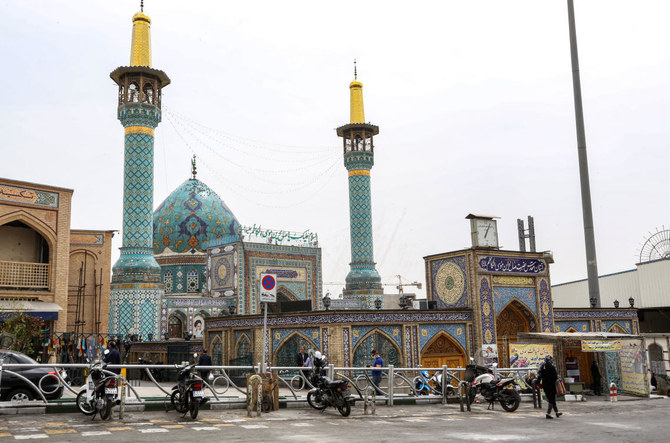
Virus-hit Iran to reopen mosques for holy nights

Mosques in Iran have been closed due to the COVID-19 pandemic. (Atta Kenare/AFP)
Short Url
Updated 12 May 2020
Follow

Virus-hit Iran to reopen mosques for holy nights

  • The Islamic republic shut its mosques and shrines in March as part of its efforts to contain the Middle East’s deadliest outbreak of the novel coronavirus
  • Health ministry spokesman Kianoush Jahanpour said another 1,481 people tested positive for the virus in the past 24 hours

TEHRAN: Virus-hit Iran will reopen its mosques for three nights over the next week so that worshippers can pray during one of the holiest times of year, a minister said Tuesday.
The Islamic republic shut its mosques and shrines in March as part of its efforts to contain the Middle East’s deadliest outbreak of the novel coronavirus.
The reopening was granted for Laylat Al-Qadr — a high point during the fasting month of Ramadan that marks when the Qur'an was revealed to Prophet Muhammad.
But Health Minister Saeed Namaki sounded a note of caution as he announced that worshippers would be allowed to attend mosques and ceremonies for three of the next five nights.
“The biggest strategic mistake is to think that coronavirus is finished,” he said in remarks broadcast on state television.
“At any time, we can go back to bad circumstances” due to “negligence,” said Namaki.
“Our priority is to hold ceremonies outdoors” such as “in stadiums,” he said, “so that social distancing is properly observed.”
Namaki said his ministry agreed in a meeting to help “organize ceremonies from midnight to 2:00 am during the nights of Qadr.”
He said the move came in response to “concern” expressed by Ayatollah Ali Khamenei, but stressed the supreme leader “always supports all measures” to contain the virus.
All gatherings would need to respect “sanitary protocols to the maximum,” he added.
But he warned: “They shouldn’t blame the health ministry and say they wanted to open mosques but didn’t care about people’s health.”
His remarks came shortly before Iran announced another 48 deaths from the virus taking its overall toll to 6,733.
Health ministry spokesman Kianoush Jahanpour said another 1,481 people tested positive for the virus in the past 24 hours, bringing the total number of cases to 110,767 since the start of the crisis.
Iran has struggled to contain its outbreak of the virus that causes COVID-19 since announcing its first cases in the Shiite holy city of Qom on February 19.
The government closed schools, postponed major events and banned inter-city travel but it has eased restrictions gradually since April 11.
It allowed mosques to reopen on May 4 in 132 counties where the virus was deemed to be under control.
And on Friday last week worshippers were able to attend the main weekly prayers for the first time in more than two months, except for in the capital.
The government warned on Monday of a setback in its efforts to contain the virus.
“We have regressed in Khuzestan due to (people) not observing health protocols,” Deputy Health Minister Alireza Raisi said, referring to a southwestern province that is now the epicenter of the country’s outbreak.
“This can happen to any other province if we are not careful,” he added, noting that tighter measures would be reimposed in other places too if needed.
Experts inside and outside Iran have cast doubt on the country’s official COVID-19 figures, and say the real toll could be much higher.


Israel’s ‘deliberate intention of preventing births among Palestinians’ meets ‘legal criteria of Genocide Convention’: Reports

Updated 10 sec ago
Follow

Israel’s ‘deliberate intention of preventing births among Palestinians’ meets ‘legal criteria of Genocide Convention’: Reports

  • Births in Gaza fell by 41% during conflict as maternal deaths, miscarriages surged
  • ‘The destruction of maternal care in Gaza reflects the deliberate infliction of conditions of life calculated to bring about the destruction of the Palestinian people, in whole or in part’

LONDON: Births in Gaza fell by 41 percent due to Israel’s war on the territory, with the conflict resulting in catastrophic numbers of maternal deaths, miscarriages and birth complications, two reports have found.

The data on pregnant women, babies and maternity care in the war-torn Palestinian enclave also revealed a surge in newborn mortality and premature births, The Guardian reported on Wednesday.

Dangerous wartime conditions and Israel’s systematic destruction of Gaza’s health systems were blamed for the alarming statistics.

The two reports were conducted by Physicians for Human Rights, in collaboration with the University of Chicago Law School’s Global Human Rights Clinic and Physicians for Human Rights — Israel.

Researchers highlighted Israel’s “deliberate intention of preventing births among Palestinians, meeting the legal criteria of the Genocide Convention.”

The reports build on earlier findings by PHR’s Israel branch. They place the testimonies of pregnant women and new mothers within the context of health data and field reports, which recorded “2,600 miscarriages, 220 pregnancy-related deaths, 1,460 premature births, over 1,700 underweight newborns, and over 2,500 infants requiring neonatal intensive care” between January and June 2025.

PHRI’s Lama Bakri, a psychologist and project manager, said: “These figures represent a shocking deterioration from pre-war ‘normalcy,’ and are the direct result of war trauma, starvation, displacement and the collapse of maternal healthcare.

“These conditions endanger both mothers and their unborn babies, newborns, and breastfed infants, and will have consequences for generations, permanently altering families.”

She added: “Beyond the numbers, what emerges in this report are the women themselves, their voices, choices and lived realities, confronting impossible dilemmas that statistics alone cannot fully capture.”

Maternal and newborn care in Gaza has been damaged by Israel’s destruction of health infrastructure, as well as fuel shortages, blocked medical supplies, mass displacement and relentless bombardment.

As a result, survival in Gaza’s overcrowded tent encampments has become the sole option for pregnant women and new mothers.

During the first six months of Israel’s war on the territory, more than 6,000 mothers were killed, at an average of two every hour, according to UN Women estimates.

It is also believed that about 150,000 pregnant women and new mothers have been forcibly displaced by the conflict.

In the first months of last year, just 17,000 births were recorded in Gaza, a 41 percent fall compared to the same period in 2022.

The researchers examined Israel’s apparent strategy to undermine Palestinian births, highlighting a targeted strike in December 2023 on the Al-Basma IVF clinic.

The attack on Gaza’s largest fertility center destroyed about 5,000 reproductive specimens and ended a pattern of 70-100 IVF procedures each month.

The strike was deliberately designed to target the reproductive potential of Palestinians, the Independent International Commission of Inquiry later found.

“Reproductive violence constitutes a violation under international law; when carried out systematically and with them intent to destroy, it falls within the definition of genocide of the Genocide Convention,” the reports said.

“The destruction of maternal care in Gaza reflects the deliberate infliction of conditions of life calculated to bring about the destruction of the Palestinian people, in whole or in part.”