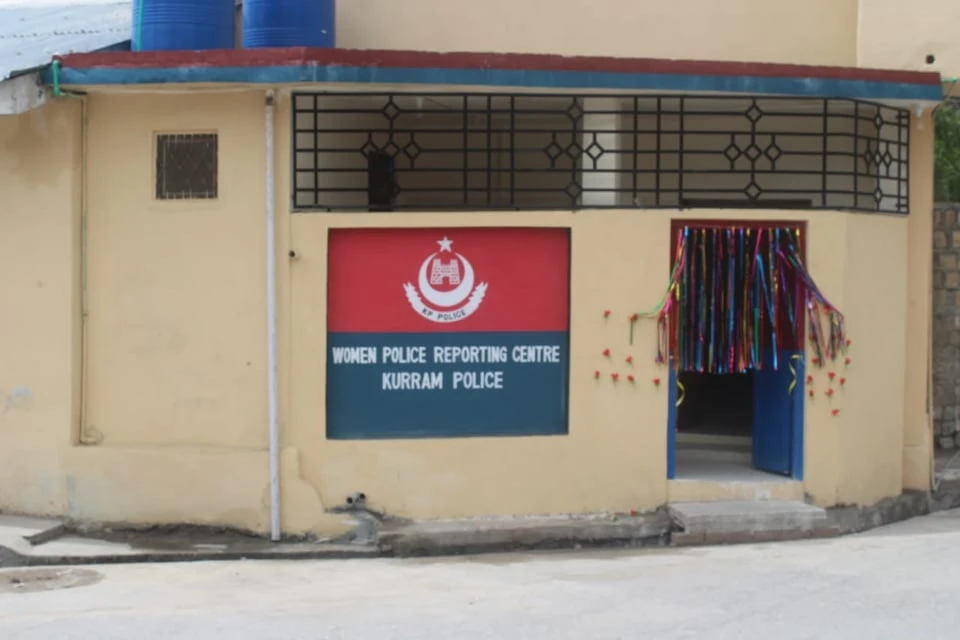
- The center in Parachinar has 14 female police personnel and all facilities needed to assist women who seek help
- Most of the problems faced by women in the region are related to domestic violence at the hands of in-laws
PESHAWAR: Police in Kurram have launched the first female reporting center in Khyber Pakhtunkhwa's tribal districts, in hopes of expanding women's access to justice in a region where they had been traditionally deprived of it.
"I observed that women were reluctant to approach police stations with complaints, so I decided to launch a separate reporting center for them," Kurram District Police Officer (DPO) Muhammad Quraish Khan told Arab News
He said that when he took his post last year, he found local police stations completely unaccommodating to women.
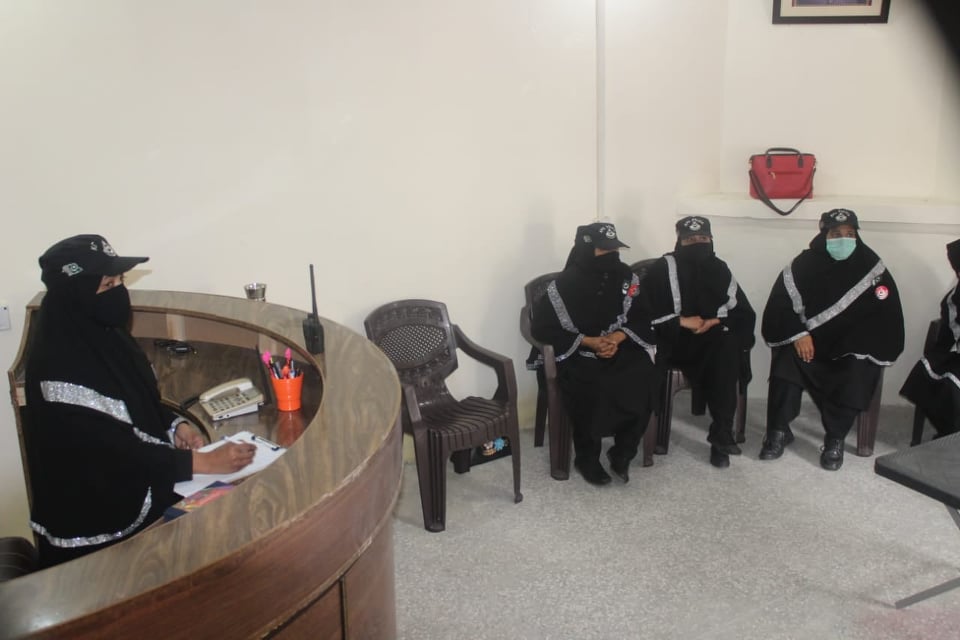
"My idea was to provide an environment for women in this male-dominated tribal society to come without hesitation and register their complaints," he said.
Inaugurated on May 1, the spacious center in Parachinar, the capital of Kurram, has 14 female police personnel and all facilities needed to assist women who come to seek help. It also has a playground for children whose officer mothers are on duty.
"I am getting immensely positive feedback from locals," Khan said, adding that if this pilot project is successful, he would recommend the establishment of similar centers in other tribal areas.
While such facilities already exist in other parts of Khyber Pakhtunkhwa, in the tribal region the very idea of women seeking justice is revolutionary and may also prove lifesaving.
"In tribal culture, women can't go outside alone to file a complaint with male police. This adds to their burdens, leads many young women to commit suicide to get rid of their problems forever," Naila Altaf, a social activist from the district, told Arab News.
Most of the problems, she said, are related to the tribal society's joint-family system, which is marred by domestic violence at the hands of in-laws.
Barriers to reporting and seeking formal help are often fear of tarnishing family members, getting into bigger trouble or unawareness of one's own rights.
"Women are hesitant to complain, especially when their problems involve domestic issues," Khan confirmed.
Since the center's inauguration, he said, about three women a week come to lodge reports — the district's population is about 620,000.
But more will come in the future, Khan believes, as with special training underway, his female police officers will be able to provide a sense of security to women and ensure that their privacy is kept, so that gradually there would be more confidence in the police system.
According to Mahrukh Jabeen, a graduate from Kurram district, the new initiative is a step forward in women's empowerment and their access to justice and law enforcement.
"Women in tribal areas have yet to be able to benefit from the merger of tribal districts with Khyber Pakhtunkhwa. The transition is very slow, so the female reporting center will somehow mitigate the situation," she said.
The introduction of police in Pakistan's tribal areas — the erstwhile Federally Administered Tribal Area (FATA) — followed the 2018 constitutional amendment, which merged the region with Khyber Pakhtunkhwa and revoked archaic British colonial-era laws, bringing in modern systems of justice and law enforcement.
Khan is aware that the changes will require long-term efforts and work on social perceptions before they are fully implemented. The female reporting center aims to ensure that women would not be left out in the process.
"The transition period of the tribal region will take time," he said, "We're here for women to get their constitutional rights."