

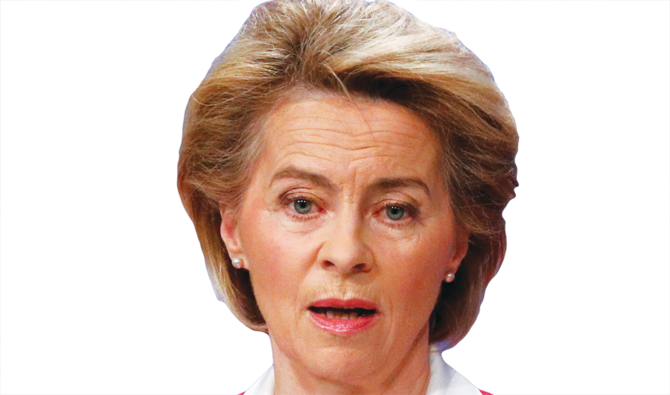
BERLIN: European Commission chief Ursula von der Leyen has raised the spectre of legal action against Germany after the country’s highest court issued harsh criticism of the bloc’s top court.
The unprecedented spat threatens to undermine the authority of the European Court of Justice, giving ammunition to countries like Poland and Hungary in their battle with EU institutions.
“I take this matter very seriously,” von der Leyen said in a written response to a question from Greens MEP Sven Giegold, which he shared on Twitter on Sunday.
“The Commission is now in the process of analizing in detail the more than 100-page judgment of the German Constitutional Court,” von der Leyen wrote.
“On the basis of these findings, we are considering possible next steps, including infringement proceedings.”
In a bombshell ruling on Tuesday, Germany’s Constitutional Court questioned the ECB’s bond-buying scheme, which has been credited with powering eurozone growth after the financial crisis.
The judges in Karlsruhe gave the ECB three months to justify the stimulus and show that the benefits of mass government debt purchases outweigh the side effects.
Otherwise, the judges said they will ban Germany’s powerful Bundesbank central bank from participating in the two-trillion-euro scheme.
The court also slammed the Luxembourg-based ECJ for rubber-stamping the asset purchases in an earlier ruling, and said Germany was not bound by the ECJ decision.
BACKGROUND
The judges in Karlsruhe gave the ECB three months to justify the stimulus and show that the benefits of mass government debt purchases outweigh the side effects. Otherwise, the judges said they will ban Germany’s Bundesbank central bank from participating in the two-trillion-euro scheme.
Observers said the German sidelining of the ECJ could be a boost for nations like Hungary and Poland, whose reforms to the political and judicial systems have drawn allegations they are eroding democracy.
“EU law takes precedence over national law, and of course the rulings of the European Court of Justice are binding for all national courts,” von der Leyen said in the letter, written in German.
The ECJ also hit back at Germany, saying in a statement on Friday that it alone had legal authority over the ECB.
But Polish Prime Minister Mateusz Morawiecki welcomed the German ruling as “one of the most important rulings in the history of the European Union.”
For the first time judges have clearly stated that the member states decide “where the lines are for EU institutions,” he said in a guest article for the Frankfurter Allgemeine newspaper on Sunday.
Artificial intelligence is transitioning into a ‘digital employee’
AI can be an effective tool, business leaders tell Arab News
Not about jobs, but ‘convergence of human capital and AI’
Updated 57 min 29 sec ago
Hebshi Alshammari
RIYADH: Artificial intelligence is fundamentally reshaping the world of work, transitioning from a supporting tool to an active partner that is radically changing the nature of professions and productivity standards.
Amidst the current global transformations, an active regional digital environment is emerging.
This is being led by Saudi Arabia through Vision 2030 and massive investments in smart infrastructure, providing a living model for studying the implications of this partnership between humans and machines on the future of work in the region.
Arab News spoke to various business leaders about the emerging shape of the sector.
Salem Bagami, co-founder of Metatalent, said the ideal relationship between humans and machines at work should be complementary and collaborative.
Humans would bring creativity, emotional intelligence, and complex decision-making, while machines excel at processing big data and performing repetitive, precise tasks.
He believes that this type of balanced partnership would lead to unprecedented productivity and innovation.
While machines excel at processing big data and performing repetitive, precise tasks, humans would bring creativity, emotional intelligence, and complex decision-making. (Supplied)
Mohammad Al-Jallad, chief technologist and director at HPE, said AI has gone beyond being merely an executive tool to becoming a “digital employee” entrusted with automating routine tasks and providing insights based on data analysis.
He believes that the real opportunity lies not in the debate over job replacement, but in “the convergence of human capital and artificial intelligence.”
AI should augment human teams by taking on menial and routine tasks, enabling employees to focus on critical thinking, creativity, and ethical reasoning, significantly improving operational results.
Bagami also emphasized the complementary nature of this partnership. “The ideal relationship between humans and machines at work is one of collaboration, where each complements the others.”
He explained that humans bring creativity, emotional intelligence, and nuanced decision-making, while machines excel at processing big data and performing repetitive tasks efficiently, leading to increased productivity and innovation.
Opinion
This section contains relevant reference points, placed in (Opinion field)
Salem Alanazi, chairman of Jathwa Technology Co., notes a significant trend among Saudi Arabia companies toward using AI applications to provide faster services to customers at lower costs.
The emergence of the “virtual employee” available around the clock has eliminated the need for some traditional jobs in specific sectors.
Alanazi warns that some companies’ reluctance to adopt AI may expose them to real risks. “All those who hesitated to benefit from AI applications have a lack of understanding of these technologies.”
He said those who adopt these technologies will be able to offer lower-cost, higher-quality services, which will affect the market position of companies that lag behind.
Ali Aljumhour, CEO of VALUE Consultancy, said that the transition of AI into a partner has reshaped the list of most in-demand skills in the job market.
Skills such as “prompt engineering,” “human-machine integration,” and “digital ethics” are becoming increasingly important.
He added that AI has become an instantly available “technical knowledge base,” shifting the criteria for professional distinction toward those capable of smart interaction with these technologies.
In terms of ethics, transparency, and trust, Alanazi points to the complexities of global AI governance, where legislation overlaps and evolves rapidly to keep pace with potential risks, particularly in the areas of cybersecurity and privacy.
Ali Aljumhour, CEO of VALUE Consultancy. (Supplied)
Al-Jallad emphasizes this crucial dimension, noting that providing responsible and reliable AI solutions that meet the highest standards of transparency is a key priority, especially in regulated sectors.
Bagami believes there should be basic standards for the ethical use of Al, emphasizing the need for transparency, accountability, and fairness, along with using diverse data sets to prevent bias and protect privacy.
He believes that building trust between humans and machines requires clear explanations of how systems work, giving users the opportunity to provide feedback and conducting periodic performance reviews.
On performance evaluation, Aljumhour said: “I expect radical changes in standards, shifting from measuring individual effort to evaluating the quality of the partnership between humans and machines.”
There should be a focus on the quality of inputs provided to intelligent systems, the accuracy of review and modification, and complex decision-making based on outputs.
He warns, however, of new risks that may arise, such as over-reliance on AI or difficulty in determining responsibility for mistakes.
In the employment sector, Aljumhour expects fundamental changes in standards.
There will be questions and tests focusing on measuring skills in dealing with AI, such as asking candidates about their experiences of collaborating with these systems, or testing their ability to formulate effective requests for complex tasks.
Aljumhour identifies significant human challenges in this transition, with “fear, loss of power, and exclusivity of knowledge” being the biggest concerns for experienced employees.
