

French, Dutch urge EU to show teeth on trade

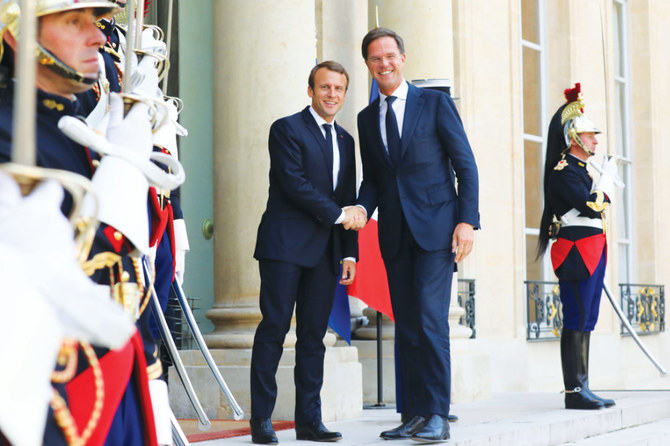
French President Emmanuel Macron welcomes Dutch Prime Minister Mark Rutte at the Elysee Palace in Paris. (Reuters File Photo)
Short Url
Updated 10 May 2020
Follow

French, Dutch urge EU to show teeth on trade

  • Initiative comes as the bloc tries to negotiate a new deal with Britain

PARIS: France and the Netherlands have joined forces to urge the EU to enforce environmental and labor standards more forcefully with countries the bloc signs trade deals with.

The initiative comes as the EU tries to negotiate a new trade deal with Britain, which formally left the bloc on Jan. 31, amid concerns that it might seek to undercut EU labor and environmental standards to boost its competitiveness.

The involvement of the traditionally strongly pro-free trade Dutch underscores a shift in European thinking on the need to protect domestic industry and jobs, a French diplomat said, as the coronavirus pandemic batters the global economy.

A more assertive China and US President Donald Trump’s more protectionist “America-First” agenda have also helped to reshape European attitudes toward free trade.

In their joint proposal sent to the other 25 EU member states, the French and Dutch trade ministers urge the European Commission to be ready to raise tariffs against trade partners that fail to meet their commitments on sustainable development.

BACKGROUND

The involvement of the traditionally strongly pro-free trade Dutch underscores a shift in European thinking on the need to protect domestic industry and jobs, a French diplomat says.

A more assertive China and US President Donald Trump’s more protectionist ‘America-First’ agenda have also helped to reshape European attitudes toward free trade. •In their joint proposal sent to the other 25 EU member states, the French and Dutch trade ministers urge the European Commission to be ready to raise tariffs against trade partners that fail to meet their commitments on sustainable development.

“Trade policy instruments can provide additional leverage to the implementation of international environmental and labor standards,” the document said.

The EU should link tariff reductions “where relevant” to the effective implementation of trade and sustainable development provisions and be willing to take action when those provisions are breached, it added.

The European Commission, which handles trade policy on behalf of EU member states, has yet to give a formal response to the joint proposals, which the French and Dutch want applied to deals under negotiation and to updates of existing trade pacts.

The document urges the Commission to inform member states more regularly on the impact that trade deals have on European jobs and domestic industries.

It also says a commitment to the Paris Agreement on climate change must be a pre-requisite for any trade pact. Trump has decided to ditch the climate pact.

France has long favored a more protectionist stance on trade. As early as his first EU summit in 2017, President Emmanuel Macron said attracting foreign investment should not mean exposing Europe to “the disorder of globalization,” and he cautioned the EU against being too “naive” in global trade.


Saudi residential sales rise in Q3 as Riyadh leads quarterly rebound 

Updated 7 sec ago
Follow

Saudi residential sales rise in Q3 as Riyadh leads quarterly rebound 

RIYADH: Residential sales transactions in Riyadh reached 13,000 in the third quarter of 2025, marking a 19 percent increase compared to the previous three months, a new analysis showed. 

In its latest report, the real estate advisory firm Cavendish Maxwell said residential sales values in the capital rose to SR17.6 billion ($4.69 billion) during the July–September period, as Riyadh prepares to deliver 57,000 new housing units in 2026 and 2027. 

Strengthening the property sector is a key pillar of Saudi Arabia’s Vision 2030 agenda, as the Kingdom seeks to position itself as a global tourism and business destination by the end of the decade. 

Despite the quarterly growth, sales volumes in Riyadh were down 44 percent compared to the third quarter of 2024, largely due to affordability pressures, the report said.  

The Kingdom’s Real Estate General Authority expects the property market to reach $101.62 billion by 2029, with an anticipated compound annual growth rate of 8 percent from 2024. 

Sean Heckford, director of Built Asset Consulting at Cavendish Maxwell, said: “Riyadh’s rapid price appreciation in 2024 led to sharp increases in both sales and rental prices, prompting the Government to introduce a five-year rent freeze to address affordability concerns.” 

According to the report, residential sales in Dammam reached their highest levels for several years, with 3,000 transactions recorded in the third quarter, up nearly 60 percent year on year and 37 percent compared to the previous quarter. Sales values in the city reached SR3.2 billion. 

Jeddah also saw a pickup in quarterly activity, with transactions rising 10 percent to 7,500, while sales values climbed 9 percent quarter on quarter to SR8.7 billion. However, transactions in Jeddah declined 19 percent compared to the same period in 2024. 

“In Jeddah, price conditions have stabilized, and affordability pressures have eased slightly. Meanwhile, Dammam, where property is more affordable, is emerging as a new hot spot for property investment, with a year-on-year surge in buying activity from both end-users and investors,” added Heckford. 

Sales prices and rental rates 

The largest increases in sales prices were recorded in Riyadh, where apartment prices rose 7.5 percent year on year in the third quarter to an average of SR6,160 per sq. meter. Villa prices in the capital climbed 10.1 percent to SR5,500 per sq. meter. 

In Jeddah, apartment prices increased 1.6 percent year on year to SR4,360 per sq. meter, while villa prices rose 3.1 percent to SR5,140 per sq. meter. In Dammam, apartment prices climbed 5.8 percent year on year, while villa prices rose 3.2 percent. 

Riyadh also recorded the steepest rental increases, with apartment rents up 11.8 percent year on year and villa rents rising 10.7 percent. In Jeddah, apartment rents increased 5.6 percent, while villa rents edged down 2.1 percent. In Dammam, apartment rents rose 4.8 percent and villa rents increased 2.2 percent. 

New deliveries 

Riyadh, Jeddah and Dammam collectively delivered 13,500 new homes in the first nine months of 2025, with total deliveries expected to reach 22,800 units by the end of the year. 

By the end of 2025, Riyadh is expected to have added 16,000 new homes, compared to 5,000 in Jeddah and 1,800 in Dammam. Looking ahead, Riyadh has 57,000 new units in the pipeline for 2026 and 2027, while Jeddah is set to deliver 36,000 units and Dammam 12,000. 

Impact of new laws and tax reforms 

Cavendish Maxwell said new laws and tax reforms are likely to support real estate demand and development from 2026 onward. 

“The new foreign ownership law, which comes into effect in January 2026, is a major step forward for Saudi Arabia’s real estate sector that should further accelerate buyer activity, while the recently introduced White Land Tax incentivises land owners to either sell or develop their plots,” said the report. 

The analysis added that Riyadh’s five-year rent freeze, announced in September, is expected to improve affordability but could also reduce landlords’ incentives to invest in maintenance and future supply, potentially creating short-term pressure on new developments. 

According to Heckford, Saudi Arabia’s residential market performance in the third quarter reflects a transitional phase marked by strong macroeconomic fundamentals and evolving regulatory measures. 

“Despite affordability challenges in Riyadh, demand remains resilient, supported by the new laws and tax systems,” said Heckford. 

He added: “Jeddah demonstrates stability with balanced supply and demand dynamics, and Dammam stands out as a growth hotspot driven by affordability and investor interest. Vision 2030 initiatives and infrastructure investments will be pivotal in sustaining momentum and unlocking new investment opportunities across all major cities in Saudi Arabia.”