LONDON: Iran has imprisoned at least 13 people since April for protesting against the shooting down of a passenger jet by the Islamic Revolutionary Guard Corps (IRGC), according to the group Human Rights Watch (HRW).
In a report published on its website, HRW accused the Iranian authorities of “dodging accountability” and “refusing to provide details” about the disaster, while “wasting no time” in bringing prosecutions against people protesting against Iran’s handling of the episode.
The IRGC shot down Ukraine International Airlines Flight 752 on Jan. 5, 2020, minutes after it had taken off from Tehran’s Imam Khomeini International Airport, killing all 176 people on board.
Iran initially denied involvement, before stating on Jan. 11 that the plane was caught in the crossfire of the Iranian military response to the assassination of IRGC commander Gen. Qassem Soleimani by a US drone at Baghdad International Airport on Jan. 3 and was shot down in error.
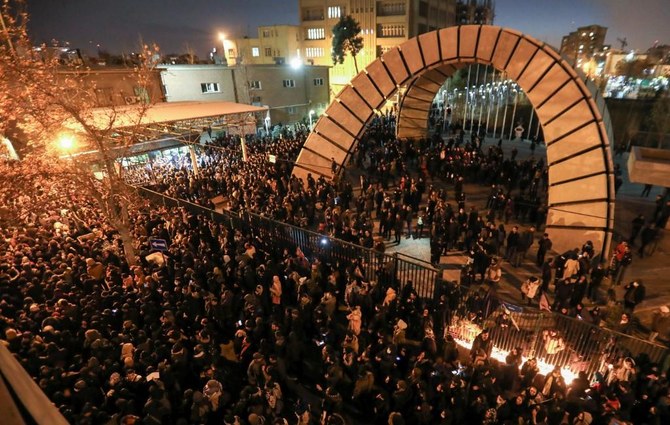
The widespread protests in the country in response to the admission were met with a crackdown described as “brutal” by observers, including HRW.
On Jan. 14, the spokesman for Iran’s judiciary, Gholamhossein Esmaili, said that at least 30 people had been arrested for their part in the protests.
HRW revealed the details of several people who were subsequently convicted. They included Mostafa Hashemizadeh, a student at the University of Tehran who was sentenced to five years in prison, three months of community service and 74 lashes for “assembly and collusion to disrupt national security.”
Another University of Tehran student, Amir Mohammad Sharifi, was sentenced to six months for “propaganda against the state,” which he said stemmed from him photographing police officers. HRW added that 11 people were sentenced to 8 months in prison for “propaganda against the state, chanting slogans against the Islamic Republic of Iran, and taking photos and videos” at a vigil for the victims of the plane in the city of Amol, in Mazandran province.
Michael Page, HRW’s deputy Middle East director, said: “Iranian authorities are following their usual playbook of dodging accountability. While refusing to provide details about any investigation of culpability for the deadly mistake, judicial officials are wasting no time in sentencing people who protested the loss of 176 lives.
“Instead of prosecuting those who exercised their right to free expression and peaceful assembly, the Iranian authorities should conduct a transparent investigation and cooperate with international bodies to find out exactly what happened in this tragedy.”
Despite admitting culpability, Iran has so far failed to cooperate with the international community over investigating the shooting down of Flight 752 and has not allowed other countries access to evidence or to the site of the crash.
On March 11, according to HRW, Iran’s delegation to the International Civil Aviation Organization “agreed to send black boxes from (the) downed Ukrainian jetliner to Kiev for analysis,” but said that they had failed to materialize.
So far, no one has been charged for their role in the incident, and Iranian politicians have speculated that prosecutions remain unlikely.
Of the “unspecified” number of IRGC members and others initially arrested, only one remains in custody, according to Shokrallah Bahrami, head of Iran’s Judicial Organization of the Armed Forces.


![]()


HRW: Iran imprisons protesters over Ukraine airplane disaster
Short Url
https://arab.news/yhedc
HRW: Iran imprisons protesters over Ukraine airplane disaster
- The human rights group says at least 13 people have been imprisoned for speaking out
- No one has yet been charged in relation to the downing of the jet by the IRGC on Jan. 5


Israel army says striking Hezbollah targets in Lebanon
JERUSALEM: The Israeli military announced a series of strikes on Hezbollah targets in Lebanon on Friday, including weapons depots and a training complex.
“A number of weapons storage facilities and terrorist infrastructure sites were struck, which were used by Hezbollah to advance terror attacks against the state of Israel,” a military statement said.
Despite a November 2024 ceasefire that was supposed to end more than a year of hostilities between Israel and the Iran-backed Hezbollah group, Israel has continued to strike in Lebanon and has maintained troops in five areas it deems strategic.
More than 340 people have been killed by Israeli fire in Lebanon since the ceasefire, according to an AFP tally of Lebanese health ministry reports.
The strikes on Friday come a day after similar Israeli attacks near the Syrian border and in southern Lebanon left three people dead.
The Israeli military had reported on Thursday it had killed a member of arch-foe Iran’s elite Quds Force in a strike in Lebanon.
On Friday, the military said it had struck several military structures of Hezbollah, warning it would “remove any threat posed to the state of Israel.”
Under heavy US pressure and fears of expanded Israeli strikes, Lebanon has committed to disarming Hezbollah, starting in the south of the country near the frontier.
Lebanon’s army plans to complete the disarmament south of the Litani River — about 30 kilometers (19 miles) from the border with Israel — by year’s end.
Israel has questioned the Lebanese military’s effectiveness and has accused Hezbollah of rearming, while the group itself has rejected calls to surrender its weapons.
“A number of weapons storage facilities and terrorist infrastructure sites were struck, which were used by Hezbollah to advance terror attacks against the state of Israel,” a military statement said.
Despite a November 2024 ceasefire that was supposed to end more than a year of hostilities between Israel and the Iran-backed Hezbollah group, Israel has continued to strike in Lebanon and has maintained troops in five areas it deems strategic.
More than 340 people have been killed by Israeli fire in Lebanon since the ceasefire, according to an AFP tally of Lebanese health ministry reports.
The strikes on Friday come a day after similar Israeli attacks near the Syrian border and in southern Lebanon left three people dead.
The Israeli military had reported on Thursday it had killed a member of arch-foe Iran’s elite Quds Force in a strike in Lebanon.
On Friday, the military said it had struck several military structures of Hezbollah, warning it would “remove any threat posed to the state of Israel.”
Under heavy US pressure and fears of expanded Israeli strikes, Lebanon has committed to disarming Hezbollah, starting in the south of the country near the frontier.
Lebanon’s army plans to complete the disarmament south of the Litani River — about 30 kilometers (19 miles) from the border with Israel — by year’s end.
Israel has questioned the Lebanese military’s effectiveness and has accused Hezbollah of rearming, while the group itself has rejected calls to surrender its weapons.
Latest updates


© 2025 SAUDI RESEARCH & PUBLISHING COMPANY, All Rights Reserved And subject to Terms of Use Agreement.