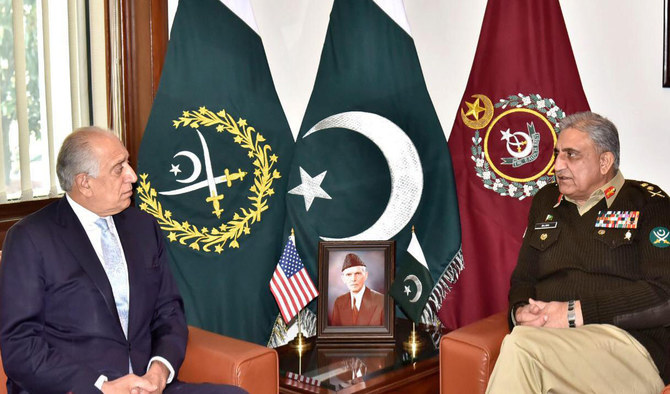
ISLAMABAD: The US special envoy for Afghanistan reconciliation met with Pakistan army chief, General Qamar Javed Bajwa, at the army’s headquarters in Rawalpindi on Friday and discussed the “overall regional security situation including Afghan reconciliation process,” the military said in a statement.
Gen. Bajwa “reiterated that our support toward peace process is a manifestation of our goodwill toward the cause,” said the Inter-Services Public Relations (ISPR), the military’s media wing, in its official handout.
“The visiting dignitary appreciated Pakistan’s continuous efforts for peace and stability in the region,” the statement added.
Khalilzad, who secured a peace deal for the United States with the Taliban in February to withdraw all American and NATO forces, arrived in Pakistan after he held talks with the Taliban in Qatar on Wednesday and visited India on Thursday.
The envoy said that in his lengthy meeting with Mullah Ghani Baradar, the head of the Taliban political office, and his team in Doha, he “sought progress on a range of topics” including reduction in violence and “humanitarian cease-fire as demanded by the international community” to allow for better cooperation on managing COVID-19 pandemic in Afghanistan, according to his Twitter post on Thursday.
Khalilzad also said he called for acceleration of prisoner releases by the Taliban and the Afghan government, actions necessary to secure the freedom of US citizen Mark Frerichs, regional and international support for the peace process, and movement to intra-Afghan negotiations as soon as possible.
The US envoy said he will meet the Taliban again after his trip to India and Pakistan. He visited India on Thursday as part of his peace efforts.
US media earlier reported that American contractor Frerichs of Lombard, from Illinois, was kidnapped in late January in Afghanistan’s eastern Khost province that borders Pakistan’s North Waziristan tribal district.
No group has claimed responsibility for the kidnapping of Frerichs and the US for the first time has spoken about him.
The US envoy arrived in Pakistan at a time when there is an apparent stalemate in the peace process over the release of prisoners as Taliban want release of their 5000 prisoners.
The Taliban-US agreement says up to 5,000 prisoners of the Taliban and up to 1,000 prisoners of the Afghan government will be released by March 10, the first day of the intra-Afghan dialogue. The talks could not start as the Taliban have refused to join the process that is key to decide a future political roadmap.
Spokesperson for Afghanistan’s Office of the National Security Council, Javid Faisal, said on Thursday that a total of 933 Taliban prisoners have been released so far. Faisal told the media in Kabul that 1,500 Taliban prisoners will be released in the coming days pursuant to President Ashraf Ghani’s decree based on their age, health and length of remaining sentence as part of the government’s efforts toward peace and battling COVID-19.
Taliban have freed 207 government’s prisoners until Friday Taliban spokesman Zabihullah Mujahid told Arab News.
It is Khalilzad’s second visit to Pakistan in less than a month.
He last visited Pakistan on April 14 accompanied by Resolute Support Mission Commander General Scott Miller and had a meeting with General Bajwa.
Meanwhile, Pakistan said on Thursday that the US-Taliban peace agreement is a historic opportunity for the Afghan leadership to seize and resolve their mutual issues through an Afghan-owned and Afghan-led peace process.
“We hope it helps bring sustainable peace and stability to Afghanistan, which can be secured through successful Intra-Afghan negotiations. We hope that the Afghan parties would seize this historic opportunity and workout a comprehensive and inclusive political settlement for durable peace and stability in Afghanistan and the region,” Foreign Office spokesperson Aisha Farooqui said at the weekly briefing.
She said that Pakistan has facilitated Afghan peace process throughout U.S-Taliban negotiations and that the country has always maintained that there is no military solution to the Afghan conflict.


![]()

Khalilzad discusses Afghan peace with officials in Pakistan
Short Url
https://arab.news/ybzj5
Khalilzad discusses Afghan peace with officials in Pakistan
- Khalilzad met with Taliban leaders in Qatar on Wednesday and sought progress on a range of issues
- The visit comes at a time when there is an apparent stalemate in the peace process over the release of prisoners
Latest updates


© 2026 SAUDI RESEARCH & PUBLISHING COMPANY, All Rights Reserved And subject to Terms of Use Agreement.