Pakistani rice exports to Middle East surge after India lockdown

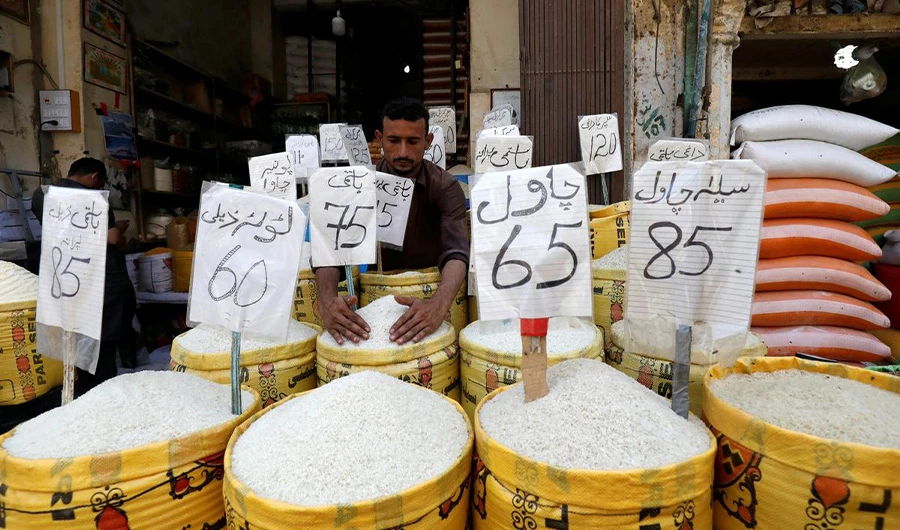
A vendor arranges different types of rice, with their prices displayed, at his shop in a wholesale market in Karachi, Pakistan April 2, 2019. (REUTERS)
Short Url
Updated 09 May 2020
Follow

Pakistani rice exports to Middle East surge after India lockdown

  • Official statistics reveal the country’s overall exports dropped by 54 percent against $2.9 billion recorded during July-April 2019-20
  • India’s lockdown restrictions also benefited Pakistan in the African market

KARACHI: Pakistan’s rice exporters managed to increase their market share in the Middle East by about 59 percent in April 2020 as India went into a strict lockdown due to the coronavirus pandemic, said businessmen affiliated with the trade on Thursday.

The development has taken place at a time when the country’s other exports have significantly declined owing to the COVID-19 situation.

“The Middle East is the main market of India’s basmati rice,” Muhammad Raza, senior vice chairman of the Rice Exporters’ Association of Pakistan (REAP), told Arab News. “When New Delhi decided to impose the lockdown, the orders were diverted to Pakistan.”

Pakistan also went into a state of lockdown on March 23, witnessing a massive decline of 47 percent in its exports in April to $957 million. According to the Pakistan Bureau of Statistics (PBS), the country’s exports dropped by 54 percent against $2.9 billion recorded during July-April 2019-20 on a year-on-year basis.

As a result, the country’s trade deficit shot up by 42 percent from $1.5 billion in March 2020 to $2.1 billion in April 2020, though it still remained 19 percent down when compared with $2.6 billion recorded in April 2019.

According to provisional data, the country's rice exports to the Middle East increased by 59 percent to $420 million in April 2020 mainly due to the increasing demand of long grain rice in the United Arab Emirates, Saudi Arabia, Qatar, Bahrain and other regional countries. The export of basmati rice increased by 33 percent and overall rice exports surged by seven percent during July-March 2019-20 period, according to the PBS.

“The Middle East market was good for the country,” said the REAP vice president, “but the Indian lockdown also benefited Pakistan in the European and African markets.”

Commodity experts say the demand for Pakistani rice in the Middle East and other countries owed to the measures taken by other governments to maintain sufficient food stocks to ensure uninterrupted supply of these necessary items during lockdowns and quarantines.

“There is a huge demand for parboiled (sella) rice in Saudi Arabia, while white rice is a much sought after commodity in the UAE,” Muzamil R. Chapal, chairman of the Cereal Association of Pakistan, told Arab News.

Pakistan is among the top 10 rice producing countries in the world. The production of rice is expected to remain stagnant at 7.2 million tons in the current fiscal year (FY20), according to the State Bank of Pakistan.

“The country has more than 3.3 million tons of exportable surplus and there is no shortage of grain in Pakistan,” he said, adding: “The country can further consolidate its share in international markets by removing hurdles such as high shipping charges.”

Exporters said they could have exported more rice but could not go beyond the shipped volume due to labor shortage. However, the pace of export could decelerate due to the ease in lockdown restrictions in India.

“May 2020 will be a little subdued because India has eased lockdown and brought down its prices. Obviously, a country that shut down for more than one and half months will offload its stocks at lower prices,” Raza observed.
Pakistan, UK launch £10 million higher education partnership

Updated 15 December 2025
Follow

Pakistan, UK launch £10 million higher education partnership

  • Pak-UK Education Gateway second phase expands climate research, scholarships, university exchanges
  • First phase was launched in 2018 and delivered 165 partnerships, 2,000 joint studies and £5 million in grants

ISLAMABAD: Pakistan’s Higher Education Commission (HEC) and the British Council have launched the £10 million second phase of the Pak-UK Education Gateway, the HEC said on Monday, a joint initiative aimed at deepening collaboration between universities in both countries on research, mobility and higher-education reform.

The program, funded equally by the HEC and the British Council, builds on a partnership launched in 2018 and seeks to strengthen institutional ties between Pakistani and British universities, focusing on shared challenges including climate change, skills development and economic growth.

Education cooperation has become an increasingly important pillar of broader Pakistan-UK relations, as both countries look to expand academic mobility, research collaboration and international recognition of qualifications at a time when higher-education systems face pressure to respond to climate risks, labor-market shifts and funding constraints.

“This £10 million partnership is set to deepen collaboration between UK and Pakistani universities on critical issues like Climate Change and Mobility. A true system-to-system commitment,” the HEC said in an X post. 

According to the British Council and HEC, the first phase of the Pak-UK Education Gateway supported 165 institutional partnerships, generated around 2,000 joint research papers and awarded £5 million in research grants. Officials say the second phase aims to build on that foundation as part of a longer-term effort to internationalize Pakistan’s higher-education sector.

“Education is the building block of growth and prosperity. Our work on education in Pakistan supports people throughout their lives: from helping reform education policy at the school level, to our strong partnership in higher education,” British High Commissioner Jane Marriott said in a statement.

“This next phase builds on our already strong relationship, and will unlock opportunities to help both our higher education sectors thrive.”

Opportunities under the second phase include increased funding for scholarships, joint research grants and faculty exchanges, alongside a Start-Up Challenge Fund to support Pakistan-UK university collaborations pursuing commercial opportunities and access to new markets.

The program will also focus on leadership and governance reforms within Pakistan’s higher-education system, including quality assurance, improved campus accessibility for people with disabilities, and greater participation of women in senior leadership roles. It further aims to expand opportunities for Pakistani students to study UK-accredited courses without leaving their home cities, alongside a commitment to mutual recognition of qualifications.

Pakistan’s Minister for Federal Education and Professional Training Khalid Maqbool Siddiqui said the initiative had already delivered concrete results since its launch in 2018, calling education “the bridge that connects people, cultures, and futures.”

Acting HEC Chairperson Nadeem Mahbub described the Gateway as a system-to-system partnership rather than a stand-alone program, noting that it had benefited institutions and students in both countries.