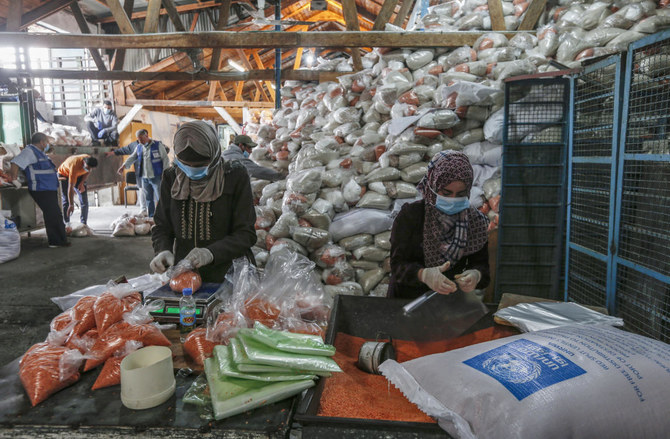
JERUSALEM: Scrambling to tackle COVID-19 in camps across the Middle East, the UN agency supporting Palestinian refugees said on Tuesday it only has enough cash to operate until the end of May because of American funding cuts.
In 2018 President Donald Trump’s administration halted annual payments of $360 million to the United Nations Relief and Works Agency (UNRWA), which provides assistance to some 5.5 million registered refugees in the West Bank, Gaza Strip, East Jerusalem, Jordan, Lebanon and Syria.
Elizabeth Campbell, UNRWA’s director in Washington, told reporters that the loss of US aid had a “corrosive impact” on the agency’s ability to help vulnerable people.
“We are basically operating on a month-to-month basis. Right now, we have funding to pay our 30,000 health care workers until the end of this month,” Campbell said in a Zoom conference call from Washington.
She said UNRWA had only secured a third of its $1.2 billion annual budget and that it was suffering its “worst financial crisis” since beginning operations some 70 years ago.
The agency is trying to plug the $800 million shortfall in part by appealing to European and Gulf countries for emergency donations, Campbell said.
Donations from the European Union, Britain, Germany, Sweden, Canada and Japan have helped fill UNRWA’s 2020 budget gap, Campbell said, while Saudi Arabia has also provided project-specific funding.
The United States was by far UNRWA’s biggest donor until it withdrew funding, calling for reforms and suggesting its services be transferred to refugee host countries.
Palestinian refugees are mostly descendants of some 700,000 Palestinians who were driven out of their homes or fled amid fighting in the 1948 war that led to Israel’s creation. Nearly a third live in 58 camps where UNRWA provides services.
Many refugees fear the dwindling aid they receive could fall further as the coronavirus crisis persists and donors shift priorities.
UNRWA has tried to halt the spread of COVID-19 in and around camps, closing all its 276 schools that are attended by close to 300,000 children.
It has launched a $14 million emergency appeal for coronavirus funding, and says it will issue another, larger, aid request in the coming days.


![]()


UN Palestinian refugee agency operating on ‘month-to-month’ basis due to US aid cuts
Short Url
https://arab.news/pjndy
UN Palestinian refugee agency operating on ‘month-to-month’ basis due to US aid cuts
- In 2018 President Donald Trump’s administration halted annual payments of $360 million to the United Nations Relief and Works Agency (UNRWA)
- Many refugees fear the dwindling aid they receive could fall further as the coronavirus crisis persists and donors shift priorities


Iraq says it will prosecute Daesh detainees sent from Syria
- Iraq government says transfer was pre-emptive step to protect national security
- Prosoners have been held for years in prisons and camps guarded by the Kurdish-led SDF
BAGHDAD: Iraq’s Supreme Judicial Council said on Thursday it would begin legal proceedings against Daesh detainees transferred from Syria, after the rapid collapse of Kurdish-led forces in northeast Syria triggered concerns over prison security.
More than 10,000 members of the ultra-hard-line militant group have been held for years in about a dozen prisons and detention camps guarded by the Kurdish-led Syrian Democratic Forces (SDF) in Syria’s northeast.
The US military said on Tuesday its forces had transferred 150 Daesh detainees from Syria to Iraq and that the operation could eventually see up to 7,000 detainees moved out of Syria.
It cited concerns over security at the prisons, which also hold thousands more women and children with ties to the militant group, after military setbacks suffered by the SDF.
A US official told Reuters on Tuesday that about 200 low-level Daesh fighters escaped from Syria’s Shaddadi prison, although Syrian government forces had recaptured many of them.
Iraqi officials said Prime Minister Mohammed Shia Al-Sudani mentioned the transfer of Daesh prisoners to Iraq in a phone call with Syrian President Ahmad Al-Sharaa on Tuesday, adding that the transfers went ahead following a formal request by the Iraqi government to Syrian authorities.
Iraqi government spokesperson Basim Al-Awadi said the transfer was “a pre-emptive step to protect Iraq’s national security,” adding that Baghdad could not delay action given the rapid pace of security and political developments in Syria.
Daesh emerged in Iraq and Syria, and at the height of its power from 2014-2017 held swathes of the two countries. The group was defeated after a military campaign by a US-led coalition.
An Iraqi military spokesperson confirmed that Iraq had received a first batch of 150 Daesh detainees, including Iraqis and foreigners, and said the number of future transfers would depend on security and field assessments. The spokesperson described the detainees as senior figures within the group.
In a statement, the Supreme Judicial Council said Iraqi courts would take “due legal measures” against the detainees once they are handed over and placed in specialized correctional facilities, citing the Iraqi constitution and criminal laws.
“All suspects, regardless of their nationalities or positions within the terrorist organization, are subject exclusively to the authority of the Iraqi judiciary,” the statement said.
Iraqi officials say under the legal measures, Daesh detainees will be separated, with senior figures including foreign nationals to be held at a high-security detention facility near Baghdad airport that was previously used by US forces.
Two Iraqi legal sources said the Daesh detainees sent from Syria include a mix of nationalities, with Iraqis making up the largest group, alongside Arab fighters from other countries as well as European and other Western nationals.
The sources said the detainees include nationals of Britain, Germany, France, Belgium and Sweden, and other European Union countries, and will be prosecuted under Iraqi jurisdiction.
More than 10,000 members of the ultra-hard-line militant group have been held for years in about a dozen prisons and detention camps guarded by the Kurdish-led Syrian Democratic Forces (SDF) in Syria’s northeast.
The US military said on Tuesday its forces had transferred 150 Daesh detainees from Syria to Iraq and that the operation could eventually see up to 7,000 detainees moved out of Syria.
It cited concerns over security at the prisons, which also hold thousands more women and children with ties to the militant group, after military setbacks suffered by the SDF.
A US official told Reuters on Tuesday that about 200 low-level Daesh fighters escaped from Syria’s Shaddadi prison, although Syrian government forces had recaptured many of them.
Iraqi officials said Prime Minister Mohammed Shia Al-Sudani mentioned the transfer of Daesh prisoners to Iraq in a phone call with Syrian President Ahmad Al-Sharaa on Tuesday, adding that the transfers went ahead following a formal request by the Iraqi government to Syrian authorities.
Iraqi government spokesperson Basim Al-Awadi said the transfer was “a pre-emptive step to protect Iraq’s national security,” adding that Baghdad could not delay action given the rapid pace of security and political developments in Syria.
Daesh emerged in Iraq and Syria, and at the height of its power from 2014-2017 held swathes of the two countries. The group was defeated after a military campaign by a US-led coalition.
An Iraqi military spokesperson confirmed that Iraq had received a first batch of 150 Daesh detainees, including Iraqis and foreigners, and said the number of future transfers would depend on security and field assessments. The spokesperson described the detainees as senior figures within the group.
In a statement, the Supreme Judicial Council said Iraqi courts would take “due legal measures” against the detainees once they are handed over and placed in specialized correctional facilities, citing the Iraqi constitution and criminal laws.
“All suspects, regardless of their nationalities or positions within the terrorist organization, are subject exclusively to the authority of the Iraqi judiciary,” the statement said.
Iraqi officials say under the legal measures, Daesh detainees will be separated, with senior figures including foreign nationals to be held at a high-security detention facility near Baghdad airport that was previously used by US forces.
Two Iraqi legal sources said the Daesh detainees sent from Syria include a mix of nationalities, with Iraqis making up the largest group, alongside Arab fighters from other countries as well as European and other Western nationals.
The sources said the detainees include nationals of Britain, Germany, France, Belgium and Sweden, and other European Union countries, and will be prosecuted under Iraqi jurisdiction.
Latest updates


© 2026 SAUDI RESEARCH & PUBLISHING COMPANY, All Rights Reserved And subject to Terms of Use Agreement.