Thousands rally against fatal attack on Pashtun leader in SW

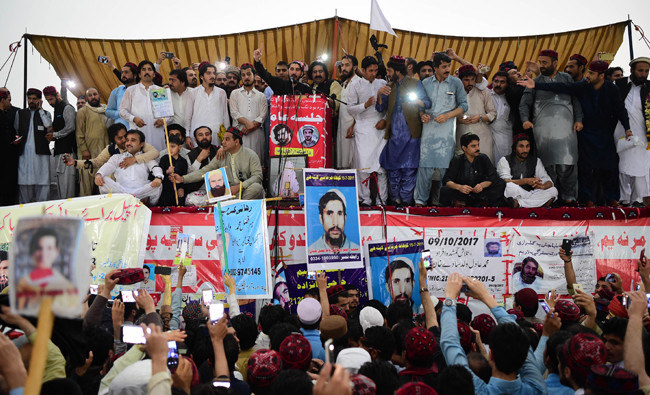
Demonstrators of Pashtun Protection Movement gather at a public rally in Peshawar on April 8, 2018. (AFP)
Short Url
Updated 07 May 2020
Follow

Thousands rally against fatal attack on Pashtun leader in SW

  • Defying government ban of gatherings, most were not wearing face masks and ignored social distancing guidelines
  • Rallygoers demanded the arrest of the assailants who wounded Arif Wazir in his hometown of Wana last week

DERA ISMAIL KHAN: Thousands of residents of Pakistan’s former tribal districts in the northwest defied a government ban on gatherings meant to contain the spread of the coronavirus to rally Tuesday against a recent attack on their top leader.
Most of the protesters were not wearing face masks and did not adhere to social distancing guidelines when they gathered in Wana, a town in the former Taliban stronghold of South Waziristan that borders Afghanistan.
Rallygoers demanded the arrest of the assailants who wounded Arif Wazir in his hometown of Wana last week. Wazir, who died in a hospital over the weekend, was a top leader of the Pashtun Protection Movement, which has emerged as a force among the country’s Pashtun minority in recent years.
Similar rallies were held in the nearby North Waziristan district and elsewhere.
Wazir was a vocal critic of the army. His group contends the military is waging a campaign of intimidation as it battles Islamist militants in the rugged border region. The military and the government deny the charge.
Pakistan on Tuesday reported another spike in deaths from the coronavirus with 28 new fatalities in the past 24 hours.
So far, 514 Pakistanis have died from the illness caused by the virus and most of the deaths were reported in the northwestern Khyber Pakhtunkhwa province, where 194 people have died from the virus, which has infected more than 21,000.


Pakistan, ADB sign $730 loan agreements to boost SOE reforms, energy infrastructure

Updated 25 December 2025
Follow

Pakistan, ADB sign $730 loan agreements to boost SOE reforms, energy infrastructure

  • Both sign $330 million Power Transmission Strengthening Project and $400 million SOE Transformation Program loan agreements
  • Economic Affairs Division official says Transmission Project will secure Pakistan’s energy future by strengthening national grid’s backbone

KARACHI: Pakistan and the Asian Development Bank (ADB) on Thursday signed two loan agreements totaling $730 million to boost reforms in state-owned enterprises (SOEs) and energy infrastructure in the country, the bank said.

The first of the two agreements pertains to the SOE Transformation Program worth $400 million while the second loan, worth $330 million, is for a Power Transmission Strengthening Project, the lender said. 

The agreements were signed by ADB Country Director for Pakistan Emma Fan and Pakistan’s Secretary of Economic Affairs Division Humair Karim. 

“The agreements demonstrate ADB’s enduring commitment to supporting sustainable and inclusive economic growth in Pakistan,” the ADB said. 

Pakistan’s SOEs have incurred losses worth billions of dollars over the years due to financial mismanagement and corruption. These entities, including the country’s national airline Pakistan International Airlines, which was sold to a private group this week, have relied on subsequent government bailouts over the years to operate.

The ADB approved the $400 million loan for SOE reforms on Dec. 12. It said the program seeks to improve governance and optimize the performance of Pakistan’s commercial SOEs. 

Karim highlighted that the Power Transmission Strengthening Project will enable reliable evacuation of 2,300 MW from Pakistan’s upcoming hydropower projects, relieve overloading of existing transmission lines and enhance resilience under contingency conditions, the Press Information Department (PID) said. 

“The Secretary emphasized that both initiatives are transformative in nature as the Transmission Project will secure Pakistan’s energy future by strengthening the backbone of the national grid whereas the SOE Program will enhance transparency, efficiency and sustainability of state-owned enterprises nationwide,” the PID said. 

The ADB has supported reforms by Pakistan to strengthen its public finance and social protection systems. It has also undertaken programs in the country to help with post-flood reconstruction, improve food security and social and human capital. 

To date, ADB says it has committed 764 public sector loans, grants and technical assistance totaling $43.4 billion to Pakistan.