

From cleaning to screening, robots join fight against COVID-19 at Abu Dhabi Airport

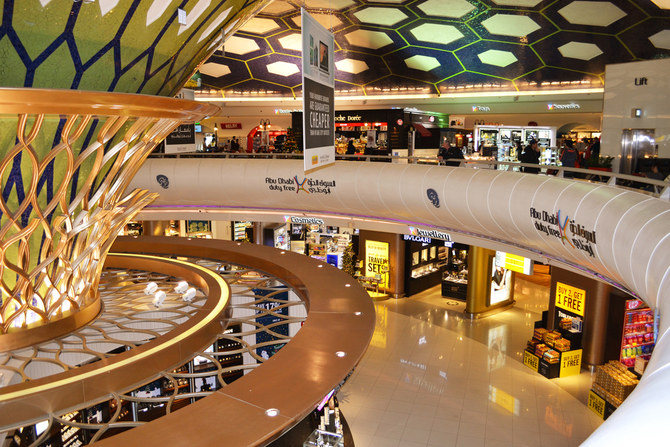
Robots are being rolled out at Abu Dhabi airport to disinfect public areas and screen passengers using infrared thermal technology during the coronavirus outbreak. (Shutterstock)
Short Url
Updated 02 May 2020
Follow

From cleaning to screening, robots join fight against COVID-19 at Abu Dhabi Airport

  • The robot will be piloted from May throughout Abu Dhabi International Airport
  • It will also be used in aircraft cabins

LONDON: Robots are being rolled out at Abu Dhabi airport to disinfect public areas and screen passengers using infrared thermal technology.

The robots will be piloted this month throughout Abu Dhabi International Airport, including in staff areas and cargo facilities. It will also be used as part of cabin cleaning processes on passenger aircraft, the company said in a statement on Saturday.

“The acute impact of the pandemic would have heightened our overall sense of awareness toward hygiene, and as a vital piece of public infrastructure, we have a clear responsibility to ensure our spaces remain clear of any virus threat,” said Shareef Hashim Al-Hashmi, CEO of Abu Dhabi Airports. “By deploying artificial intelligence, it adds another layer of protection and builds on our comprehensive response to the COVID-19 outbreak.”

Airports worldwide are rapidly deploying new technology and robotics in an attempt to curb the spread of the virus that has already killed at least 200,000 people globally while establishing new procedures for arriving passengers.

Hong Kong International Airport is currently trialing the use of sanitizing booths where passengers undergo a 40-second disinfection process and have their temperatures scanned simultaneously. Airport chiefs will decide at the end of the month whether to make it a permanent feature. Like Abu Dhabi, Hong Kong is also using autonomous cleaning robots.

The adoption of such technologies is especially urgent for the big Gulf hubs such as Dubai International Airport, which handled 86.4 million passengers in 2019, making it the world’s busiest hub for international passengers.

But getting the balance between passenger safety and airport efficiency right will be a challenge, say aviation consultants. Social distancing also creates obvious logistical difficulties, with the potential for check in queues to quickly lengthen and clog up open spaces in terminals, slowing passenger throughput and potentially creating delays.

“Some kind of health checking seems to be a likely pre-requisite for any return to ‘normal’ travel, aviation consultant John Strickland told Arab News. “However technology and simplicity will be essential. In any airport with high volumes of traffic any small extension of time in process, even seconds, could multiply up to creating delays and inability to maintain punctual and reliable schedules including the ability to offer viable connecting flights.”

Emirates last month started to conduct blood tests for departing passengers with the first ones carried out on a flight to Tunisia with the results available in 10 minutes.

It is scaling up its testing capacity so that it can transport passengers to countries that require COVID-19 test certificates. Passengers are also required to wear their own masks when at the airport and onboard aircraft.


Closing Bell: Saudi main market sheds 85 points to finish at 11,098 

Updated 17 February 2026
Follow

Closing Bell: Saudi main market sheds 85 points to finish at 11,098 

RIYADH: Saudi Arabia’s Tadawul All Share Index closed lower in the latest session, falling 85.79 points, or 0.77 percent, to finish at 11,098.06. 

The MSCI Tadawul 30 Index declined 0.63 percent to close at 1,495.23, while the parallel market index Nomu dropped 0.91 percent to 23,548.56.  

Market breadth was firmly negative, with 42 gainers against 218 decliners on the main market. Trading activity saw 226 million shares exchanged, with total turnover reaching SR4.5 billion ($1.19 billion).  

Among the session’s gainers, Tourism Enterprise Co. rose 9.40 percent to SR15.02. SHL Finance Co. advanced 4.51 percent to SR16.00, while Almasar Alshamil for Education Co. gained 3.56 percent to SR23.88.  

Dar Alarkan Real Estate Development Co. added 3.03 percent to SR19.70, and Banque Saudi Fransi climbed 2.61 percent to SR19.30. 

On the losing side, Almasane Alkobra Mining Co. recorded the steepest decline, falling 6.61 percent to SR96.

Al Moammar Information Systems Co. dropped 5.14 percent to SR164.20, while National Company for Learning and Education declined 4.60 percent to SR124.30. Saudi Ceramic Co. slipped 4.14 percent to SR27.30, and Arabian Contracting Services Co. fell 4.12 percent to SR116.50. 

On the announcement front, Saudi Telecom Co. announced the distribution of interim cash dividends for the fourth quarter of 2025 in line with its approved dividend policy.  

The company will distribute SR2.74 billion, equivalent to SR0.55 per share, to shareholders for the quarter.  

The number of shares eligible for dividends stands at approximately 4.99 billion shares. The eligibility date has been set for Feb. 23, with distribution scheduled for March 12.  

The company noted that treasury shares are not entitled to dividends and that payments will be made through Riyad Bank via direct transfer to shareholders’ bank accounts. stc shares last traded at SR44.80, unchanged on the session. 

Separately, National Environmental Recycling Co., known as Tadweer, reported its annual financial results for the year ended Dec. 31, 2025, posting significant growth in revenue and profit.  

Revenue rose 53.5 percent year on year to SR1.24 billion, compared with SR806 million in the previous year. Net profit attributable to shareholders increased 68.4 percent to SR60.9 million, up from SR36.2 million a year earlier, driven by higher sales volumes and operational expansion.

Tadweer shares last traded at SR3.80, up 2.70 percent.