

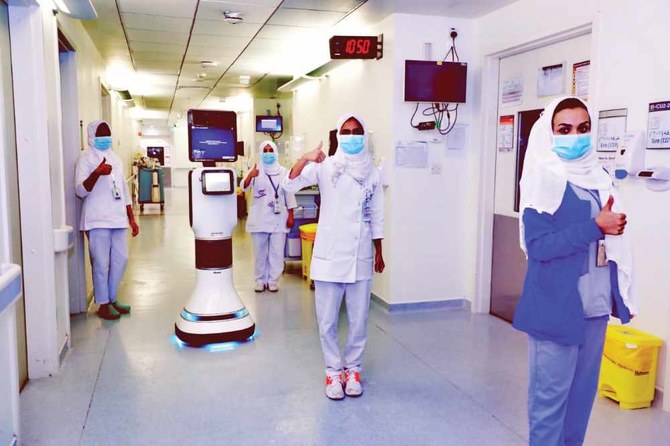
Saudi hospital uses robot medic to treat virus patients

The hi-tech machine at the King Abdullah Medical Complex allows doctors and nurses to work from a safe distance in diagnosing COVID-19 cases. (Supplied)
Short Url
Updated 23 April 2020
Follow

Saudi hospital uses robot medic to treat virus patients

  • Robot equipped with medical devices such as a stethoscope, otoscope, eye camera, and a high resolution camera

JEDDAH: A robot medic is being used to treat coronavirus disease (COVID-19) patients in a Saudi hospital.

The hi-tech machine, in operation at the King Abdullah Medical Complex in Jeddah, is capable of carrying out tests and making diagnoses on people suspected of having contracted the killer virus.

By using the robot, health officials aim to curb the spread of COVID-19 among medical and nursing staff, as well as patients, while conserving stocks of personal protective equipment and other preventive medical supplies.

Dr. Khalid Al-Thumali, the general supervisor of the complex, said the robot had been installed with medical devices such as a stethoscope, otoscope, eye camera, and a camera specialized in examining the skin from afar through a built-in high-resolution lens.

It also carried other tools that allowed doctors and nurses to work from a safe distance in diagnosing COVID-19 cases, providing patients with medical consultations, reading their vital signs, producing radiograph images, and checking patient files via a smartphone app.

Al-Thumali added that the technology not only speeded up response times but provided top-quality medical services both inside and outside the complex. The robot had been given automatic access to isolation rooms and could be programmed to move between them and sanitize after leaving each room.


Saudi inventor wins two gold medals at Mideast International Invention Fair

Updated 14 February 2026
Follow

Saudi inventor wins two gold medals at Mideast International Invention Fair

  • Khudry was recognized for inventing a device designed to filter materials and recycle used liquids
  • The innovation aims to improve efficiency in liquid purification and reuse

RIYADH: Saudi inventor Duaa Nizar Khudry won two gold medals at the 16th International Invention Fair in the Middle East (IIFME), held in Kuwait from February 8 to 11, the Saudi Press Agency (SPA) reported.

Khudry was recognized for inventing a device designed to filter materials and recycle used liquids, an innovation aimed at improving efficiency in liquid purification and reuse. The technology has potential applications in environmental protection, industrial processing, and water conservation, particularly in regions where sustainable resource management is critical.

A member of the Mawhiba Alumni Program, Khudry represented Saudi Arabia with the support and nomination of the King Abdulaziz and His Companions Foundation for Giftedness and Creativity (Mawhiba), which was participating in the fair for the third time.

She received her first gold medal from the fair’s organizers and was also awarded the IFIA Best Invention Award by the International Federation of Inventors’ Associations, recognizing her innovation as one of the most outstanding entries in the exhibition.

The IIFME, organized annually by the Kuwait Science Club since its launch in 2007, is regarded as one of the region’s largest specialized invention exhibitions and a major platform for inventors to present their work to international audiences.

As a student, Khudry won first place nationwide at the National Olympiad for Scientific Creativity (Ibdaa) in 2013 for the same recycling device, competing against tens of thousands of students across the Kingdom. She later obtained an official patent for the invention in 2024, strengthening its scientific and commercial potential. 

She studied chemistry and is currently pursuing graduate studies in materials science and engineering under the Custodian of the Two Holy Mosques Scholarship Program. Her research focuses on environmental sustainability, advanced materials, and liquid purification technologies.