

Robots may become heroes in war on coronavirus

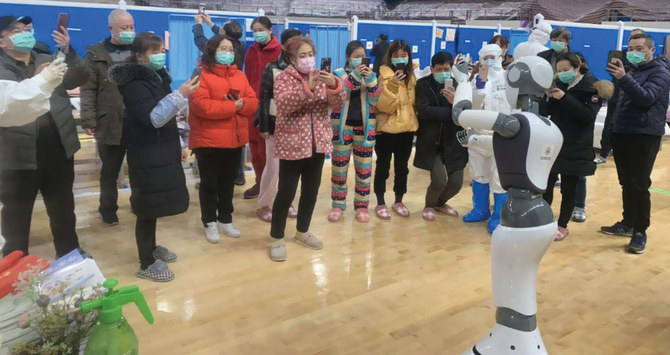
Helping hand: A robot undergoes a trial at a field hospital in Wuhan, where robotic devices were put to use during China’s coronavirus outbreak. (AFP)
Short Url
Updated 10 April 2020
Follow

Robots may become heroes in war on coronavirus

SAN FRANCISCO: Long maligned as job-stealers and aspiring overlords, robots are being increasingly relied on as fast, efficient, contagion-proof champions in the war against the deadly coronavirus.

One team of robots temporarily cared for patients in a makeshift hospital in Wuhan, the Chinese city where the outbreak began.

Meals were served, temperatures taken and communications handled by machines, one of them named “Cloud Ginger” by its maker CloudMinds, which has operations in Beijing and California.

“It provided useful information, conversational engagement, entertainment with dancing, and even led patients through stretching exercises,” CloudMinds President Karl Zhao said of the humanoid robot.

“The smart field hospital was completely run by robots.”

BACKGROUND

Patients in hospitals in some countries already meet with robots for consultations usually done by doctors via videoconference. Some consultation robots even tend to the classic checkup task of listening to patients’ lungs as they breathe.

A small medical team remotely controlled the field hospital robots. Patients wore wristbands that gathered blood pressure and other vital data.

The smart clinic only handled patients for a few days, but it foreshadowed a future in which robots tend to patients with contagious diseases while health workers manage from safe distances.

Patients in hospitals in Thailand, Israel and elsewhere meet with robots for consultations done by doctors via videoconference. Some consultation robots even tend to the classic checkup task of listening to patients’ lungs as they breathe.

Alexandra Hospital in Singapore will use a robot called BeamPro to deliver medicine and meals to patients with coronavirus or those suspected to be infected. Doctors and nurses can control the robot by using a computer from outside the room, and can hold conversations with the patient via the screen and camera.

The robot reduces the number of “touch points” with patients who are isolated, thereby reducing risk for health-care workers.

Robotic machines can also be sent to scan for the presence of the virus, such as when the Diamond Princess cruise ship cabins were checked for safety weeks after infected passengers were evacuated, according to the US Centers for Disease Control.


PIF’s Humain invests $3bn in Elon Musk’s xAI prior to SpaceX acquisition

Updated 18 February 2026
Follow

PIF’s Humain invests $3bn in Elon Musk’s xAI prior to SpaceX acquisition

JEDDAH: Humain, an artificial intelligence company owned by Saudi Arabia’s Public Investment Fund, invested $3 billion in Elon Musk’s xAI shortly before the startup was acquired by SpaceX.

As part of xAI’s Series E round, Humain acquired a significant minority stake in the company, which was subsequently converted into shares of SpaceX, according to a press release.

The transaction reflects PIF’s broader push to position Saudi Arabia as a central hub in the global AI ecosystem, as part of its Vision 2030 diversification strategy.

Through Humain, the fund is seeking to combine capital deployment with infrastructure buildout, partnerships with leading technology firms, and domestic capacity development to reduce reliance on oil revenues and expand into advanced industries.

The $3 billion commitment offers potential for long-term capital gains while reinforcing the company’s role as a strategic, scaled investor in transformative technologies.

CEO Tareq Amin said: “This investment reflects Humain’s conviction in transformational AI and our ability to deploy meaningful capital behind exceptional opportunities where long-term vision, technical excellence, and execution converge, xAI’s trajectory, further strengthened by its acquisition by SpaceX, one of the largest technology mergers on record, represents the kind of high-impact platform we seek to support with significant capital.” 

The deal builds on a large-scale collaboration announced in November at the US-Saudi Investment Forum, where Humain and xAI committed to developing over 500 megawatts of next-generation AI data center and computing infrastructure, alongside deploying xAI’s “Grok” models in the Kingdom.

In a post on his X handle, Amin said: “I’m proud to share that Humain has invested $3 billion into xAI’s Series E round, just prior to its historic acquisition by SpaceX. Through this transaction, Humain became a significant minority shareholder in xAI.”

He added: “The investment builds on our previously announced 500MW AI infrastructure partnership with xAI in Saudi Arabia, reinforcing Humain’s role as both a strategic development partner and a scaled global investor in frontier AI.”

He noted that xAI’s trajectory, further strengthened by SpaceX’s acquisition, exemplifies the high-impact platforms Humain aims to support through strategic investments.

Earlier in February, SpaceX completed the acquisition of xAI, reflecting Elon Musk’s strategy to integrate AI with space exploration.

The combined entity, valued at $1.25 trillion, aims to build a vertically integrated innovation ecosystem spanning AI, space launch technology, and satellite internet, as well as direct-to-device communications and real-time information platforms, according to Bloomberg.

Humain, founded in August, consolidates Saudi Arabia’s AI initiatives under a single entity. From the outset, its vision has extended beyond domestic markets, participating across the global AI value chain from infrastructure to applications.

The company represents a strategic initiative by PIF to diversify the Kingdom’s economy and reduce oil dependence by investing in knowledge-based and advanced technologies.