In Swat, an artist preserves memories of past

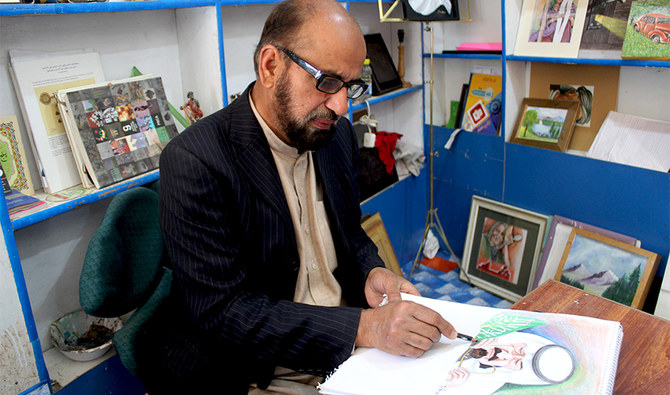
Amanullah Khan, an artist from Swat, is working on a portrait of Saudi Arabia’s late king, Abdullah bin Abdulaziz, at his studio in Saidu Sharif on February 27, 2020. (AN Photo)
Short Url
Updated 02 May 2020
Follow

In Swat, an artist preserves memories of past

  • Amanullah Khan likes to use his craft to document the cultural heritage of his region
  • The artist spent three decades in Saudi Arabia and was inspired by its tribal customs and traditions

SAIDU SHARIF: Amanullah Khan was always inspired by his picturesque surroundings. An artist from Swat district in Pakistan’s northwestern Khyber Pakhtunkhwa province, he painted hundreds of colorful landscapes to capture the beauty of his mountainous hometown that mesmerized him since childhood.

“I was obsessed with art from the beginning and wanted to recreate the splendor of the area,” said the 58-year-old artist while talking to Arab News at his small studio in Saidu Sharif.

Father of four, Khan said he was taught how to hold a paintbrush by Akhtar Munir, a visual artist who promoted latest films by drawing their images on a cinema in Swat. However, Khan decided to use his craft for a different purpose: Not only was he interested in capturing the magnificence of the lush green mountains and valleys but also sought to preserve the history and culture of the place through his paintings.

“My love for natural beauty forced me to paint some of the images that you see here,” he said while pointing at different images in his studio. “But I also wanted to document the cultural heritage of this scenic valley for our children and spread the message of peace that this place has always represented.”
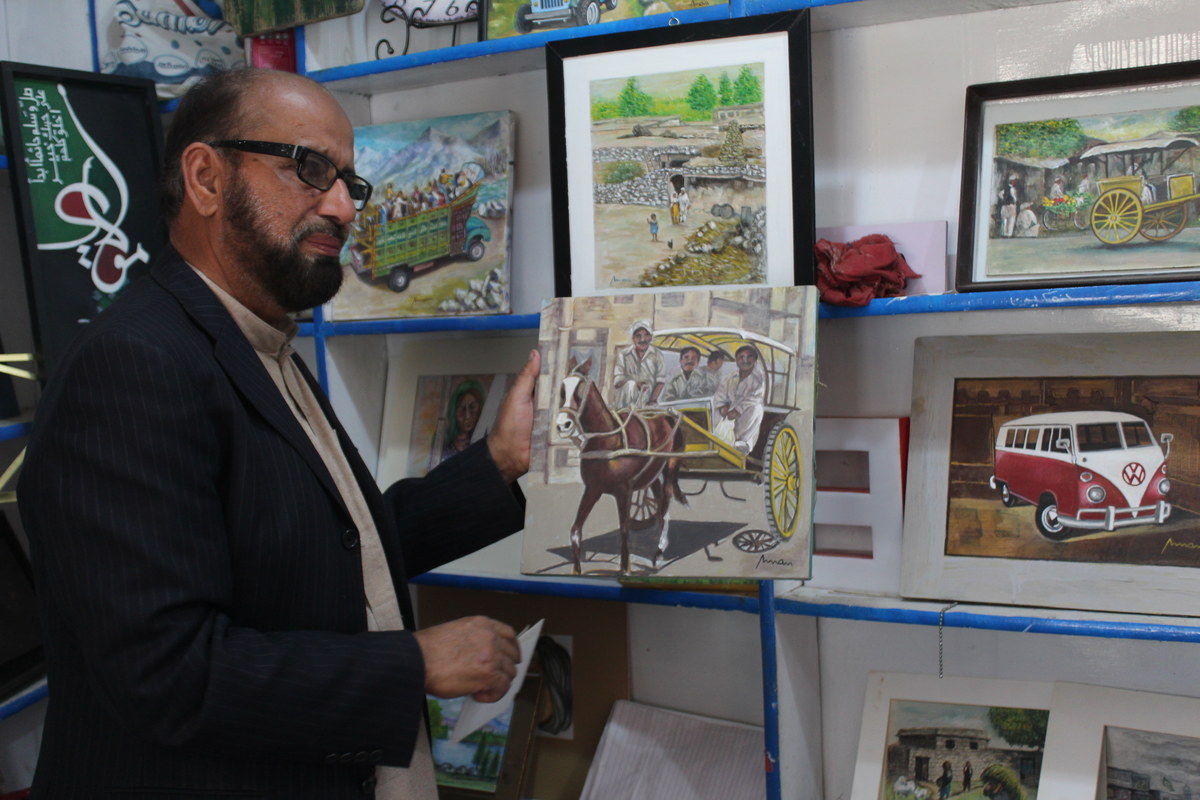


Amanullah Khan, an artist from Swat, is holding a painting of a horse-drawn carriage at his studio in Saidu Sharif on February 27, 2020. (AN Photo)

Khan added it was important to emphasize the last bit since the valley made headlines in recent years after it was captured by local Taliban militants who beheaded their enemies and publicly flogged people. The group ruled the region between 2007 and 2009 before the army launched a military operation to reclaim the territory.

Khan maintained that the darkness of Taliban rule was not in keeping with the character of the place. According to historical accounts, he said, Swat emerged as a princely state in the British Indian Empire in 1926. Back then, it was quite underdeveloped with no education institutes or literate people.

The situation changed within a few years under its local ruler, and the area witnessed a sharp incline in its literacy rate. In this context, he noted, it was also fascinating that the valley produced the world’s youngest Nobel Laureate, Malala Yousafzai, who fought for girls’ education under the Taliban rule and survived a bid on her life in October 2012.
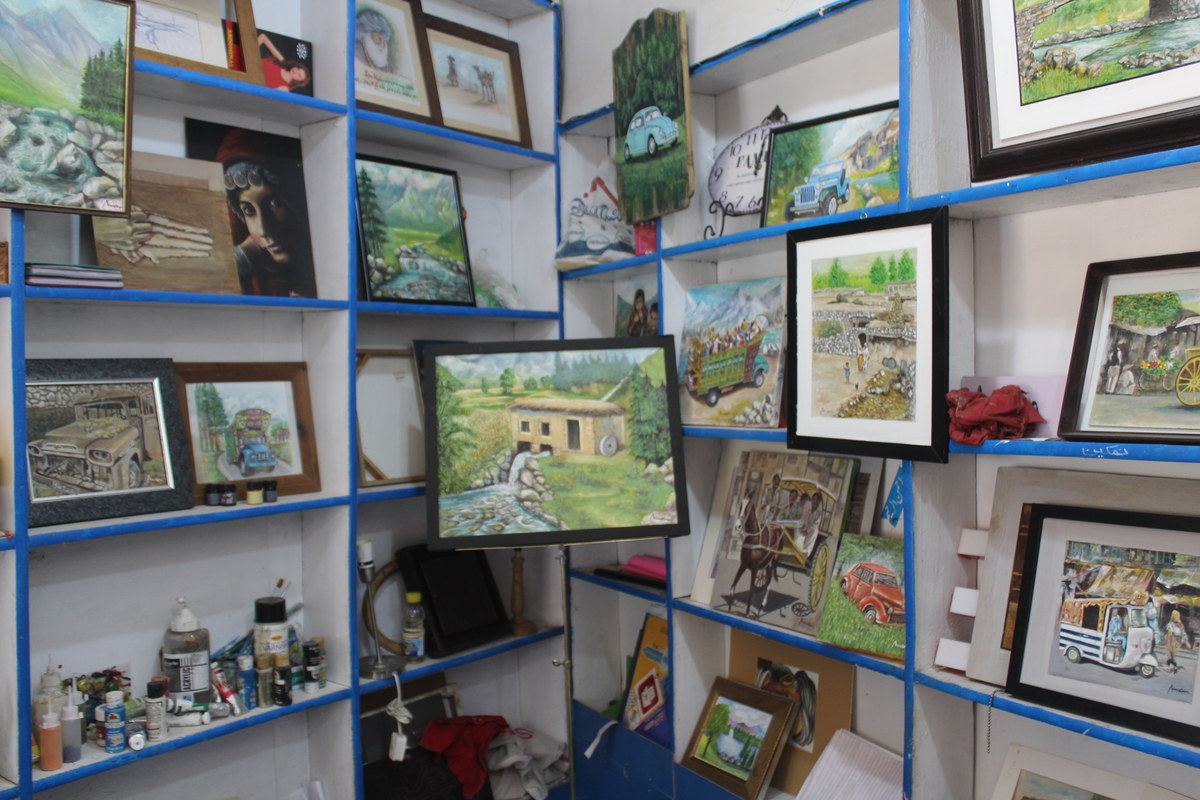


This picture shows a collection of paintings displayed by Amanullah Khan, an artist from Swat, at his studio in Saidu Sharif on February 27, 2020. (AN Photo)

Swat also progressed in other ways as a princely state since it laid out an elaborate road network which helped its economy by strengthening its tourism industry. However, its ruler acceded to Pakistan in 1969, though most local residents fondly remember his time to this day.

Khan noted that Swat had undergone significant changes over the years.

“This place is one of the most attractive tourist destinations in Pakistan,” he said. “However, most people know very little about the valley and its past. My aim is to bring them face to face with its cultural heritage through my paintings.”

The only other place that caught his fancy was Saudi Arabia where he spent considerable time. It was also during this period that Khan started painting portraits of prominent members of the Kingdom’s royal family.
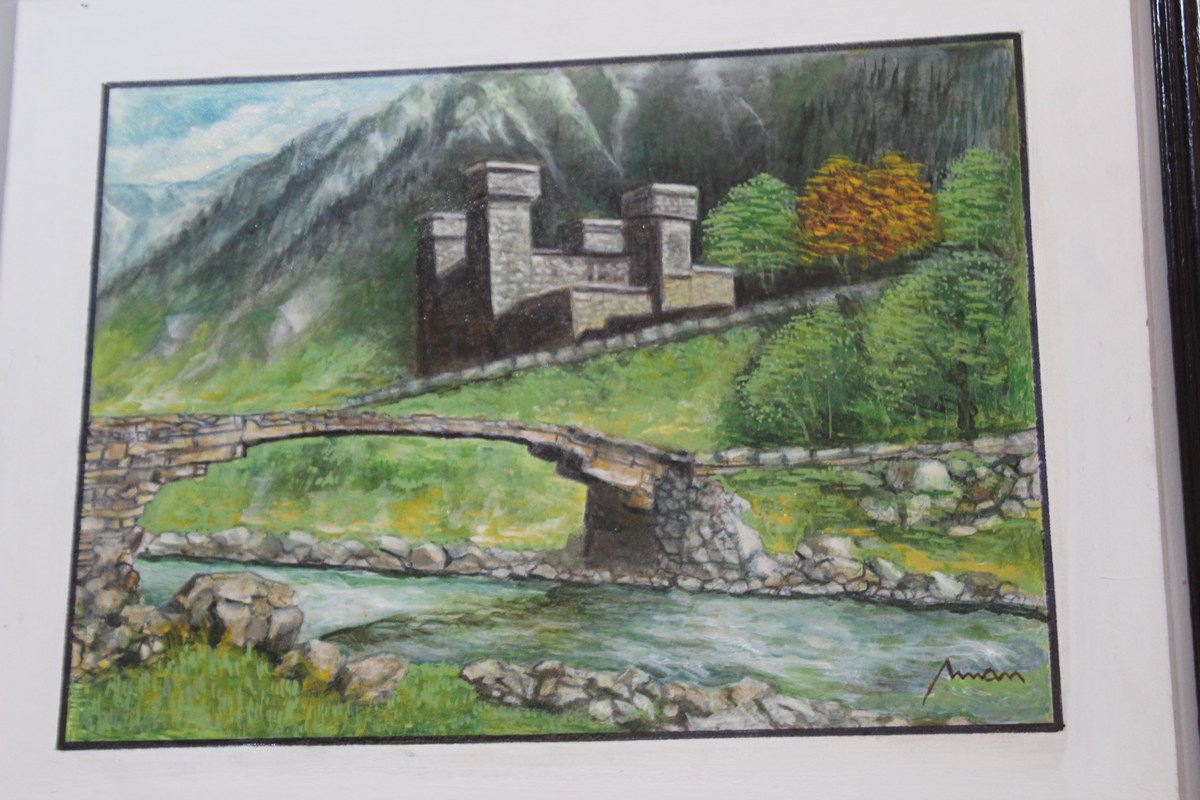


This picture shows a collection of paintings displayed by Amanullah Khan, an artist from Swat, at his studio in Saidu Sharif on February 27, 2020. (AN Photo)

“After living for three decades in Saudi Arabia, I was inspired by its cultural and tribal traditions,” he continued. “I particularly liked how Arab men danced on special occasions like Eid Al-Fitr.”

Khan’s work is also recognized by people in his hometown.

“I have a lot of respect for him since he reminds us of what Swat achieved as a princely state,” said Iftikhar Ahmad while talking to Arab News.

“Plenty of art lovers come to the valley and many of them like my work,” Khan told Arab News. “But due to my financial constraints, I am unable to arrange an exhibition to introduce my paintings to a larger Pakistani audience.”


IMF warns against policy slippage amid weak recovery as it clears $1.2 billion for Pakistan

Updated 11 December 2025
Follow

IMF warns against policy slippage amid weak recovery as it clears $1.2 billion for Pakistan

  • Pakistan rebuilt reserves, cut its deficit and slowed inflation sharply over the past one year
  • Fund says climate shocks, energy debt, stalled reforms threaten stability despite recent gains

ISLAMABAD: Pakistan’s economic recovery remains fragile despite a year of painful stabilization measures that helped pull the country back from the brink of default, the International Monetary Fund (IMF) warned on Thursday, after it approved a fresh $1.2 billion disbursement under its ongoing loan program.

The approval covers the second review of Pakistan’s Extended Fund Facility (EFF) and the first review of its climate-focused Resilience and Sustainability Facility (RSF), bringing total disbursements since last year to about $3.3 billion.

Pakistan entered the IMF program in September 2024 after years of weak revenues, soaring fiscal deficits, import controls, currency depletion and repeated climate shocks left the economy close to external default. A smaller stopgap arrangement earlier that year helped avert immediate default, but the current 37-month program was designed to restore macroeconomic stability through strict monetary tightening, currency adjustments, subsidy rationalization and aggressive revenue measures.

The IMF’s new review shows that Pakistan has delivered significant gains since then. Growth recovered to 3 percent last year after shrinking the year before. Inflation fell from over 23 percent to low single digits before rising again after this year’s floods. The current account posted its first surplus in 14 years, helped by stronger remittances and a sharp reduction in imports. And the government delivered a primary budget surplus of 1.3 percent of GDP, a key program requirement. Foreign exchange reserves, which had dropped dangerously low in 2023, rose from US$9.4 billion to US$14.5 billion by June.

“Pakistan’s reform implementation under the EFF arrangement has helped preserve macroeconomic stability in the face of several recent shocks,” IMF Deputy Managing Director Nigel Clarke said in a statement after the Board meeting.

But he warned that Islamabad must “maintain prudent policies” and accelerate reforms needed for private-sector-led and sustainable growth.

The Fund noted that the 2025 monsoon floods, affecting nearly seven million people, damaging housing, livestock and key crops, and displacing more than four million, have set back the recovery. The IMF now expects GDP growth in FY26 to be slightly lower and forecasts inflation to rise to 8–10 percent in the coming months as food prices adjust.

The review warns Pakistan against relaxing monetary or fiscal discipline prematurely. It urges the State Bank to keep policy “appropriately tight,” allow exchange-rate flexibility and improve communication. Islamabad must also continue raising revenues, broadening the tax base and protecting social spending, the Fund said.

Despite the progress, Pakistan’s structural weaknesses remain severe.

Power-sector circular debt stands at about $5.7 billion, and gas-sector arrears have climbed to $11.3 billion despite tariff adjustments. Reform of state-owned enterprises has slowed, including delays in privatizing loss-making electricity distributors and Pakistan International Airlines. Key governance and anti-corruption reforms have also been pushed back.

The IMF welcomed Pakistan’s expansion of its flagship Benazir Income Support Program, which raises cash transfers for low-income families and expands coverage, saying social protection is essential as climate shocks intensify. But it warned that high public debt, about 72 percent of GDP, thin external buffers and climate exposure leave the country vulnerable if reform momentum weakens.

The Fund said Pakistan’s challenge now is to convert short-term stabilization into sustained recovery after years of economic volatility, with its ability to maintain discipline, rather than the size of external financing alone, determining the durability of its gains.