


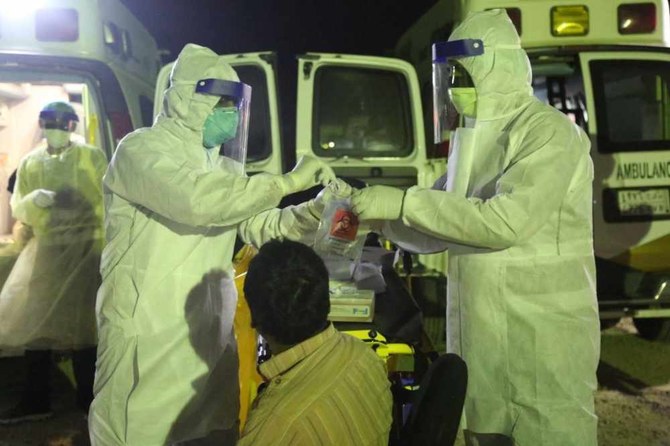

JEDDAH/RIYADH: The Saudi Ministry of Health has taken another step in its fight against the coronavirus disease (COVID-19) by introducing community testing surveys.
“If need be, this will be conducted in an organized manner through scheduled screening appointments across the Kingdom,” a source at the ministry told Arab News, adding there will be no knocking on random doors to test people.
According to media reports, the initial circulated date for the commencement of testing was set to be Friday, May 1, which the Health Ministry’s spokesperson, Dr. Mohammed Al-Abd Al-Aly, denied.
“We noticed yesterday the circulation of false information, where messages were exchanged about the active survey teams entering homes to start the testing, which is incorrect,” said Al-Aly.
The mass testing aims to relieve the spike in cases and catch areas that are already infected early to stop further cases from arising.
During a mass screening procedure, medical teams normally visit places where previous infections have been reported, and subject people to tests in order to make sure there are no further cases of COVID-19.
Dr. Abdullah Al-Zahrani, an orthopedic surgeon at Al-Mana General Hospital, told Arab News that there was no doubt that screening tests for COVID-19 were a great step forward.
“We know that prevention is the gold standard in the management of the pandemic on both national and international fronts. As many infected people do not show any signs or symptoms of the illness in the so-called period of incubation, these people are especially responsible for the spread of the disease, and they are the ones screening tests are done (for) in a susceptible population,” Al-Zahrani said.
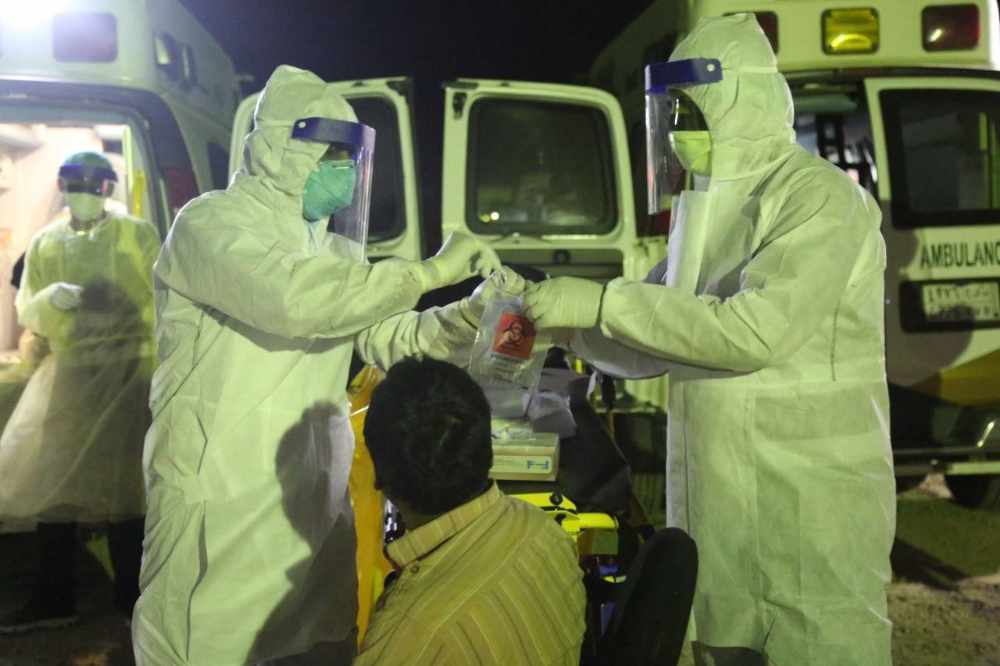
Health officials in Jazan examine a man for possible COVID-19 infection. (SPA)
He added that the concept of mass screening had been adopted by many countries, such as the UK, where an average of 10,000 tests were done on a daily basis at the beginning of the pandemic.
He said that tests recently reached 50,000 per day in the UK, and that they were planning and hoping to reach 100,000 tests a day in their campaign of mass screening.
Speaking to Arab News, community medicine consultant Dr. Abdul-Hafeez Khoja said that the Kingdom took pride in the ability of its leaders to implement modern scientific measures in the fight against the pandemic.
“They are implementing the measures in several stages, studied and recommended by the World Health Organization (WHO) and officials in the field of infection control at the Saudi Ministry of Health, who have a high level of experience in this field, through their proper handling of previous pandemics,” Khoja said.
While adopting such a step, Khoja said, Saudi Arabia was disregarding the massive financial costs of mass testing and following its principle of “health first and the economy second.”
He said that the importance of this campaign from a scientific point of view depended on the characteristics of the virus, which does not reproduce and lives only within the living cell.
The virus’ presence in nature, he said, would lead to its death after a few days unless it can reach a human being and multiply in its cells.
“The second fact is that infection with this virus can occur as soon as it enters the human body and before symptoms appear,” Khoja said, adding: “One of the characteristics of this virus is that it is contagious before the symptoms appear on the infected person.”
The consultant sent two messages to the community, as a preventive and community medical expert saying: “This is our role towards our family and community in detecting anyone who carries the virus, even if I’m the one infected.”
He assured people in his second message that those detected to be carrying the virus will not be blamed nor their family. “Only home quarantine steps will be taken as a bold, scientific step to eliminate the virus.”


