HSBC sees mounting credit losses after pandemic halves first-half profit

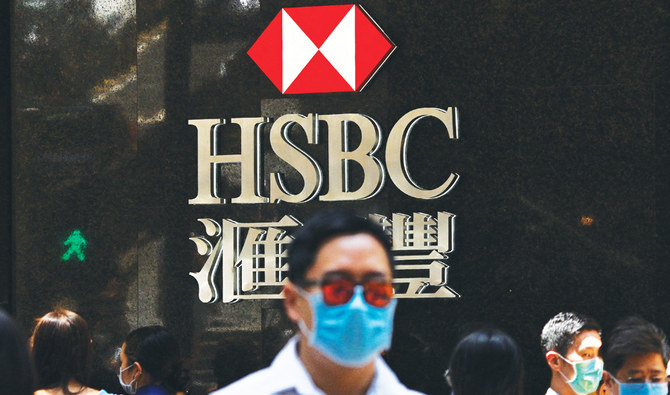
HSBC said first quarter pre-tax profits almost halved as it was battered by the global coronavirus pandemic while it embarked on a major restructuring. (AFP)
Short Url
Updated 29 April 2020
Follow

HSBC sees mounting credit losses after pandemic halves first-half profit

  • Bank forced to put restructuring plans on hold to minimize disruption

HONG KONG: HSBC Holdings warned of more earnings pain ahead after first-quarter profit nearly halved as it set aside a hefty $3 billion in bad loan provisions due to the coronavirus pandemic.

Europe’s biggest bank said the outbreak would mean sustained pressure on its revenues as customer activity declined and lower interest rates squeezed margins, while noting increased fraudulent activity could lead to “potentially significant” credit losses.
The bleak outlook, shared by many lenders reporting earnings this season, underscored the scale of the problems facing the sector as it grapples with corporate borrowers in crisis, plunging stock and oil prices, as well as low interest rates.
HSBC’s new Chief Executive Officer Noel Quinn faces additional hurdles as plans to cut costs through layoffs, part of a wider restructuring unveiled in February, have been put on hold due to the pandemic.
The bank increased its expected credit impairment charges for January-March by $2.4 billion to $3 billion, its highest quarterly level in nine years, and said total provisions for the year could range from $7 billion to $11 billion.

FASTFACT

In February, HSBC laid out plans to cut 35,000 jobs.

“No one really knows how the coronavirus will develop over the next three to six months and what scenarios will play out. It’s most important for us to be prepared for all scenarios — the optimistic and the less optimistic,” Quinn said.
Profit before tax for the quarter tumbled 48 percent to $3.2 billion, below an average analyst forecast of $3.7 billion compiled by the bank. Revenue dropped 5 percent to $13.7 billion.
The results were also hit by the slide in oil prices as well as “a significant charge related to a corporate exposure in Singapore,” it said.
HSBC did not name the company, but the lender is among leading creditors to Singapore oil trader Hin Leong Trading, which sources have said is under court-appointed supervision to restructure billions of dollars in debt following the collapse in the price of oil.
Hin Leong has declined to comment on its debt restructuring.
“I think the management team are doing OK in the circumstances, said Hugh Young, managing director at Aberdeen Asset Management Asia, one of HSBC’s 20 biggest shareholders.
The London-headquartered bank, which generates the bulk of its profits in Asia, said it plans to reduce its operating costs to mitigate the fall in revenue which is set to lead to “materially lower” profitability in 2020 than last year.
In February, HSBC laid out plans to cut 35,000 jobs. While many of those redundancies have been paused to avoid disruption and leaving staff unable to find work elsewhere, Quinn has cut some top-level jobs and reshuffled others as he tries to prune HSBC’s complicated management structure.
The bank reiterated, however, that it will press ahead with plans to shift capital from underperforming businesses and reduce other costs.
HSBC’s sharply higher loan loss provisions follows similar moves by US lenders this month. The top four US banks set aside $14.2 billion in loan loss provisions, with sales and trading revenue from investment banking the only silver lining as frenzied markets worldwide drove up commissions.


Saudi investment pipeline active as reforms advance, says Pakistan minister

Updated 08 February 2026
Follow

Saudi investment pipeline active as reforms advance, says Pakistan minister

ALULA: Pakistan’s Finance Minister Mohammed Aurangzeb described Saudi Arabia as a “longstanding partner” and emphasized the importance of sustainable, mutually beneficial cooperation, particularly in key economic sectors.

Speaking to Arab News on the sidelines of the AlUla Conference for Emerging Market Economies, Aurangzeb said the relationship between Pakistan and Saudi Arabia remains resilient despite global geopolitical tensions.

“The Kingdom has been a longstanding partner of Pakistan for the longest time, and we are very grateful for how we have been supported through thick and thin, through rough patches and, even now that we have achieved macroeconomic stability, I think we are now well positioned for growth.”

Aurangzeb said the partnership has facilitated investment across several sectors, including minerals and mining, information technology, agriculture, and tourism. He cited an active pipeline of Saudi investments, including Wafi’s entry into Pakistan’s downstream oil and gas sector.

“The Kingdom has been very public about their appetite for the country, and the sectors are minerals and mining, IT, agriculture, tourism; and there are already investments which have come in. For example, Wafi came in (in terms of downstream oil and gas stations). There’s a very active pipeline.”

He said private sector activity is driving growth in these areas, while government-to-government cooperation is focused mainly on infrastructure development.

Acknowledging longstanding investor concerns related to bureaucracy and delays, Aurangzeb said Pakistan has made progress over the past two years through structural reforms and fiscal discipline, alongside efforts to improve the business environment.

“The last two years we have worked very hard in terms of structural reforms, in terms of what I call getting the basic hygiene right, in terms of the fiscal situation, the current economic situation (…) in terms of all those areas of getting the basic hygiene in a good place.”

Aurangzeb highlighted mining and refining as key areas of engagement, including discussions around the Reko Diq project, while stressing that talks with Saudi investors extend beyond individual ventures.

“From my perspective, it’s not just about one mine, the discussions will continue with the Saudi investors on a number of these areas.”

He also pointed to growing cooperation in the IT sector, particularly in artificial intelligence, noting that several Pakistani tech firms are already in discussions with Saudi counterparts or have established offices in the Kingdom.

Referring to recent talks with Saudi Minister of Economy and Planning Faisal Alibrahim, Aurangzeb said Pakistan’s large freelance workforce presents opportunities for deeper collaboration, provided skills development keeps pace with demand.

“I was just with (Saudi) minister of economy and planning, and he was specifically referring to the Pakistani tech talent, and he is absolutely right. We have the third-largest freelancer population in the world, and what we need to do is to ensure that we upscale, rescale, upgrade them.”

Aurangzeb also cited opportunities to benefit from Saudi Arabia’s experience in the energy sector and noted continued cooperation in defense production.

Looking ahead, he said Pakistan aims to recalibrate its relationship with Saudi Arabia toward trade and investment rather than reliance on aid.

“Our prime minister has been very clear that we want to move this entire discussion as we go forward from aid and support to trade and investment.”