

India softens toward Muslims after Islamophobia outcry

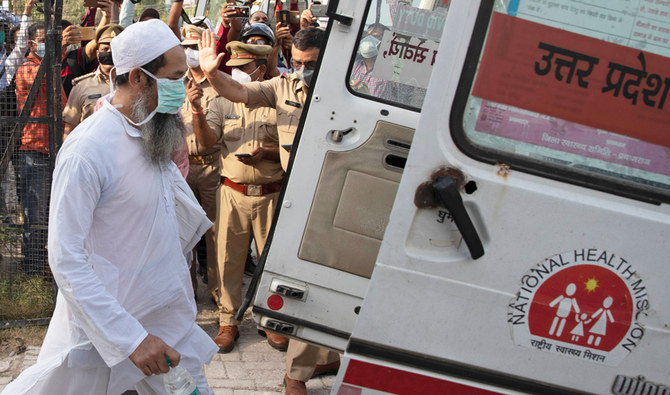
A Muslim man, among 29 people arrested by Indian authorities, walks towards an ambulance before being taken to a prison from a quarantine center in Prayagraj. (Files/AP)
Short Url
Updated 29 April 2020
Follow

India softens toward Muslims after Islamophobia outcry

  • Growing attacks on Muslims undermine India’s positive image, says analyst

NEW DELHI: India’s ruling Bharatiya Janata Party (BJP) has called for unity and religious harmony after an international outcry over increasing Islamophobia in the country.

The Muslim outreach attempts began after influential figures in the Arab world objected to the government blaming an event organized by the religious missionary group the Tablighi Jamaat (TJ) for “contributing to a 30 percent rise in the coronavirus cases” in India.
On Sunday the head of the Rashtriya Swayamsevak Sangh (RSS), the BJP’s paternal organization and masthead of Hindu rightwing nationalism, called upon people to “come together and fight the menace of coronavirus jointly.”
“All 130 crore Indians are our family,” said RSS chief Mohan Bhagwat. “We are one. We should not blame the entire community for the mistake of a few individuals. People who are more mature in both communities should come forward and start a dialogue to remove prejudices among people’s minds.”
A day earlier Prime Minister Narendra Modi greeted Muslims on the start of Ramadan.
“I pray for everyone’s safety, well-being and prosperity,” he tweeted. “May this Holy Month bring with it abundance of kindness, harmony and compassion. May we achieve a decisive victory in the ongoing battle against COVID-19 and create a healthier planet.”
Blaming TJ placed New Delhi’s carefully cultivated relationship with the Middle East under the microscope after the Organization of Islamic Cooperation (OIC) strongly disapproved of hate speech by Indian nationals accusing the missionary group of deliberately exacerbating the pandemic.
Princess Hend Al-Qassimi, a member of the UAE royal family, reprimanded an Indian expatriate in Dubai for targeting Muslims and blaming the TJ for the spread of the outbreak.

FASTFACT

Princess Hend Al-Qassimi, a member of the UAE royal family, reprimanded an Indian expatriate in Dubai for targeting Muslims for the spread of the outbreak.

She shared a UAE law which banned hate speech, adding that anyone who was “openly racist and discriminatory” in the UAE would be fined and made to leave.
She further stressed the need “to reject hatred and replace it with love on earth to live together.”
On Friday, India’s Foreign Minister Subrahmanyam Jaishankar called his counterparts in the Gulf Cooperation Council countries and reassured them about the situation in India.
“Pandemics further highlight the need for international cooperation,” he tweeted after the talks. “Few better examples than our relationship with #UAE. Applaud the generosity of spirit and clarity of policy that has characterised its approach. Thank HH @ABZayed for the warm conversation.”
Analysts said that such strong reactions from the Gulf countries were “causing anxiety” in the government.
“This is the first time in many years that we are witnessing a trenchant reaction coming from the Arab world about the happenings in India,” Sanjay Kapoor, editor of English magazine Hardnews, told Arab News. “It is unusual and is causing anxiety in the government as well amongst all those who do business with the Gulf. Modi has to be wise in how he deals with the Arab world, not just due to the remittances that the workers send, but much of its politics in that region is linked to the support that Saudi provides.”
Prof. Sujata Ashwarya, of New Delhi-based Jamia Milia Islamia University, said that the growing Islamophobia in India undermined the positive image of India in the Muslim world.
“The consequences could be grave,” she told Arab News. “Once you lose your touch, it is difficult to get that back easily. Soft power is the twin of hard power.”


Carney says Canada has no plans to pursue free trade agreement with China as Trump threatens tariffs

Updated 26 January 2026
Follow

Carney says Canada has no plans to pursue free trade agreement with China as Trump threatens tariffs

TORONTO: Canadian Prime Minister Mark Carney said Sunday his country has no intention of pursuing a free trade deal with China. He was responding to US President Donald Trump’s threat to impose a 100 percent tariff on goods imported from Canada if America’s northern neighbor went ahead with a trade deal with Beijing.
Carney said his recent agreement with China merely cuts tariffs on a few sectors that were recently hit with tariffs.
Trump claims otherwise, posting that “China is successfully and completely taking over the once Great Country of Canada. So sad to see it happen. I only hope they leave Ice Hockey alone! President DJT”
The prime minister said under the free trade agreement with the US and Mexico there are commitments not to pursue free trade agreements with nonmarket economies without prior notification.
“We have no intention of doing that with China or any other nonmarket economy,” Carney said. “What we have done with China is to rectify some issues that developed in the last couple of years.”
In 2024, Canada mirrored the United States by putting a 100 percent tariff on electric vehicles from Beijing and a 25 percent tariff on steel and aluminum. China had responded by imposing 100 percent import taxes on Canadian canola oil and meal and 25 percent on pork and seafood.
Breaking with the United States this month during a visit to China, Carney cut its 100 percent tariff on Chinese electric cars in return for lower tariffs on those Canadian products.
Carney has said there would be an initial annual cap of 49,000 vehicles on Chinese EV exports coming into Canada at a tariff rate of 6.1 percent, growing to about 70,000 over five years. He noted there was no cap before 2024. He also has said the initial cap on Chinese EV imports was about 3 percent of the 1.8 million vehicles sold in Canada annually and that, in exchange, China is expected to begin investing in the Canadian auto industry within three years.
Trump posted a video Sunday in which the chief executive of the Canadian Vehicle Manufacturers’ Association warns there will be no Canadian auto industry without US access, while noting the Canadian market alone is too small to justify large scale manufacturing from China.
“A MUST WATCH. Canada is systematically destroying itself. The China deal is a disaster for them. Will go down as one of the worst deals, of any kind, in history. All their businesses are moving to the USA. I want to see Canada SURVIVE AND THRIVE! President DJT,” Trump posted on social media.
Trump’s post on Saturday said that if Carney “thinks he is going to make Canada a ‘Drop Off Port’ for China to send goods and products into the United States, he is sorely mistaken.”
“We can’t let Canada become an opening that the Chinese pour their cheap goods into the U.S,” US Treasury Secretary Scott Bessent said on ABC’s “This Week.”
“We have a , but based off — based on that, which is going to be renegotiated this summer, and I’m not sure what Prime Minister Carney is doing here, other than trying to virtue-signal to his globalist friends at Davos.”
Trump’s threat came amid an escalating war of words with Carney as the Republican president’s push to acquire Greenland strained the NATO alliance.
Carney has emerged as a leader of a movement for countries to find ways to link up and counter the US under Trump. Speaking in Davos before Trump, Carney said, “Middle powers must act together because if you are not at the table, you are on the menu” and he warned about coercion by great powers — without mentioning Trump’s name. The prime minister received widespread praise and attention for his remarks, upstaging Trump at the World Economic Forum.
Trump’s push to acquire Greenland has come after he has repeatedly needled Canada over its sovereignty and suggested it also be absorbed into the United States as a 51st state. He posted an altered image on social media this week showing a map of the United States that included Canada, Venezuela, Greenland and Cuba as part of its territory.