

Filipino president urges ‘patience’ as Manila virus lockdown extended to May 15

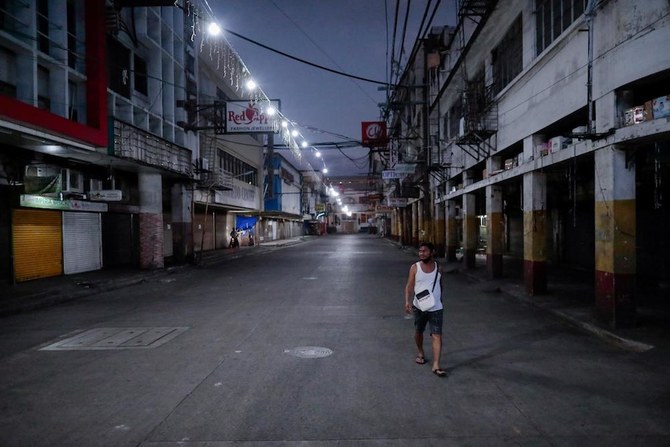
The Luzon island-wide enhanced community quarantine measure, one of the world’s strictest lockdowns to curb the spread of the deadly virus, was imposed in March. (Reuters/File Photo)
Short Url
Updated 24 April 2020
Follow

Filipino president urges ‘patience’ as Manila virus lockdown extended to May 15

  • Quarantine in lower-risk regions of Philippines to be modified for partial resumption of commercial activities

MANILA: Filipino President Rodrigo Duterte on Friday urged citizens to “be patient” as he announced an extension to the coronavirus disease (COVID-19) lockdown in the country’s capital region until May 15.

The Luzon island-wide enhanced community quarantine measure, one of the world’s strictest lockdowns to curb the spread of the deadly virus, was imposed in March with a view to it being lifted on April 30.

But in a recorded public address, Duterte said: “We are just waiting for the right time. Just be patient, please. We are trying to limit the contamination. We are all at risk. But do not increase the odds or the chances of getting it (COVID-19).”

Following a series of meetings with medical experts and the Inter-Agency Task Force for the Management of Emerging Infectious Diseases (IATF-EID), the president moved to extend the quarantine period in the Metro Manila region, where the outbreak has been at its worst, along with other high-risk areas in Luzon and parts of Visayas and Mindanao, including the city of Davao.

The latest measures will be re-evaluated by Filipino authorities on May 16.

Quarantine in lower-risk regions will be modified, allowing partial resumption of commercial activity, transportation and construction works from May 1. If there is no deterioration, normalization will start on May 16.

In a press briefing at the presidential palace, National Task Force COVID chief Carlito Galvez Jr. said Metro Manila had “more or less” 12,000 suspected COVID-19 cases out of a population of more than 12.8 million. Through aggressive testing, he added, the government aimed to bring the number down to zero.

He pointed out that the enhanced community quarantine in the capital region could not be lifted due to the risk of a second wave of infections, and that the government’s extension was in accordance with World Health Organization (WHO) guidelines.

Filipino Health Undersecretary Maria Rosario Vergeire said that the additional two weeks’ extension was to allow time for the country’s health care system to prepare medical facilities and reach a high testing capacity in readiness to deal with any rise in the number of COVID-19 cases.

Vergeire added that the public should be ready for a “new normal” where physical distancing and stricter hygiene measures would remain as the “virus will still be here.”

Meanwhile, Duterte repeated his threat to impose martial law if communist guerrillas active in the country’s north attacked government forces delivering aid to communities during the COVID-19 quarantine.

“I am now warning everybody and putting the armed forces and police on notice. I might declare martial law and there will be no turning back,” he said.


Bangladesh votes in its first election since the 2024 Gen Z uprising that ousted Hasina

Updated 5 sec ago
Follow

Bangladesh votes in its first election since the 2024 Gen Z uprising that ousted Hasina

DHAKA, Bangladesh: Bangladesh on Thursday held its first election since 2024 mass protests toppled Sheikh Hasina’s government with balloting being largely peaceful in a vote seen as a test of the country’s democracy after years of political turmoil.
A projection showed that an alliance led by the Bangladesh Nationalist Party, or BNP, took the lead with 127 seats, while its main challenger, an 11-party alliance led by the Jamaat-e-Islami party, garnered 32 seats and three seats by others, according to Dhaka-based Jamuna TV.
Official results were expected on Friday. Bangladesh is a parliamentary democracy in which 300 lawmakers are elected through direct voting.
After a slow start, crowds converged on polling stations in the capital, Dhaka, and elsewhere later in the day. By 2 p.m., more than 47 percent voters had cast their ballots, the Election Commission said.
At one Dhaka polling station, poll officials manually counted the paper ballots and checked each for validity before tabulating the results. Political party representatives were present as election observers, and security officials kept a close watch on Thursday evening.
More than 127 million people were eligible to vote in the country’s first election since Hasina’s ouster after weeks of mass protests, dubbed by many as a Generation Z uprising. Hasina fled the country and is living in India in exile, while her party was barred from the polls.
As the voting closed, Hasina’s Awami League party, which was barred from the election, rejected Thursday’s election.
“Today’s so-called election by Yunus, who seized power illegally and unconstitutionally, was essentially a well-planned farce,” the former governing party said in a statement on X. “The people’s voting rights, democratic values, and the spirit of the constitution were completely disregarded in this deceptive, voter-less election conducted without the Awami League,” it said.
‘Birthday of a new Bangladesh’
The BNP’s Tarique Rahman is a leading contender to form the next government. He’s the son of former Prime Minister Khaleda Zia and returned to Bangladesh in December, after 17 years in self-exile in London. Rahman has pledged to rebuild democratic institutions, restore the rule of law and revive the struggling economy.
Television stations reported late Thursday that Rahman won in two constituencies, one in Dhaka and another in his northern ancestral home.
Challenging the BNP is an 11-party alliance led by Jamaat-e-Islami, the country’s largest Islamist party, which was banned under Hasina but has gained prominence since her removal.
The conservative religious group’s growing influence has fueled concern, particularly among women and minority communities, that social freedoms could come under pressure, if they come to power. Bangladesh is more than 90 percent Muslim, while around 8 percent are Hindu.
Jamaat-e-Islami leader Shafiqur Rahman expressed optimism after casting his vote at a polling station.
The election “is a turning point,” he told The Associated Press. “People demand change. They desire change. We also desire the change.”
Bangladesh’s interim leader, Muhammad Yunus, was upbeat about the election.
“This is a day of great joy. Today is the birthday of a new Bangladesh,” Yunus told reporters.
Election follows turbulent period
Yunus, a Nobel Peace Prize laureate, has said the interim government was committed to delivering a credible and transparent election. As part of that effort, around 500 international observers and foreign journalists were present, including delegations from the European Union and the Commonwealth, to which Bangladesh belongs.
Bangladesh’s Parliament has 350 seats, including 300 elected directly from single-member constituencies and 50 reserved for women. Lawmakers are chosen by plurality and the parliament serves a five-year term. The Election Commission recently postponed voting in one constituency after a candidate died.
The election follows a turbulent period marked by mob violence, attacks on Hindu minorities and the media, the growing influence of Islamists and weakening of the rule of law.
It could reshape the domestic stability of Bangladesh, a country whose post-1971 history since gaining independence from Pakistan has been marked by entrenched political parties, military coups and allegations of vote rigging. Young voters, many of whom played a central role in the 2024 uprising, are expected to be influential. Around 5 million first-time voters are eligible.
“I think it is a very crucial election, because this is the first time we can show our opinion with freedom,” said Ikram ul Haque, 28, adding that past elections were far from fair.
“We are celebrating the election. It is like a festival here,” he said.
Referendum for reforms
Thursday’s election is a critical test not just of leadership, but of trust in Bangladesh’s democratic future. Voters can say “Yes” to endorse major reform proposals that stemmed from a national charter signed by major political parties last year.
Yunus was also enthusiastic about the referendum.
“Voting for a candidate is important, but the referendum is very important. The whole of Bangladesh will change,” he said.
If a majority of voters favor the referendum, the newly elected parliament could form a constitutional reform council to make the changes with 180 working days from its first session. The proposals include the creation of new constitutional bodies and changing parliament from a single body to a bicameral legislature with an upper house empowered to amend the constitution by a majority vote.
The BNP and Jamaat-e-Islami both signed the document with some changes after initially expressing some dissent.
Hasina’s Awami League party — still a major party in Bangladesh though banned from the polls — and some of its former allies were excluded from the discussion. From exile, Hasina denounced the election for excluding her party.
Some critics have also said that the referendum has limited the options put before voters.