

Turkish economy to shrink for first time in a decade this year

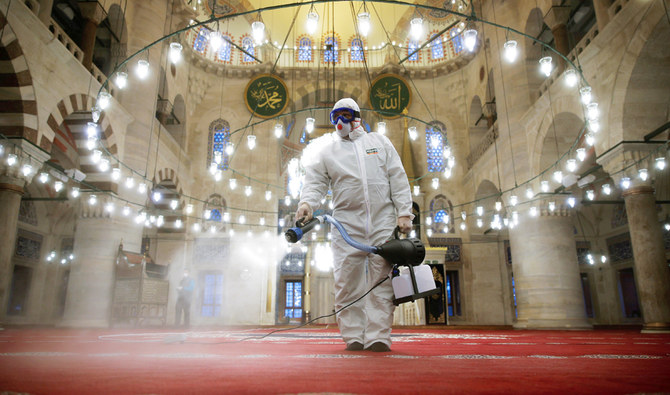
A worker disinfects Kilic Ali Pasha Mosque in Istanbul, Turkey, where authorities have stopped short of a full lockdown to retain some economic activity. (Reuters)
Short Url
Updated 22 April 2020
Follow

Turkish economy to shrink for first time in a decade this year

  • Ankara has not imposed a full lockdown to maintain some economic activity

ISTANBUL: Turkey’s economy is expected to contract this year for the first time in over a decade as the coronavirus pandemic slashes output through mid-year, and it’s unlikely to grow again until 2021, a Reuters poll showed on Tuesday.

The median forecast of 40 economists was for a contraction of 1.4 percent in 2020, with drops in the second and third quarters of 8.6 percent and 5.3 percent respectively.
Before the coronavirus outbreak, the government expected the economy to expand 5 percent this year after rebounding from a recession last year.
The government has not updated its gross domestic product forecast since the country recorded its first case of the coronavirus disease (COVID-19) in mid-March. The virus has since spread, putting Turkey seventh globally in confirmed coronavirus cases.
The economy is expected to grow again next year by 3.7 percent, according to the poll’s median. For the first quarter of this year, the official report due on May 29 is forecast to show growth of 4.4 percent.
Ankara has shut schools and some businesses, closed borders and adopted weekend lockdowns. But it has stopped short of imposing a full stay-at-home order in an effort to support some economic activity.
Economists said robust lending in the first quarter positioned Turkey relatively well as it headed into the global downturn.

FASTFACT

Turkey’s economy last contracted on an annual basis in 2009.

“We think that all sectors of the economy will be affected by COVID-19 and we assume that most of the negative impact would concentrate on Q2-Q3 2020,” UBS economists said.
“Both investments and exports should outright contract in 2020 given the global slowdown from the pandemic. However, credit growth — while clearly expected to fall notably from current levels — might remain flat by end-2020.”
Turkey’s economy last contracted on an annual basis in 2009, by 4.7 percent. From 2010 to 2018, its average growth rate was more than 5 percent thanks to a construction boom driven by cheap capital following the global financial crisis.
A currency crisis in 2018 was set off by concerns over central bank independence and tension between Ankara and Washington. That led to three straight quarters of economic contraction and a modest annual growth rate of 0.9 percent last year.
Since July, the central bank has cut rates to 9.75 percent from 24 percent to boost growth and reflect declining inflation.
In the poll, economists predicted that the central bank would cut to reach 8 percent by July as it ramps up its response to the outbreak, according to the median response.


The Family Office to host global investment summit in Saudi Arabia

Updated 18 January 2026
Follow

The Family Office to host global investment summit in Saudi Arabia

RIYADH: The Family Office, one of the Gulf’s leading wealth management firms, will host its exclusive investment summit, “Investing Is a Sea,” from Jan. 29 to 31 on Shura Island along Saudi Arabia’s Red Sea coast.

The event comes as part of the Kingdom’s broader Vision 2030 initiative, reflecting efforts to position Saudi Arabia as a global hub for investment dialogue and strategic economic development.

The summit is designed to offer participants an immersive environment for exploring global investment trends and assessing emerging opportunities and challenges in a rapidly changing financial landscape.

Discussions will cover key themes including shifts in the global economy, the role of private markets in portfolio management, long-term investment strategies, and the transformative impact of artificial intelligence and advanced technologies on investment decision-making and risk management, according to a press release issued on Sunday.

Abdulmohsin Al-Omran, founder and CEO of The Family Office, will deliver the opening remarks, with keynote addresses from Saudi Energy Minister Prince Abdulaziz bin Salman and Prince Turki Al-Faisal, chairman of the King Faisal Center for Research and Islamic Studies.

The press release said the event reflects the firm’s commitment to institutional discipline, selective investment strategies, and long-term planning that anticipates economic cycles.

The summit will bring together prominent international and regional figures, including former UK Treasury Commercial Secretary Lord Jim O’Neill, Mohamed El-Erian, chairman of Gramercy Fund Management, Abdulrahman Al-Rashed, chairman of the editorial board at Al Arabiya, Lebanese Minister of Economy and Trade Dr. Amer Bisat, economist Nouriel Roubini of NYU Stern School of Business, Naim Yazbeck, president of Microsoft Middle East and Africa, John Pagano, CEO of Red Sea Global, Dr. Anne-Marie Imafidon, MBE, co-founder of Stemettes, SRMG CEO Jomana R. Alrashed and other leaders in finance, technology, and investment.

With offices in Bahrain, Dubai, Riyadh, and Kuwait, and through its Zurich-based sister company Petiole Asset Management AG with a presence in New York and Hong Kong, The Family Office has established a reputation for combining institutional rigor with innovative, long-term investment strategies.

The “Investing Is a Sea” summit underscores Saudi Arabia’s growing role as a global center for financial dialogue and strategic investment, reinforcing the Kingdom’s Vision 2030 objective of fostering economic diversification and sustainable development.