Amazon deploys thermal cameras to scan for fevers faster

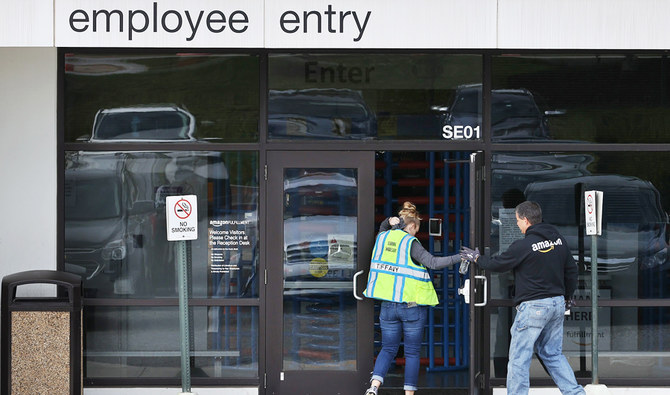
Employees arrrive for work at an Amazon warehouse in Baltimore, Maryland. (AFP)
Short Url
Updated 19 April 2020
Follow

Amazon deploys thermal cameras to scan for fevers faster

  • Amazon has set up the hardware for the thermal cameras in at least six warehouses outside Los Angeles and Seattle, where the company is based, according to employees and posts on social media

SAN FRANCISCO: Amazon.com has started to use thermal cameras at its warehouses to speed up screening for feverish workers who could be infected with the coronavirus, employees told Reuters.
The cameras in effect measure how much heat people emit relative to their surroundings. They require less time and contact than forehead thermometers, earlier adopted by Amazon, workers said.
Cases of the virus have been reported among staff at more than 50 of Amazon’s US warehouses. That has prompted some workers to worry for their safety and walk off the job. Unions and elected officials have called on Amazon to close buildings down.
The use of cameras, previously unreported, shows how America’s second-biggest corporate employer is exploring methods to contain the virus’ spread without shuttering its warehouses.
US states have given Amazon the green light to deliver goods with nearly all the country under stay-at-home orders.
In France, Amazon has closed six of its fulfillment centers temporarily — one of the biggest fallouts yet from a dispute with workers over the risks of coronavirus contagion.
Companies that have explored using the thermal cameras include Tyson Foods and Intel. The camera systems, which garnered widespread use at airports in Asia after the SARS epidemic in 2003, can cost between $5,000 and $20,000.

FASTFACT

$20 k - Temperature-scanning cameras can cost between $5,000 and $20,000.

Amazon has set up the hardware for the thermal cameras in at least six warehouses outside Los Angeles and Seattle, where the company is based, according to employees and posts on social media.
Thermal cameras will also replace thermometers at worker entrances to many of Amazon’s Whole Foods stores, according to a recent staff note seen by Reuters and previously reported by Business Insider.
The company performs a second, forehead thermometer check on anyone flagged by the cameras to get an exact temperature, a worker said. An international standard requires the extra check, though one camera system maker said the infrared scan is more accurate.
Early this month, Amazon said it would offer face masks and start checking hundreds of thousands of people for fevers daily at all its US and European warehouses. Associates walk up to a Plexiglas screen, and an employee on the other side scans their forehead through a small hole.
That process has not been without challenges. A worker performing temperature checks in Houston said his proximity to associates made him uncomfortable, in spite of the screen separating them. “I didn’t sign up for this,” he said.


Saudi National Development Fund sees 45 agreements worth $1.6bn at Momentum 2025

Updated 42 min 12 sec ago
Follow

Saudi National Development Fund sees 45 agreements worth $1.6bn at Momentum 2025

RIYADH: Saudi Arabia’s National Development Fund and its affiliates signed 45 agreements with a total value of SR6 billion ($1.59 billion), with several local and international partners at the conclusion of the Momentum 2025 development finance conference.

The event, held from Dec. 9 to 11 at the King Abdulaziz International Conference Center in Riyadh, was organized by the NDF under the patronage of Prince Mohammed bin Salman bin Abdulaziz Al Saud, crown prince, prime minister, and chairman of the NDF board of directors.

The new agreements seek to accelerate the pace of investment, empower the private sector, and unlock new opportunities in priority sectors including small and medium sized enterprises, tourism, and sustainable development.

On the institutional level, the fund signed two strategic agreements with two leading global partners in technology and professional services, aiming to enable artificial intelligence, data, and digital solutions within the development finance ecosystem. 

The two memorandum of understandings aim to enhance the institutional capabilities of the fund, encourage innovation in products and services, and improve the efficiency and overall impact of development financing in the Kingdom.

The NDF signed a memorandum of understanding through the National Infrastructure Fund aimed at unifying the efforts of the development system to support small enterprises by cooperating on designing a developmental financing model for SMEs.

The Saudi SME Bank signed 19 cooperation agreements and MoUs with a value exceeding SR3 billion, to support the developmental finance system and enhance integration between public and private sector entities.

The Tourism Development Fund concluded 6 agreements with entities from both the government and private sectors, strengthening its partnerships with an impact exceeding SR4 billion. These aim to enhance financing solutions through the “Tourism Enablement Programs” offered by the fund to micro, small, and medium enterprises.

The Cultural Development Fund signed five credit facility agreements within the framework of the “Cultural Financing” program, with a total value exceeding SR63 million, to finance numerous cultural projects.

As part of its efforts to support human capital development, the Human Resources Development Fund concluded 3 agreements aimed at supporting and enabling 2,191 male and female job seekers in multiple sectors, with a value exceeding SR324 million.

The Saudi Industrial Development Fund signed a cooperation agreement with the Saudi Railways Co. to identify cooperation opportunities in enabling the industrial sector, including the railway sector, and supporting investors in localizing goods and services to increase local content.

The Saudi Fund for Development signed five developmental memoranda of understanding with Imam Mohammad Ibn Saud Islamic University, the Islamic Military Counter Terrorism Coalition, and the Middle East Green Initiative, as well as the Saudi Agricultural and Livestock Investment Co., and the Arab Urban Development Institute.

The Investment Events Fund signed a partnership agreement with entertainment firm Legends Global to enhance the events sector by leveraging international expertise in organizing major global events.

The agreements and MoUs signed during the Momentum 2025 conference represent a significant step in the Kingdom’s efforts to build a diverse, inclusive, and sustainable economy.

These partnerships contribute to bridging financing gaps, mitigating risks for strategic projects, and achieving long-term value for Saudi citizens, companies, and communities. Furthermore, they advance global sustainable development goals by aligning public and private capital with national priorities in infrastructure, SMEs, and green growth. 

Dialogue sessions embody development transformation message

The conference agenda included over 35 sessions addressing sustainable investment, climate adaptation, and the role of development finance institutions in expanding economic opportunities. It also featured an exhibition with participation from more than 20 public and private sector entities. 

Over 100 speakers from more than 100 countries participated to discuss ways to develop financing for development efforts, tackle emerging global challenges, and accelerate national and international priorities.

The confernce saw many dialogue sessions and discussions. SPA

The conference concluded with a session titled “The Role of Development Finance Institutions: Enabling Development by Enhancing Financial Capabilities,” which brought together the Governor of the NDF, Stephen Groff, and the CEOs of various development funds and banks.

The session discussions focused on enhancing joint coordination, improving investment readiness, and expanding developmental impact across multiple sectors including tourism, infrastructure, and SMEs.

During the roundtable discussion, participants reviewed the pivotal role led by the Fund and its development ecosystem across various sectors and their role in supporting the economic transformation of the Kingdom.

Groff explained that the strength of this ecosystem lies in the diversity of the funds and the integration of their mandates, adding that achieving the targets of Saudi Vision 2030 requires flexibility in resource allocation and the ability to adapt to national development priorities.

In support of expanding the presence of international companies in the Kingdom and enhancing the competitiveness of the financial sector, the Minister of Investment, Khalid Al-Falih, presented the regional headquarters license to HSBC Bank on the sidelines of the conference, a step that reflects growing confidence in and the attractiveness of the Saudi market to global financial institutions.

To enrich the development sector, the Digital Cooperation Organization launched, on the sidelines of the conference, the Digital Economy Trends 2026 report. The report predicted that the global digital economy will grow by 9.5 percent next year, three times faster than global economic growth.