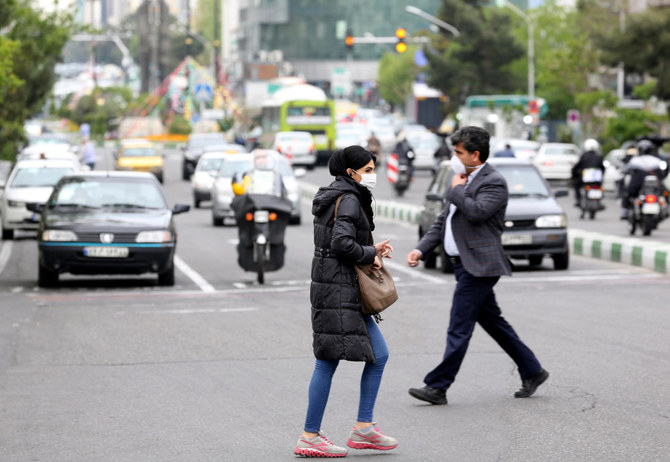
TEHRAN: Iran allowed some businesses in the capital and nearby towns to re-open Saturday after weeks of lockdown aimed at containing the worst coronavirus outbreak in the Middle East.
Iran was slow to respond to the pandemic and held off on imposing widespread restrictions even after other countries in the region with far fewer cases forced most businesses to close. Iran has reported more than 80,000 confirmed cases and over 5,000 deaths.
Gyms, restaurants, shopping malls and Tehran’s grand bazaar will remain closed. Shrines and mosques are also shuttered, and a ban on public gatherings remains in place. Government offices have reopened with a third of employees working from home, and schools and universities are still closed.
Traffic was heavy in Tehran early Saturday, the first day of the work week. Authorities allowed businesses outside the capital to reopen a week ago.
The virus causes mild to moderate flu-like symptoms in most patients, who recover within a few weeks. But it is highly contagious and can cause severe illness or death, particularly in older patients or those with underlying health problems.
Iran’s leaders have said they had to consider the economic consequences of quarantine measures, as the country struggles under severe sanctions imposed by President Donald Trump after he withdrew the US from Tehran’s nuclear deal with world powers.
On Friday, UN human rights experts called on Iran to release political prisoners who could be vulnerable to infection inside the country’s detention facilities. Iran has temporarily released 100,000 prisoners, but is still detaining many convicted on security charges, including several dual-nationals.
Rights groups say many of the dual-nationals are political prisoners or are being held as bargaining chips for future negotiations with the West.
“We recognize the emergency situation in the Islamic Republic of Iran and the problems it faces in fighting the pandemic, including reported challenges in accessing medical supplies due to sanctions,” the UN experts said. “Some are at great risk from COVID-19 due to their age or underlying health conditions. We call on the authorities to immediately release them.”
The experts highlighted the cases of human rights lawyer Nasrin Sotoudeh and defenders Narges Mohammadi and Arash Sadeghi, as well as dual nationals Ahmadreza Djalali , an Iranian-Swedish national; Morad Tahbaz, an Iranian-British-American national; and Kamran Ghaderi and Massud Mossaheb , two Iranian-Austrian nationals.
They said all seven have requested temporary release but have been rejected or not received a response.
Judiciary spokesman Gholamhossein Esmaili denied nationality was a factor in the prisoner releases. He was quoted by the Hamshahri daily as saying release is denied when it is forbidden by law or when “their freedom puts our citizens’ social, economic and psychological security at risk.”
Elsewhere in the region, Sudanese formed long lines outside bakeries and fuel stations early Saturday ahead of a round-the-clock curfew in the capital, Khartoum, that is set to last three weeks. The country, which is still reeling from last year’s uprising that toppled longtime ruler Omar Al-Bashir, has reported 66 cases, including 10 deaths.
An outbreak in Sudan would severely strain the health system, which has been weakened by decades of civil war and sanctions.
Authorities have also banned Friday prayers in Khartoum mosques, a measure taken by several other countries in the region. The transitional government sacked Khartoum’s governor, Lt. Gen. Ahmed Abdoun Hamad, after he objected to the ban.
In Israel, authorities closed off two small Arab towns in the north to prevent the spread of the virus. Police said movement into and out of Deir Assad and neighboring Bineh would be strictly limited. Israel has increased testing in Arab areas in recent days, and the closures appeared to be linked to a spike in cases. Arab citizens of Israel account for 20% of the population and have long faced discrimination.
Israeli authorities have imposed similar closures on some ultra-Orthodox Jewish areas, where cases spiked after many disregarded health guidelines in the early days of the pandemic.
Israel, which imposed nationwide restrictions and ordered all non-essential businesses to close in mid-March, has reported more than 13,000 cases, including 158 deaths.

Iran lets some Tehran businesses reopen after virus lockdown
Short Url
https://arab.news/vzuzm
Iran lets some Tehran businesses reopen after virus lockdown
- Gyms, restaurants, shopping malls and Tehran’s grand bazaar will remain closed
- Shrines and mosques are also shuttered, and a ban on public gatherings remains in place
Gaza hospital says receives fuel but only for about two days
KHAN YUNIS: A major Gaza hospital that had suspended several services due to diesel shortages said it resumed some operations on Friday after receiving fuel but warned the supplies would only last about two days.
Ravaged by more than two years of war, the Al-Awda Hospital in central Gaza’s Nuseirat district cares for around 60 in-patients and receives nearly 1,000 people seeking medical treatment each day.
Earlier Friday, a senior official involved in managing the hospital, Ahmed Mehanna, said “most services have been temporarily stopped due to a shortage of the fuel needed for the generators.”
“Only essential departments remain operational: the emergency unit, maternity ward and paediatrics,” he had told AFP, adding that the hospital rented a small generator to keep those services running.
He had warned that a prolonged fuel shortage “would pose a direct threat to the hospital’s ability to deliver basic services.”
Under normal conditions, Al-Awda Hospital consumes between 1,000 and 1,200 liters of diesel per day, but it only had some 800 liters available.
Later Friday, Mehanna said that “this evening, 2,500 liters of fuel arrived from the World Health Organization, and we immediately resumed operations.”
“This quantity of fuel will last only two and a half days, but we have been promised an additional delivery next Sunday.”
Mohammed Salha, the hospital’s acting director, accused Israeli authorities of deliberately restricting fuel supplies to hospitals in Gaza.
“We are knocking on every door to continue providing services, but while the occupation allows fuel for international institutions, it restricts it for local health facilities such as Al-Awda,” Salha told AFP.
Health hard hit
Despite a fragile truce observed since October 10, the Gaza Strip remains engulfed in a severe humanitarian crisis.
While the ceasefire agreement stipulated the entry of 600 aid trucks per day, only 100 to 300 carrying humanitarian assistance can currently enter, according to the United Nations and non-governmental organizations.
The remaining convoys largely transport commercial goods that remain inaccessible to most of Gaza’s 2.2 million people.
Earlier Friday, Khitam Ayada, 30, who has taken refuge in Nuseirat, said she had gone to Al-Awda hospital after days of kidney pain.
But “they told me they didn’t have electricity to perform an X-ray... and that they couldn’t treat me,” the displaced woman said.
“We lack everything in our lives, even the most basic medical services,” she told AFP.
Gaza’s health sector has been among the hardest hit by the war.
During the fighting, the Israeli miliary repeatedly struck hospitals across Gaza, accusing Hamas of operating command centers there, an allegation the group denied.
International medical charity Doctors Without Borders now manages roughly one-third of Gaza’s 2,300 hospital beds, while all five stabilization centers for children suffering from severe malnutrition are supported by international NGOs.
The war in Gaza was sparked by an unprecedented Hamas attack on Israel on October 7, 2023 that resulted in the deaths of 1,221 people, most of them civilians, according to an AFP tally based on official Israeli figures.
In Israel’s ensuing military campaign in Gaza, at least 70,942 people — also mostly civilians — have been killed, according to the health ministry in the Hamas-run territory.
These figures are considered reliable by the United Nations.
Ravaged by more than two years of war, the Al-Awda Hospital in central Gaza’s Nuseirat district cares for around 60 in-patients and receives nearly 1,000 people seeking medical treatment each day.
Earlier Friday, a senior official involved in managing the hospital, Ahmed Mehanna, said “most services have been temporarily stopped due to a shortage of the fuel needed for the generators.”
“Only essential departments remain operational: the emergency unit, maternity ward and paediatrics,” he had told AFP, adding that the hospital rented a small generator to keep those services running.
He had warned that a prolonged fuel shortage “would pose a direct threat to the hospital’s ability to deliver basic services.”
Under normal conditions, Al-Awda Hospital consumes between 1,000 and 1,200 liters of diesel per day, but it only had some 800 liters available.
Later Friday, Mehanna said that “this evening, 2,500 liters of fuel arrived from the World Health Organization, and we immediately resumed operations.”
“This quantity of fuel will last only two and a half days, but we have been promised an additional delivery next Sunday.”
Mohammed Salha, the hospital’s acting director, accused Israeli authorities of deliberately restricting fuel supplies to hospitals in Gaza.
“We are knocking on every door to continue providing services, but while the occupation allows fuel for international institutions, it restricts it for local health facilities such as Al-Awda,” Salha told AFP.
Health hard hit
Despite a fragile truce observed since October 10, the Gaza Strip remains engulfed in a severe humanitarian crisis.
While the ceasefire agreement stipulated the entry of 600 aid trucks per day, only 100 to 300 carrying humanitarian assistance can currently enter, according to the United Nations and non-governmental organizations.
The remaining convoys largely transport commercial goods that remain inaccessible to most of Gaza’s 2.2 million people.
Earlier Friday, Khitam Ayada, 30, who has taken refuge in Nuseirat, said she had gone to Al-Awda hospital after days of kidney pain.
But “they told me they didn’t have electricity to perform an X-ray... and that they couldn’t treat me,” the displaced woman said.
“We lack everything in our lives, even the most basic medical services,” she told AFP.
Gaza’s health sector has been among the hardest hit by the war.
During the fighting, the Israeli miliary repeatedly struck hospitals across Gaza, accusing Hamas of operating command centers there, an allegation the group denied.
International medical charity Doctors Without Borders now manages roughly one-third of Gaza’s 2,300 hospital beds, while all five stabilization centers for children suffering from severe malnutrition are supported by international NGOs.
The war in Gaza was sparked by an unprecedented Hamas attack on Israel on October 7, 2023 that resulted in the deaths of 1,221 people, most of them civilians, according to an AFP tally based on official Israeli figures.
In Israel’s ensuing military campaign in Gaza, at least 70,942 people — also mostly civilians — have been killed, according to the health ministry in the Hamas-run territory.
These figures are considered reliable by the United Nations.
© 2025 SAUDI RESEARCH & PUBLISHING COMPANY, All Rights Reserved And subject to Terms of Use Agreement.