

Taliban reject Ghani’s ceasefire call despite looming coronavirus crisis

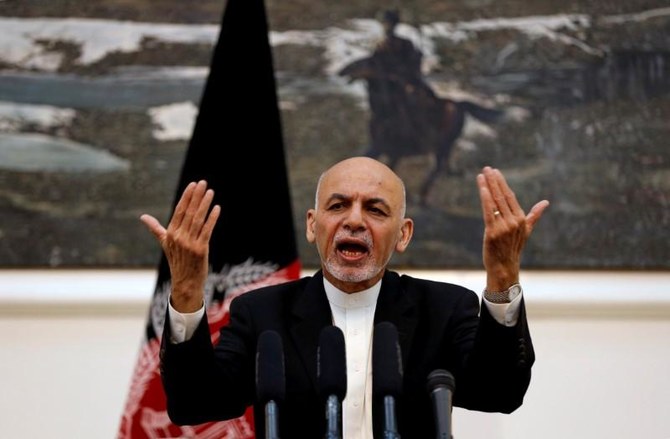
Afghanistan’s President Ashraf Ghani has freed several hundred Taliban prisoners in recent weeks. (Reuters)
Short Url
Updated 16 April 2020
Follow

Taliban reject Ghani’s ceasefire call despite looming coronavirus crisis

  • Insurgents accuse Ghani of blocking peace by not releasing Taliban inmates in light of US peace deal
  • Observers say the virus outbreak could lead to worst catastrophe in country’s history

KABUL: The Taliban on Thursday turned down President Ashraf Ghani’s ceasefire offer, despite the international community calling on the government and insurgents to halt fighting for medical aid to reach all parts of Afghanistan amid the coronavirus disease (COVID-19) outbreak.

“I urge the Taliban to respond positively to the request of the UN, regional countries and the righteous call of the Afghan people and the government, to halt the fighting and announce ceasefire,” Ghani said in a recorded video message on Wednesday evening.

Rejecting Ghani’s call, Afghan Taliban spokesman Zabihullah Mujahid accused the president of blocking peace by not freeing the group’s inmates who were supposed to be released in light of a peace agreement signed with the US in Doha, Qatar, in late February.

Mujahid added that the government had failed to hold talks with them as part of the intra-Afghan dialogue that was due to follow the deal.

“Ghani is creating hurdles on the path of ceasefire and peace,” Mujahid told Arab News, adding: “Instead of ceasefire, work should be done for permanent peace. Through this request, Ghani wants to use this opportunity in his favor. We are not fighting in areas where there are (COVID-19) patients and health workers (treating them).”

Since the Doha agreement, the Taliban has refrained from targeting US-led coalition troops and conducting large-scale attacks in cities, but the group has continued strikes against Afghan government forces across the country, in which hundreds of insurgents and troops have been killed.

Civilian casualties have also been reported. According to National Security Council spokesman Javid Faisal, 30 non-combatants have lost their lives in the past week. Afghanistan’s Independent Human Rights Commission in a report on Wednesday said 83 civilians have perished since the signing of the US-Taliban agreement on Feb. 29.

The Doha accord does not require the Taliban to halt attacks against Afghan government forces, but it obliged Ghani to release 5,000 Taliban prisoners by mid-March in exchange for 1,000 government troops held by the insurgents.

Since last week, Ghani has freed several hundred Taliban prisoners.

In his Wednesday address, he requested that people stay indoors to contain COVID-19 and prevent a “humanitarian tragedy” in the country which heavily relies on foreign aid due to its inadequate medical infrastructure.

According to analyst Zaibhullah Pakteen, Ghani’s call for caution will go unheard until “people start collapsing on the streets.”

Pakteen added that the president may have to seek help from the US to amend the Doha deal so that the truce comes into effect before the virus outbreak becomes a national threat.

Another analyst, Said Azam, said that Afghanistan was “extremely-ill prepared to fight against the virus,” which could lead to the worst catastrophe in the country’s history.

“If the pandemic becomes more widespread, neither the government nor the Taliban will be in a position to control it,” he told Arab News.

The Ministry of Health reported 840 cases of COVID-19 in Afghanistan and 25 related deaths as of Thursday. A sharp increase in the known cases has been observed lately. The numbers are likely to be much higher than those recorded as there are few diagnostic centers in the country.

Amid rising concern that the disease will claim a huge death toll, the governor of the western Herat province — the center of the virus outbreak in Afghanistan — announced on Wednesday that he was preparing to turn deserts into cemeteries.


In rare overlap, Chinese Muslims observe Ramadan with Lunar New Year

Updated 6 sec ago
Follow

In rare overlap, Chinese Muslims observe Ramadan with Lunar New Year

  • Lunar New Year started on Feb. 17 and is celebrated for another two weeks
  • Chinese Indonesians make up about 3 percent of the Indonesian population

JAKARTA: Every year, on the first day of Lunar New Year, Febriani visits relatives and gathers for a feast with her Chinese Muslim family, part of a long-standing tradition honoring their ethnic heritage.

But this year, as Thursday marks the beginning of Ramadan, she is celebrating two important occasions within the same week, in a rare overlap that last took place in 1995.

“I’m very happy and grateful that Lunar New Year and Ramadan are celebrated so closely. I observe both every year, so it’s truly special,” she told Arab News.

Widely observed across Asia, the Lunar New Year or Chinese New Year festival is believed to date back to the 14th century B.C., to the times of the Shang Dynasty, China’s earliest ruling dynasty, when people celebrated good harvests.

In 2026, it started on Feb. 17 and is celebrated for another two weeks. For many, celebrations typically involve elaborate feasts, giving children pocket money in red envelopes, and watching dragon dance parades.

In Indonesia, Chinese-descent citizens make up an estimated 3 percent of the country’s Muslim-majority population of more than 280 million. While most are either Buddhists or Christians, a small minority professes Islam.

For 25-year-old Febriani, both Lunar New Year and Ramadan are equally meaningful.

“The two celebrations teach us to strengthen bonds, to share with one another, and to become closer to family,” she said.

“They are both important to me because they happen only once every year and they’re always an occasion to gather with the extended family. It is also a chance to self-reflect and strengthen relationships with your loved ones.”

For Naga Kunadi, whose family lives in Central Java’s Cepu district, Chinese New Year is all about embracing his ethnic identity.

Earlier in the week, his family was busy preparing for the new year’s feast, which was a fusion of Chinese and Indonesian dishes, such as claypot tofu, meatball soup and shumai, or steamed dumplings.

“To celebrate Chinese New Year, we prepared halal Chinese food at home. It’s also a way to introduce to my children the traditions from our Chinese side, but there’s a bit of a fusion because my wife is Javanese,” Kunadi told Arab News.

Kunadi, an Islamic teacher at the Lautze Mosque in Jakarta, sees both Chinese New Year and Ramadan as opportunities to teach important life values for his two children. 

Upholding Chinese New Year traditions with his family is for him a way of preserving his ethnic heritage.

“We want to preserve cultural values as long as it does not clash with our religion,” he said.

“If we leave our culture behind, we might lose our identity, so this is something I want to teach my children.”

The fasting month of Ramadan, on the other hand, gives him a chance to teach and practice honesty.

“I want to focus on the religious and moral aspects during the holy month of Ramadan, when we practice honesty on a personal level,” Kunadi said.

“There’s always an opportunity to eat or snack in secret without anybody knowing, but we train ourselves not to do that. For me, Ramadan is a time for everyone to put honesty into practice, including myself and my children.”