LONDON: The British government was on Thursday expected to extend a nationwide lockdown for another three weeks, amid signs the coronavirus outbreak is peaking but also warnings of more deaths to come.
Foreign Secretary Dominic Raab, who is standing in for Prime Minister Boris Johnson as he recuperates after spending a week in hospital with COVID-19, met with ministers and officials to finalise the plans.
An announcement is due later but the government has already said that, with the death toll approaching 13,000 and still rising, now is not the time to rescind the stay-at-home order imposed on March 23.
"It is too early to make a change," Health Secretary Matt Hancock told BBC television on Thursday.
"Whilst we've seen a flattening of the number of cases, and thankfully a flattening of the number of deaths, that hasn't started to come down yet. And as far as I'm concerned that is still far too high."
He said the vast majority of Britons had followed rules not to go out except for exercise and to buy essential items.
"I don't want to put all of that good effort to waste," said Hancock, who himself has also had coronavirus but recovered quickly.
"Because if we just released all the measures then this virus would run rampant once again, and we can't let that happen."
He did not say how long the lockdown would continue, but the law states that the measures must be reviewed every 21 days.
England's chief medical officer, Chris Whitty, said Wednesday that the outbreak was peaking but warned the numbers of deaths would keep rising.
Health ministry figures show 12,868 people in hospital in Britain have so far died, making it one of the worst affected countries in the global outbreak.
The main opposition Labour party supports extending the lockdown, but has called for the government to set out its exit strategy -- a demand ministers say is premature.
There are particular concerns about the slow expansion of testing for coronavirus, something many people believe is crucial to easing the confinement measures.
Professor Neil Ferguson, an epidemiologist at Imperial College London and a government adviser, said Thursday there must be a "single-minded emphasis in government" on scaling up testing and contact tracing.
Speaking to BBC radio, he added that even then, "it's not going to be going back to normal".
"We will have to maintain some form of social distancing, a significant level of social distancing, probably indefinitely until we have a vaccine available."
The government says it currently has capacity to test 35,000 people a day, but wants to reach 100,000 by the end of the month.
Among the dead are 27 staff who work for the state-run National Health Service (NHS), Hancock confirmed.
They include 28-year-old pregnant nurse, Mary Agyeiwaa Agyapong, who died on Sunday.
The baby, a little girl, was delivered by caesarean section before she died and is said by the hospital to be doing well.
"We are all deeply touched and moved by deaths of nurses like this," Hancock said.
But healthcare staff have repeatedly warned they are not getting the protective equipment they need, amid shortages of gowns, gloves, masks and visors.
Dave Prentis, head of Britain's biggest trade union Unison, warned that "for all the warm words and promises about supplies of protective equipment, the situation appears to be getting worse, not better".
In a rare piece of good news, a World War II veteran doing sponsored laps of his garden has now raised more than £12 million ($15 million, 13.8 million euros) for the NHS.
Captain Tom Moore, 99, completed 100 laps of his 25-metre (82-foot) garden -- using a walking frame -- before his 100th birthday at the end of the month.


UK set to extend coronavirus lockdown

https://arab.news/499xh
UK set to extend coronavirus lockdown
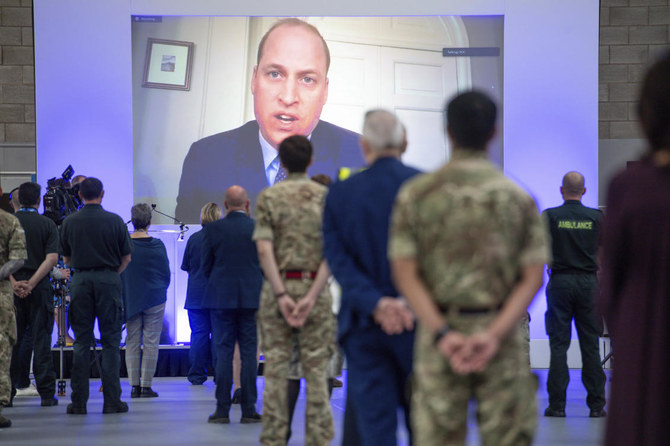
- "It is too early to make a change," Health Secretary Matt Hancock told BBC


26 Doctors without Borders workers remain unaccounted for in South Sudan a month after attacks
- A hospital in the town of Lankien was bombed by government forces, MSF said
- “We have lost contact with them amid ongoing insecurity”
NAIROBI: More than two dozen Doctors Without Borders workers remain unaccounted for a month after attacks in South Sudan, the medical charity said.
Two facilities belonging to the group, known by French acronym MSF, were attacked on Feb. 3 in Jonglei State, northeast of the capital, Juba, where violence has displaced an estimated 280,000 people since December.
A hospital in the town of Lankien was bombed by government forces, MSF said, while another medical facility in the town of Pieri was raided by “unknown assailants.” Both were located in opposition-held areas.
Staff working at the two facilities fled alongside much of the local population into deeply rural areas where armed clashes and aerial bombardments were ongoing.
MSF said in a statement on Monday that “26 of 291 of our colleagues working in Lankien and Pieri remain unaccounted for.
“We have lost contact with them amid ongoing insecurity,” it said.
The lack of communication with its staff could be linked to the limited network connectivity in much of the state. Staff members who had been contacted described “destruction, violence and extreme hardships.”
Fighting escalated sharply in December, when opposition forces captured a string of government outposts in north central Jonglei. In January, the government responded with a counteroffensive that recaptured most of the area it had lost.
Displaced people in Akobo, an opposition-held town near the Ethiopian border, described horrific violence by government fighters. Many described not being able to find food or water as they walked for days to reach safety.
The attacks on MSF facilities in Lankien and Pieri are part of an uptick in violence on humanitarian staff, supplies and infrastructure, aid groups say. MSF facilities have been attacked 10 times in the last 12 months.
“This violence has taken an unbearable toll not only on health care services, but on the very people who kept them running,” said Yashovardhan, MSF head of mission in South Sudan, who only uses one name.
“Medical workers must never be targets,” he said. “We are deeply concerned about what has happened to our colleagues and the communities we serve.”