

Pandemic mars Easter for Pakistani Christians in slums

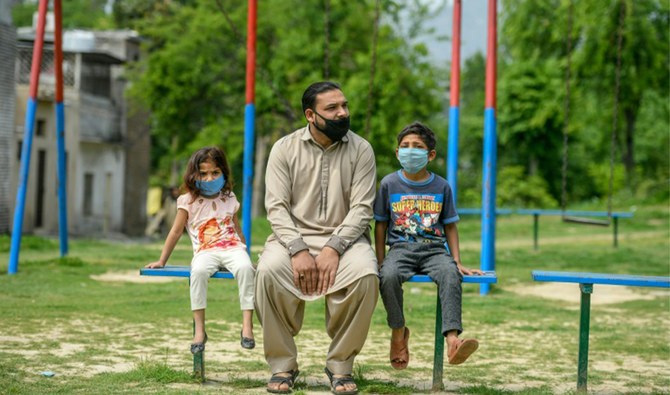
Aamir Gill (C), a cleaner and member of Pakistan's Christian underclass, was fired with no warning days after the coronavirus crisis took hold in Pakistan. (AFP)
Short Url
Updated 11 April 2020
Follow

Pandemic mars Easter for Pakistani Christians in slums

  • The pandemic and ensuing lockdown has left many Pakistani Christians without jobs
  • Some from the community tune into online services, while others join neighbours on rooftops singing hymns in unison

ISLAMABAD: Days after the coronavirus crisis took hold in Pakistan, Aamir Gill, a cleaner and member of the country’s Christian underclass, was fired with no warning or severance by the wealthy family he had helped look after.
Many other Christians — who live a hand-to-mouth existence in the Islamic country — have also been laid off and, with little access to government help, are wondering how they will survive.
“We were already untouchables and now due to corona, rich people think the poor might bring it into their homes,” Gill told AFP ahead of an uncertain Easter.
Along with two other servants, he worked at a large house in the capital — mostly to clean up after parties.
“I have no idea how many bedrooms it had but it was big,” explained Gill, who lives in Islamabad’s Christian slums in a cramped one-room home with his family of four.
“My kids asked me for new Easter dresses and shoes but I have told them we are not going to have Easter this year.”
Christians — who comprise roughly two percent of the population — occupy one of the lowest rungs in class-obsessed Pakistan.
Most work menial jobs without contracts as street sweepers, cleaners and cooks and live in crowded, multi-generational households where social distancing is all but impossible.
Their worsening plight means the Easter — which normally marks rebirth, springtime and abundance — will be filled with “depression and despair,” said Haroon Ashraf.
“The coronavirus has snatched away the bit of bread we had,” said the 25-year-old, who lost his restaurant job when the virus hit.
Along with his brother, who is also now jobless, he is supporting a family of seven that is squeezed into a two-room flat.
He was hoping to apply for financial relief from the state, but was hindered by being unable to read.
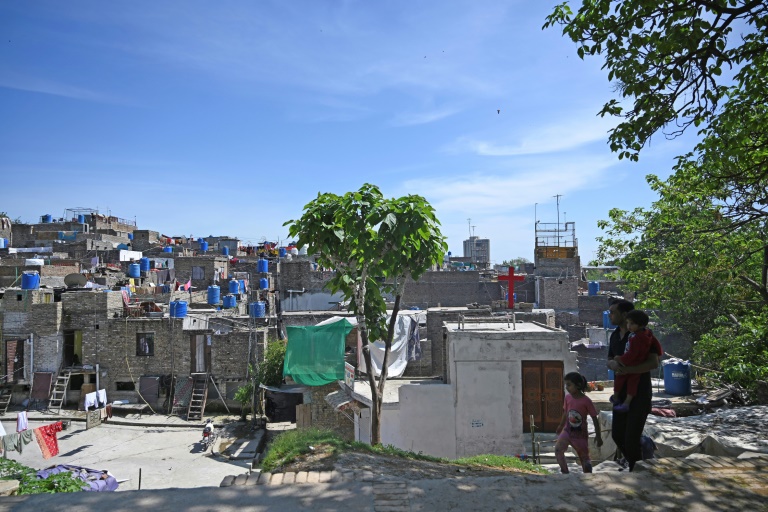


Christians occupy one of the lowest rungs in class-obsessed Pakistan, and most live in crowded slums where social distancing is all but impossible. (AFP)

Pakistan’s Christian community largely descended from low-caste Hindus who converted, resulting in persistent caste stigmas and discrimination.
For decades, they have been subjected to violent attacks by Islamists, and tarred with blasphemy allegations that they are mostly helpless to deflect and often result in lynchings.
They often live in impoverished “colonies” in urban centers, including in the capital Islamabad where the slums are sandwiched between the wealthiest neighborhoods.
The loss of a job or an unexpected medical bill frequently sends families into spiralling debt in the absence of strong safety nets in the deeply impoverished country of 215 million.
“In this crisis, where they are confined to crowded spaces with few resources, they cannot be left to face a cruel choice between starvation and infection,” said Omar Waraich, deputy regional director for South Asia at Amnesty International.
The pandemic and ensuing lockdown means lively Easter Sunday services and celebrations usually spent in churches inside the maze-like slums will be abandoned.
Christians in Pakistan with smartphones have tuned into online services while others have joined neighbors on their rooftops, where sermons are yelled and hymns are sung in unison.
For Sharoon Shakeel, this Easter season has been ladened with misery after the recent death of his father, followed by losing his job.
“We are running out of food,” said Shakeel, who was already in debt from the funeral costs. “How can we celebrate Easter?“


At Islamabad conference, Pakistan pitches agriculture as next frontier for Chinese investment

Updated 6 sec ago
Follow

At Islamabad conference, Pakistan pitches agriculture as next frontier for Chinese investment

  • Hundreds of Chinese and Pakistani firms attended the event focusing on fertilizers, seeds, smart farming and irrigation techniques
  • PM Sharif urges Pakistani farmers, businesses and universities to engage with Chinese institutions and experts to modernize agriculture

ISLAMABAD: Prime Minister Shehbaz Sharif on Monday pitched Pakistan’s agriculture sector as the next major frontier for Chinese investment, highlighting opportunities in agri-business, food processing and farming technologies.

The prime minister said this while addressing the Pakistan-China Agriculture Investment Conference, which brought together Chinese and Pakistani agriculturists, entrepreneurs, experts, academicians and government officials.

Hundreds of Chinese and Pakistani firms attended the event that focused on fertilizers, seed varieties, machinery, precision farming and smart irrigation systems, according to the organizers.

Sharif said China had never shied away from providing Pakistan with best possible expertise and technologies, and both sides had signed several memorandums of understanding (MoUs) at similar summits in Shandong and Beijing in last two years.

“I was very happy to express my satisfaction over the progress we are making in terms of converting these MOUs into agreements,” he said. “Today’s conference is a clear indication that Chinese business houses are more than willing to shake hands with Pakistani business houses.”

The conference was billed by Pakistan’s Ministry of National Food Security and Research as a platform for deepening bilateral agricultural ties and supporting broader economic engagement between the two countries.

Sharif called on Pakistani farmers, agribusinesses and universities to actively engage with Chinese institutions and experts to modernize the agriculture sector, which accounts for 24 percent of Pakistan’s GDP and employs over 37 percent of its labor force.

“Chinese experts are there to assist us and support us all the way to achieve this wonderful target [of becoming a surplus agricultural economy],” he said. “Now it’s up to us to generate this trade surplus through higher yields, comparative cost and, of course, highest quality.”

Pakistan and China have been expanding cooperation in agriculture under the China-Pakistan Economic Corridor framework, with a focus on mechanization, high-yield seeds, livestock development and value-added food processing.

Officials say stronger agricultural ties could help Pakistan boost exports, ensure food security and create jobs, while offering Chinese companies access to a large farming market and new investment opportunities.

The prime minister noted that Pakistan’s policy rate was down to 10.5 percent down from 22 percent two years ago, exports were gradually increasing and macroeconomic indicators were stable.

“Now we have to move toward growth,” he said. “But then it requires solid, hard work, untiring efforts, blood and sweat. Without that, you will not be able to achieve your targets.”

The Pakistan-China Agriculture Investment Conference focused on technology transfer and joint ventures in farming, food processing and agricultural research.

“I would urge upon Pakistani farmers, Pakistani agri-houses, experts, professors, technicians, that please come forward and show your best to your [Chinese] brothers and sisters,” Sharif said.

“China is ready, ladies and gentlemen, to support Pakistan like always in the past. Let us make use of this opportunity. Let us stand up and accept this challenge and make Pakistan great through untiring efforts, through hard work.”