

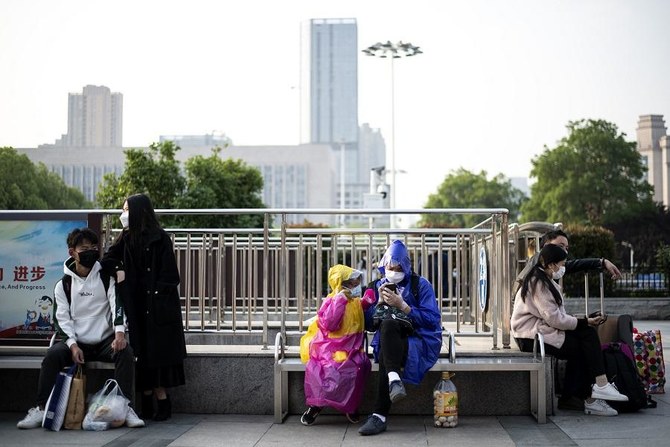
Wuhan exodus sparks virus hope despite mounting death toll

People wearing face masks sit outside Hankou Railway Station in Wuhan as people arrive in the hope of taking one of the first trains leaving the city in China's central Hubei province early on April 8, 2020. (File/AFP)
Short Url
Updated 08 April 2020
Follow

Wuhan exodus sparks virus hope despite mounting death toll

  • China has come under fire for its handling of the coronavirus crisis that originated there late last year
  • Its march across the planet has affected every level of society, with Britain’s Prime Minister Boris Johnson fighting the illness in intensive care

WUHAN, China: Thousands of relieved citizens streamed out of China’s Wuhan on Wednesday after authorities lifted months of lockdown at the coronavirus epicenter, offering some hope to the world despite record deaths in Europe and the United States.

China has come under fire for its handling of the coronavirus crisis that originated there late last year and President Donald Trump threatened to cut US funding to the World Health Organization over perceived bias toward Beijing.

From Wuhan, the coronavirus spread rapidly to infect nearly every country on Earth, killing more than 80,000, battering the global economy and forcing around half of humanity into some form of lockdown.

Its march across the planet has affected every level of society from workers to royals, with Britain’s Prime Minister Boris Johnson fighting the illness in intensive care.

But the joy of people finally free to leave — many of them queuing up to depart in hazmat suits — provided some cheer to a gloomy world, offering proof the virus would not last forever.

“You have no idea! I was already up around 4am. I felt so good. My kids are so excited. Mum is finally coming home,” said Hao Mei, a 39-year-old single mother rushing to nearby Enshi to see her young children for the first time in two months.

“I’ve been stuck for 77 days! I’ve been stuck for 77 days!” shouted one man, who arrived at the railway station for a train back to his home province of Hunan.

A robot whizzed through crowds of passengers at the station, spraying their feet with disinfectant and playing a recorded message reminding them to wear face masks.

While China celebrated its first day without coronavirus deaths on Tuesday, the relentless disease chalked up fresh milestones in hard-hit areas of Europe and the US.

A total of 1,939 people died in the US over the past 24 hours, according to a tally by Johns Hopkins University, as the country approaches tolls in worst-hit Italy and Spain.

Virus deaths hit a new daily high in Britain, where 55-year-old leader Boris Johnson was said to be “stable” and in “good spirits” despite receiving oxygen treatment in intensive care.

And Paris toughened its lockdown measures, banning daytime jogging to keep people from bending the rules as France breached 10,000 deaths.

In New York, Governor Andrew Cuomo said the state appeared be nearing the peak of its pandemic but urged citizens to continue staying indoors.

Trump, under fire for his own response to the virus, lashed out at the WHO and said there would be a “hold on money” provided to the UN body, which he accused of being “very China-centric.”

Exhausted medical staff around the world are battling with a stream of patients as makeshift hospitals spring up on ships, at hotels and even in a New York cathedral.

In Barcelona, Antonio Alvarez, a 33-year-old nurse working in intensive care, said his experience of the pandemic was akin to bereavement.

“I’ve had my phases of anger, of denial, you go through all of them.

“Now we are still a little overwhelmed but it is better. Fewer patients are dying,” he told AFP.

The global economy is also on life support as governments pour in unprecedented sums to stem the worst crisis many countries have seen in a century.

While Japan agreed a stimulus package worth around $1 trillion, a divided eurozone is battling over whether to pool debt for “coronabonds” to prop up the economy.

Individuals have also stepped in, with Twitter co-founder and chief executive Jack Dorsey committing $1 billion of his personal fortune to the coronavirus fight.

And the stock market continued its rollercoaster ride, the Dow Jones index soaring around 1,000 points on Tuesday before ending up slightly lower.

The UN’s International Labour Organization said 81 percent of the world’s 3.3 billion-strong workforce is now affected by “the worst global crisis since the Second World War.”

“We don’t know how to feed our kids... and if, God forbid, something happens to any of them, I won’t be able to foot a hospital bill,” he said.
Others have been using their skills to try to lift the gloom.

In Copenhagen, a troupe of circus performers juggle and do tricks from a courtyard for those stuck at home and watching from their windows.


Mystery of CIA’s lost nuclear device haunts Himalayan villagers 60 years on

Updated 20 December 2025
Follow

Mystery of CIA’s lost nuclear device haunts Himalayan villagers 60 years on

  • Plutonium-fueled spy system was meant to monitor China’s nuclear activity after 1964 atomic tests
  • Porter who took part in Nanda Devi mission warned family of ‘danger buried in snow’

NEW DELHI: Porters who helped American intelligence officers carry a nuclear spy system up the precarious slopes of Nanda Devi, India’s second-highest peak, returned home with stories that sent shockwaves through nearby villages, leaving many in fear that still holds six decades later.

A CIA team, working with India’s Intelligence Bureau, planned to install the device in the remote part of the Himalayas to monitor China, but a blizzard forced them to abandon the system before reaching the summit.

When they returned, the device was gone.

The spy system contained a large quantity of highly radioactive plutonium-238 — roughly a third of the amount used in the atomic bomb dropped by the US on the Japanese city of Nagasaki in the closing stages of the Second World War.

“The workers and porters who went with the CIA team in 1965 would tell the story of the nuclear device, and the villagers have been living in fear ever since,” said Narendra Rana from the Lata village near Nanda Devi’s peak.

His father, Dhan Singh Rana, was one of the porters who carried the device during the CIA’s mission in 1965.

“He told me there was a danger buried in the snow,” Rana said. “The villagers fear that as long as the device is buried in the snow, they are safe, but if it bursts, it will contaminate the air and water, and no one will be safe after that.”

During the Sino-Indian tensions in the 1960s, India cooperated with the US in surveillance after China conducted its first nuclear tests in 1964. The Nanda Devi mission was part of this cooperation and was classified for years. It only came under public scrutiny in 1978, when the story was broken by Outsider magazine.

The article caused an uproar in India, with lawmakers demanding the location of the nuclear device be revealed and calling for political accountability. The same year, then Prime Minister Morarji Desai set up a committee to assess whether nuclear material in the area near Nanda Devi could pollute the Ganges River, which originates there.

The Ganges is one of the world’s most crucial freshwater sources, with about 655 million people in India, Nepal, and Bangladesh depending on it for their essential needs.

The committee, chaired by prominent scientists, submitted its report a few months later, dismissing any cause for concerns, and establishing that even in the worst-case scenario of the device’s rupture, the river’s water would not be contaminated.

But for the villagers, the fear that the shell containing radioactive plutonium could break apart never goes away, and peace may only come once it is found.

Many believe the device, trapped within the glacier’s shifting ice, may have moved downhill over time.

Rana’s father told him that the device felt hot when it was carried, and he believed it might have melted its way into the glacier, remaining buried deep inside.

An imposing mass of rock and ice, Nanda Devi at 7,816 m is the second-highest mountain in India after Kangchenjunga. 

When a glacier near the mountain burst in 2021, claiming over 200 lives, scientists explained that the disaster was due to global warming, but in nearby villages the incident was initially blamed on a nuclear explosion.

“They feared the device had burst. Those rescuing people were afraid they might die from radiation,” Rana said. “If any noise is heard, if any smoke appears in the sky, we start fearing a leak from the nuclear device.”

The latent fear surfaces whenever natural disasters strike or media coverage puts the missing device back in the spotlight. Most recently, a New York Times article on the CIA mission’s 60th anniversary reignited the unease.

“The apprehensions are genuine. After 1965, Americans came twice to search for the device. The villagers accompanied them, but it could not be found, which remains a concern for the local community,” said Atul Soti, an environmentalist in Joshimath, Uttarakhand, about 50 km from Nanda Devi.

“People are worried. They have repeatedly sought answers from the government, but no clear response has been provided so far. Periodically, the villagers voice their concerns, and they need a definitive government statement on this issue.”

Despite repeated queries whenever media attention arises, Indian officials have not released detailed updates since the Desai-appointed committee submitted its findings.

“The government should issue a white paper to address people’s concerns. The white paper will make it clear about the status of the device, and whether leakage from the device could pollute the Ganges River,” Soti told Arab News.

“The government should be clear. If the government is not reacting, then it further reinforces the fear.”