

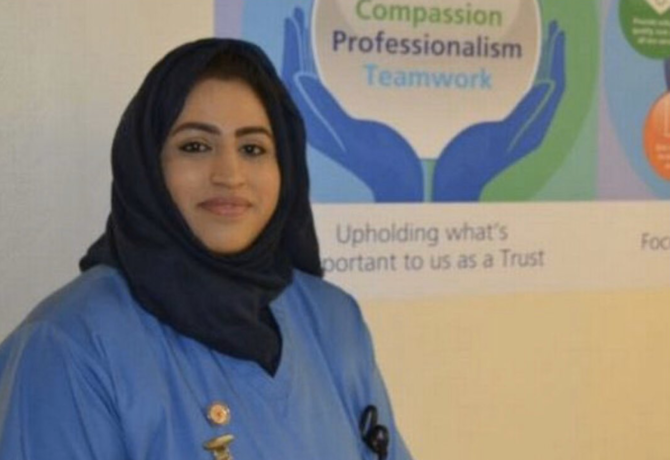
British-Pakistani nurse, 36, dies of coronavirus

British-Pakistani nurse Areema Nasreen died on April 3, 2020. (Dr Samara Afzal’s Twitter account)
Short Url
Updated 04 April 2020
Follow

British-Pakistani nurse, 36, dies of coronavirus

  • The mother of three, believed to have had no underlying health issues, first experienced symptoms on Mar. 13 and was later taken into intensive care
  • She showed slight signs of improvement last week but died in the early hours of Friday

LONDON: A 36-year-old NHS nurse died on Friday after being infected with coronavirus and fighting for her life in intensive care.
British-Pakistani Areema Nasreen had been placed on a ventilator at Walsall Manor Hospital in the West Midlands where she worked in the acute medical unit, the BBC reported.
The mother of three, believed to have had no underlying health issues, first experienced symptoms on Mar. 13 and was later taken into intensive care. She showed slight signs of improvement last week but died in the early hours of Friday.
Paying tribute to the nurse, Richard Beeken, chief executive of Walsall Healthcare NHS Trust, said Nasreen “was a professional, passionate nurse who started at the trust as a housekeeper in 2003 before working hard to gain her nursing qualification in January 2019.”
“Her dedication to her role and her popularity among her colleagues is obvious to see with the outpouring of grief and concern we are seeing around the organization and on social media. We will do everything that we can in the coming days and weeks to support those that need it,” he added.
Beekan said Nasreen always aimed to make a difference and that she “will be very sadly missed.”
Nasreen’s close friend Rubi Aktar, also a nurse, posted the news of her death on Facebook and described her as “the most loveliest, genuine person you could ever meet.” She added that her friend “above and beyond for everyone she met.”
“I’m so grateful that I had the honor to call her my best friend, she saw me at my best and my worst and accepted my every flaw. I am so broken that words can’t explain. I can’t believe I will not see your smile again,” Aktar wrote.
“You made me the nurse that I am today, with your support, motivation and inspiration I am the nurse that I am today and I hope I can do you proud Areema. I love you so much and I will never forget you. You had so much to live for, I am sorry you didn’t get to see your kids grow up and I’m sorry that you didn’t get to complete your career,” Aktar added.
Dr. Samara Afzal, a doctor who knew Nasreen, described her as a devoted nurse and “always full of life.”
“I’m lost for words..I beg you all to stay at home and keep everyone safe,” Afzal tweeted.

Meanwhile, England’s chief nurse Ruth May pleaded with Britons on Friday to stay at home over the weekend, invoking the names of Nasreen and another nurse, Aimee O’Rourke, who also died of coronavirus.   

"This weekend is going to be very warm and it will be very tempting to go out and enjoy those summer rays," May said.

"But please, I ask you to remember Aimee and Areema. Please stay at home for them," she said.

"They were one of us, they were one of my profession, of the NHS family," May said.

"They were clearly remarkable women, nurses and mothers," she added in a statement. 


Only 4% women on ballot as Bangladesh prepares for post-Hasina vote

Updated 19 min 5 sec ago
Follow

Only 4% women on ballot as Bangladesh prepares for post-Hasina vote

  • Women PMs have ruled Bangladesh for over half of its independent history
  • For 2026 vote, only 20 out of 51 political parties nominated female candidates

DHAKA: As Bangladesh prepares for the first election since the ouster of its long-serving ex-prime minister Sheikh Hasina, only 4 percent of the registered candidates are women, as more than half of the political parties did not field female candidates.

The vote on Feb. 12 will bring in new leadership after an 18-month rule of the caretaker administration that took control following the student-led uprising that ended 15 years in power of Hasina’s Awami League party.

Nearly 128 million Bangladeshis will head to the polls, but while more than 62 million of them are women, the percentage of female candidates in the race is incomparably lower, despite last year’s consensus reached by political parties to have at least 5 percent women on their lists.

According to the Election Commission, among 1,981 candidates only 81 are women, in a country that in its 54 years of independence had for 32 years been led by women prime ministers — Hasina and her late rival Khaleda Zia.

According to Dr. Rasheda Rawnak Khan from the Department of Anthropology at Dhaka University, women’s political participation was neither reflected by the rule of Hasina nor Zia.

“Bangladesh has had women rulers, not women’s rule,” Khan told Arab News. “The structure of party politics in Bangladesh is deeply patriarchal.”

Only 20 out of 51 political parties nominated female candidates for the 2026 vote. Percentage-wise, the Bangladesh Socialist Party was leading with nine women, or 34 percent of its candidates.

The election’s main contender, the Bangladesh Nationalist Party, whose former leader Zia in 1991 became the second woman prime minister of a predominantly Muslim nation — after Pakistan’s Benazir Bhutto — was the party that last year put forward the 5 percent quota for women.

For the upcoming vote, however, it ended up nominating only 10 women, or 3.5 percent of its 288 candidates.

The second-largest party, Jamaat-e-Islami, has not nominated a single woman.

The 4 percent participation is lower than in the previous election in 2024, when it was slightly above 5 percent, but there was no decreasing trend. In 2019, the rate was 5.9 percent, and 4 percent in 2014.

“We have not seen any independent women’s political movement or institutional activities earlier, from where women could now participate in the election independently,” Khan said.

“Real political participation is different and difficult as well in this patriarchal society, where we need to establish internal party democracy, protection from political violence, ensure direct election, and cultural shifts around female leadership.”

While the 2024 student-led uprising featured a prominent presence of women activists, Election Commission data shows that this has not translated into their political participation, with very few women contesting the upcoming polls.

“In the student movement, women were recruited because they were useful, presentable for rallies and protests both on campus and in the field of political legitimacy. Women were kept at the forefront for exhibiting some sort of ‘inclusive’ images to the media and the people,” Khan said.

“To become a candidate in the general election, one needs to have a powerful mentor, money, muscle power, control over party people, activists, and locals. Within the male-dominated networks, it’s very difficult for women to get all these things.”