

Britain's Prince Charles opens new 4,000-bed coronavirus field hospital in London

1 / 2
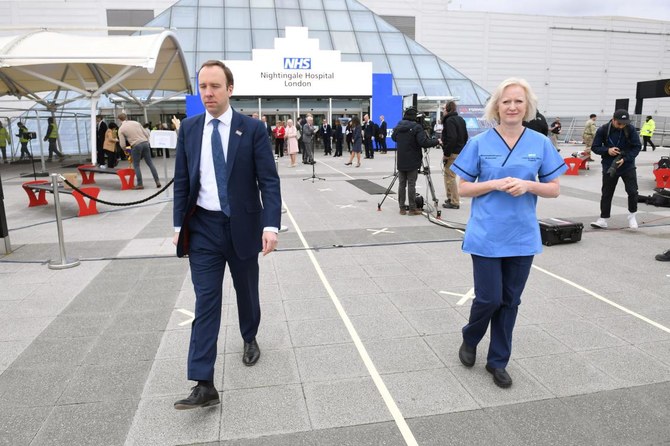
Health Secretary Matt Hancock and Ruth May, chief nursing officer for England attend the opening of the NHS Nightingale Hospital at the ExCel centre, due to the spread of coronavirus disease (COVID-19), in London, Britain April 3, 2020. (Reuters)
2 / 2
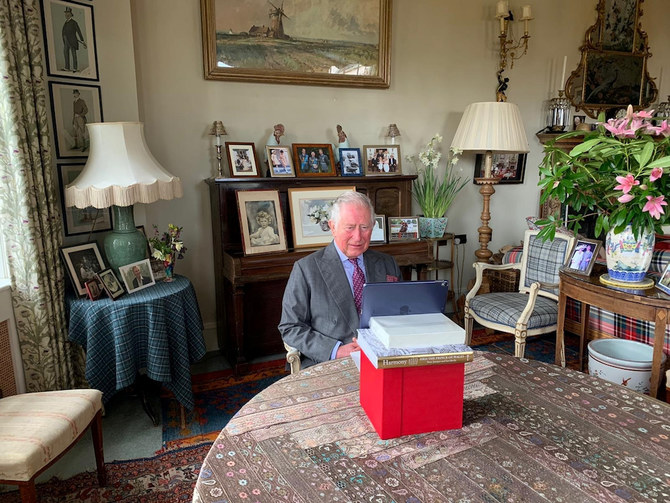
Britain's Prince Charles, who is known as the Duke of Rothesay when in Scotland, sends a video message to the guests at the opening of the NHS Nightingale Hospital in London, from his home in Birkhall, Scotland, Britain April 3, 2020. (Reuters)
Short Url
Updated 03 April 2020
Follow

Britain's Prince Charles opens new 4,000-bed coronavirus field hospital in London

  • The new state-run hospital is named after the trailblazing 19th-century nurse Florence Nightingale and has been built in just nine days
  • The size of 10 district general hospitals, the new facility has more than 80 wards, each containing 42 beds, and when fully operational will require more than 16,000 staff to run

LONDON: Prince Charles opened a new 4,000-bed temporary hospital in a conference center in east London on Friday, the first of several being built in Britain to deal with the coronavirus outbreak.
The new state-run National Health Service (NHS) Hospital is named after the trailblazing 19th-century nurse Florence Nightingale and has been built in just nine days.
Queen Elizabeth II’s eldest son and heir officially launched the facility via videolink from Scotland, where he has been in self-isolation after testing positive for COVID-19.
He paid tribute to everyone involved, calling it “quite frankly incredible” to have transformed the giant ExCeL center into a critical care facility in such a short space of time.
“I was one of the lucky ones to have COVID-19 relatively mildly,” he said. “But for some, it will be a much harder journey.
“I am therefore so relieved that everyone can now have the reassurance that they will receive all the necessary technical care they may need, and every chance to return to a normal life.”
With Nightingale often named “The Lady of the Lamp” and seen as one of the founders of modern nursing, he said the name was appropriate.
“In this dark time, this place will place will be a shining light,” the prince said, but added that he hoped it would not required for long.

NHS Nightingale London will initially take 500 people in the coming days, said Health Secretary Matt Hancock, who has also tested positive for COVID-19.
It will take intensive care patients with COVID-19 from other London hospitals, which have seen the most number of cases across Britain.
The size of 10 district general hospitals, the new facility has more than 80 wards, each containing 42 beds, and when fully operational will require more than 16,000 staff to run.
Hancock praised the NHS, a taxpayer funded service free at the point of use, which has been struggling in recent years as a result of public spending cuts.
“In these troubled times, with this invisible killer stalking the whole world, the fact that in this country we have the NHS is even more valuable than before,” he said.
Temporary hospitals are also being built in exhibition centers in the cities of Birmingham and Manchester, with capacity of up to 3,000 beds between them.
A third is under construction in Glasgow and plans are also in place to build two more in Bristol, in western England, and the northern city of Harrogate offering 1,500 beds.
NHS England chief executive Simon Stevens said he hoped the extra two sites would not be needed.
“That will partly depend on continuing public support for measures to reduce growth in the infection rate by staying at home to save lives,” he said in a statement.
Britons have been told to stay at home wherever possible and non-essential shops and services have been shut since March 23, as part a nationwide lockdown designed to stem the spread of coronavirus.
However, health officials say the measures will take time to have an effect and the death toll continues to mount rapidly, reaching 2,921 on Wednesday.


Starmer says US planes flying out of UK bases ‘special relationship in action’

Updated 11 sec ago
Follow

Starmer says US planes flying out of UK bases ‘special relationship in action’

  • “British jets are shooting down drones and missiles to protect American lives in the Middle East on our joint bases,” Starmer said
  • “Hanging on to President Trump’s latest words is not the special relationship”

LONDON: Prime Minister Keir Starmer on Wednesday defended his handling of the US-Israeli war against Iran after President Donald Trump launched a scathing attack over the British leader’s initial refusal to allow the Americans to use UK air bases.
“American planes are operating out of British bases. That is the special relationship in action,” he told parliament.
“British jets are shooting down drones and missiles to protect American lives in the Middle East on our joint bases. That is the special relationship in action, sharing intelligence every day to keep our people safe,” he said.
“Hanging on to President Trump’s latest words is not the special relationship,” he added.
Trump described the historical relationship between the US and Britain as “not like it used to be” in an interview published Tuesday.
Hours later he stepped up his criticism saying “this is not Winston Churchill that we’re dealing with.”
“The UK has been very, very uncooperative,” he said while seated next to German Chancellor Friedrich Merz at the White House.
“I’m not happy with the UK,” he said. “It’s taken three, four days for us to work out where we can land.”
Starmer — who told parliament on Monday his government “does not believe in regime change from the skies” — drew Trump’s wrath by initially refusing to have any role in Washington’s war with Iran.
He later agreed to a US request to use two British military bases for a “specific and limited defensive purpose.”
Starmer has cultivated a warm relationship with the unpredictable Trump, who was given an unprecedented second state visit to Britain last year.
The so-called special relationship between the World War II allies is largely built on long-standing defense cooperation and intelligence sharing.
But any potential military action in the Middle East is politically sensitive in the UK following former prime minister Tony Blair’s disastrous support for the US-led invasion of Iraq in 2003.