

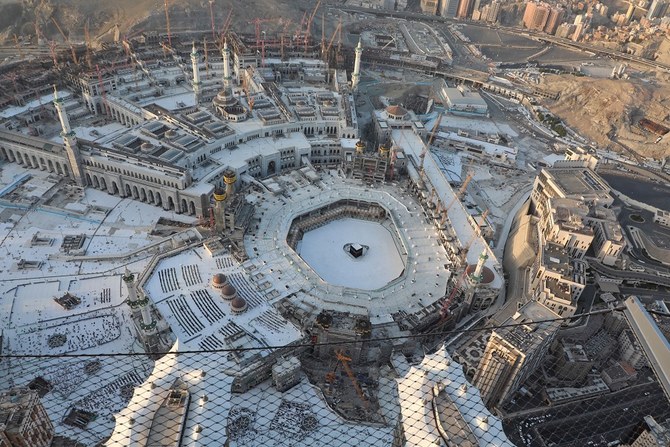

JEDDAH: Saudi Arabia’s two holy cities, Makkah and Madinah, have been put under a 24-hour curfew as of Thursday April 2, until further notice.
Col. Talal Al-Shalhoub, the Ministry of Interior spokesman, said that the decision to raise the preventive measures taken against the coronavirus disease (COVID-19) is to protect the health of residents in the two cities.
The curfew is applicable to all parts of Makkah and Madinah. The curfew does not apply to those working in key occupations in the private or governmental sector who were previously exempted.
Adult residents of Makkah and Madinah are only allowed to leave their houses in dire emergencies, such as health care and food supplies and only around their districts from 6 a.m. to 3 p.m. In case of going out in a four-wheeler, only the driver and another person are allowed out to limit human contact as much as possible.
“A mechanism will be deployed soon on how to use banking services and ATM machines in accordance with the Saudi Arabian Monetary Authority, Ministry of Interior and Ministry of Health,” said the spokesman.
All commercial activity is to be put on hold in these two cities, except for pharmacies, supermarkets, petrol stations and banking services.
Al-Shalhoub encouraged people to use phone applications to order food and grocery supplies. He also spoke about the few cases of curfew breaking, saying that the numbers are small in comparison to those who are keeping themselves and their loved ones safe by staying indoors.
“The Ministry of Interior will not tolerate those who do not abide by curfew regulations and show off their insubordination openly on social media outlets, whoever they may be,” said Al-Shalhoub.
The move comes at a time when the number of new COVID-19 cases in two cities — 48 cases in Makkah and 46 in Madinah — are the highest in the Kingdom.
The Health Ministry’s spokesperson, Dr. Mohammed Al-Abd Al-Aly, announced 165 new cases — two of which are related to traveling and have been quarantined.
The overall number confirmed cases is 1,885 — 1,536 of which are active.
Al-Aly announced five further deaths, bringing the total number to 21. The 64 recoveries makes the total number 328.
“The preventive measures taken by the Kingdom must be maintained, as they’ve helped us all keep our numbers low — we don’t want our elderly or young to suffer,” said Al-Abd Al-Aly.
He addressed the cities that have not recorded any coronavirus cases yet and encouraged them to practice self-isolation.
“No community is immune; they could be in an incubation stage right now, and symptoms can start showing later on,” he added.


