WASHINGTON: President Donald Trump has extended emergency coronavirus restrictions for the United States, where his top scientist warned up to 200,000 people could die, as the Russian capital and Africa’s biggest city readied to go into lockdown on Monday.
The reassessment by Trump, who had previously said he wanted the country back to work in mid-April, came as Britain and hard-hit Italy warned measures to prevent the spread of the disease would be in place for months to come.
COVID-19 has already killed more than 33,000 people worldwide, with the number of confirmed cases nearing 700,000.
As of Sunday, more than 3.38 billion people were asked or ordered to follow confinement measures, according to an AFP database, as the virus infects every sphere of life — wiping out millions of jobs, postponing elections and clearing the sporting calendar.
Trump warned that the US crisis, which has seen a doubling of infections in only two days, would continue to get worse.
“The modelling estimates that the peak in death rate is likely to hit in two weeks,” he said, announcing an extension of social distancing guidelines until April 30.
“Nothing would be worse than declaring victory before the victory is won.”
The president was speaking after Anthony Fauci, who leads research into infectious diseases at the National Institutes of Health, said he believed 100,000 to 200,000 Americans could die from the disease, and millions could be infected.
The US health system is groaning under the weight of new cases.
On Sunday a charity began setting up a field hospital in New York’s Central Park to help take some of the strain off the city’s overwhelmed institutions.
“There’s lots of cases here in New York and a lot of people that need help,” said Elliott Tenpenny, a doctor and team leader for Samaritan’s Purse COVID-19 Response Team.
“The hospitals all over the city are filling up and they need as much help as they can get. That’s why we’re here.”
The human consequences of a shutdown that has seen huge chunks of the US economy grind to a halt were playing out at food banks, where organizers say demand has exploded.
“Before, there were 1.2 million people in New York who needed help for food. Now, there are three times as many,” said Eric Ripert of City Harvest, a food rescue organization.
Trump’s re-evaluation of a back-to-normal timeline came as Europe’s situation continued to worsen.
Spain logged 838 deaths in a 24-hour period, the third consecutive day it has seen a rise.
“My ICU (intensive care unit) is completely full,” said Eduardo Fernandez, a nurse at Infanta Sofia hospital in Madrid, where authorities have set up a 5,500-bed field hospital and transformed an ice rink into a morgue.
“If it is not a complete collapse, we are on the verge,” he added.
British officials said life may not return to usual for six months, with Deputy Chief Medical Officer Jenny Harries saying it would be several weeks before doctors could tell if the current lockdown had slowed the spread of the disease.
Measures would be reviewed every three weeks, “probably over the next six months” or even longer, she said.
In Italy, which has logged a third of global deaths, the government warned citizens should be ready for a lengthy lockdown that would only be lifted gradually.
“We are in a very long battle,” said government medical adviser Luca Richeldi. “Through our behavior, we save lives.”
Yet the strains on Italian society imposed by measures that might have seemed unimaginable just weeks ago are gradually starting to show.
The starkest example came when armed police began guarding entrances to supermarkets in Sicily after reports of looting by people who could no longer afford food.
Moscow became the latest European city to tell people to stay indoors.
Citizens will only be allowed to leave their homes in a medical emergency, to travel to jobs judged essential by the authorities, and to shop for food or medicines.
They will, however, be allowed to walk their dogs within a 100-meter radius of their homes.
Africa’s biggest city, Lagos, was due to join the global stay-at-home from Monday, with Nigerian President Muhammadu Buhari ordering a two-week lockdown for its 20 million people.
The measures also apply to the capital Abuja.
Nigeria, Africa’s most populous nation with some 190 million people, has so far registered just 97 confirmed infections and one death from COVID-19, but testing has been limited.
Officials have warned that the country risks seeing an “exponential” rise in cases unless contacts of suspected carriers are tracked down faster.
Enforcing a total lockdown will be a mammoth challenge for authorities in a country where tens of millions live in poverty and rely on their daily earnings to survive.
The same holds true for large parts of Africa.
In Benin, President Patrice Talon said his country could not enforce public confinement because it lacks the “means of rich countries.”
Aid groups have warned that the coronavirus toll in the developed world could pale compared with the devastation it wreaks on defenseless populations in poor states and war zones such as Syria and Yemen.
Three billion people around the world lack access to running water and soap, the most basic weapons of protection against the virus, according to UN experts.


![]()
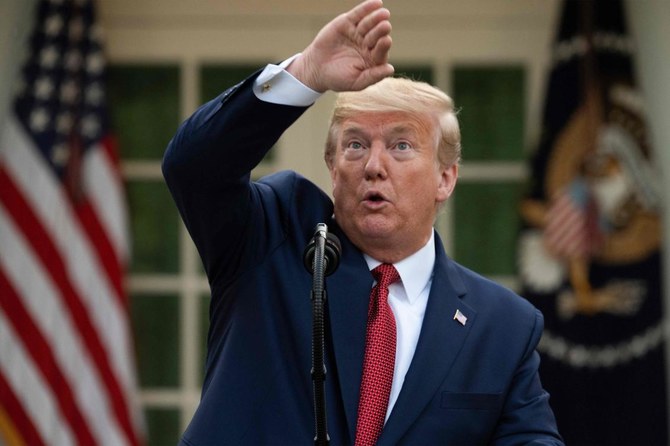
Donald Trump ditches hopes of quick coronavirus bounce-back for US

Short Url
https://arab.news/vyzwn
Donald Trump ditches hopes of quick coronavirus bounce-back for US
- ‘Nothing would be worse than declaring victory before the victory is won’
- Donald Trump’s re-evaluation of a back-to-normal timeline came as Europe’s situation continued to worsen


Latest updates


© 2026 SAUDI RESEARCH & PUBLISHING COMPANY, All Rights Reserved And subject to Terms of Use Agreement.