



SAN FRANCISCO: There are offers to pick up groceries or medicine for neighbors, to share supplies, or walk people’s dogs — and even intel on where to find scarce items like toilet paper.
For people forced to stay home to ride out the coronavirus pandemic, Nextdoor, a hyperlocal social network, has found itself playing an increasingly important role.
Daily usage of the network — an ad-supported privately held startup which touts itself as a local alternative to Facebook — soared 80 percent in March as people looked to connect more with neighbors.
“What we are seeing is proximity matters more than anything right now,” Nextdoor CEO Sarah Friar told AFP. “There is a real need in our lives for people who live close by.”
Nextdoor is free. The only caveat is that users must verify who they are and live in the real-world location that comports with the boundaries of the online neighborhood network they wish to join.
Launched in late 2011 as a variation on town squares where people could get to know neighbors and catch up on local news, San Francisco-based Nextdoor now boasts 260,000 neighborhoods across 11 countries including Australia, Britain, France, Italy, Spain, and the US.
“I am really touched by the amount of community spiritedness; people helping out, shopping for one another,” said Nextdoor user Paulina Borsook.
Borsook lives on a hill overlooking Monterey Bay on the edge of Silicon Valley, and is among those grappling with not venturing outside because their age makes it risky in a time of coronavirus. “I am used to getting lemons from neighbors, but relying on them for groceries is much different,” she said.
Earlier this month, Nextdoor launched an interactive “help map” which lets people indicate how they are able to help with chores, errands or other needs.
“Happy to do any errands that don’t require heavy lifting,” one user in the suburbs of the US capital wrote. “I’m a fantastic grocery shopper too!“
Nextdoor users share word of which restaurants have take-away food, what precautions are in place at local markets — and even ideas to soothe one another at a stressful time.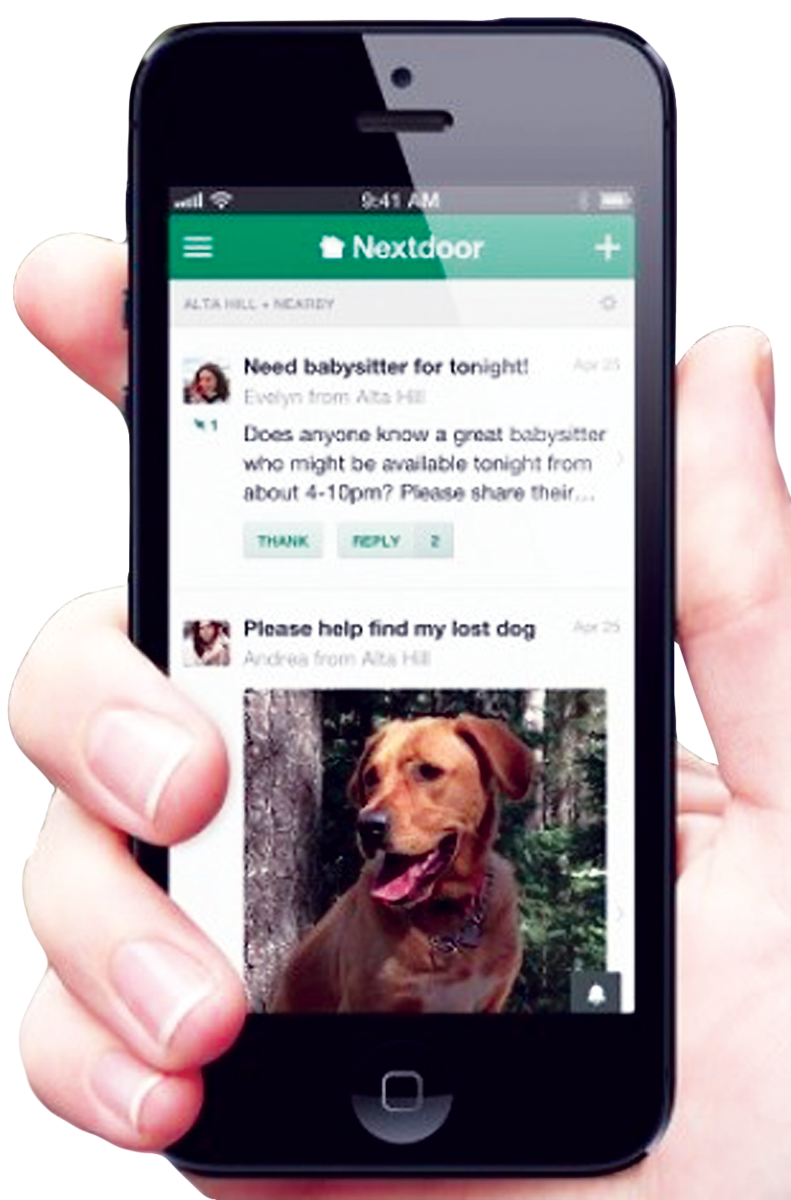
“I will be putting our Christmas lights back up tomorrow to add some cheer back to the neighborhood,” read a Nextdoor post in a Santa Cruz county community.
“They aren’t super elaborate, but I think it will give us all something beautiful to look at night while walking. Please join me.”
Nextdoor is also being used as a platform to support local businesses, collect donations for food banks, and connect parents dealing with educating children at home because schools are closed.
“There is genuine isolation, loneliness, but there is also kindness kicking in,” Friar said. “Usage is off the charts at the moment.”
HIGHLIGHTS
● Launched in late 2011 as a variation on town squares where people could get to know neighbors and catch up on local news, San Francisco-based Nextdoor now boasts 260,000 neighborhoods across 11 countries including Australia, Britain, France, Italy, Spain, and the US.
● ‘Nextdoor’ is also being used as a platform to support local businesses, collect donations for food banks, and connect parents dealing with educating children at home because schools are closed.
Nextdoor has long collaborated with agencies and governments to connect with local citizens, positioning it as a hub for local news and resources. It has been used in the past by the US Census Bureau and Federal Emergency Management Agency.
Now, the California governor’s office is using the social network to provide neighborhood-specific updates about what the state knows and is doing regarding the coronavirus.
“I find it really valuable for hyperlocal news,” Borsook said of Nextdoor, adding that neighbors are posting information “I am not getting anywhere else.”
While Nextdoor watches for misinformation or scams, it benefits from being based on verifying that those who join the social network are who they say they are and live where they say they do.
“The underpinnings are strong from a trust perspective,” Friar said. “When people post, they post with real names so you have more accountability.”
Neighbors can report dubious content to the social network while also directly challenging it in the online community.
“If you post something nonsensical, people will call you out on it,” Borsook said.
“There is more a sense of ‘we are all in this together.’”
Like Facebook, Nextdoor has seen advertising dip due to the economic disruption of sheltering-in-place, but it is also catching the eyes of restaurants, health care facilities, insurers and other businesses adapting to the crisis.
“We do, clearly, have advertisers on the platform that have pulled back,” Friar said.
“On the other side, we are seeing companies lean in that didn’t know us before and want to be there in this moment.”


