

Drastic decline in new coronavirus cases in Saudi Arabia’s Qatif

Prince Faisal bin Khalid bin Sultan bin Abdul Aziz, governor of the Northern Borders Region, visits the command and control center on Sunday, which has been established by the health authorities to contain the coronavirus. (SPA)
Short Url
Updated 23 March 2020
Follow

Drastic decline in new coronavirus cases in Saudi Arabia’s Qatif

  • 119 new cases reported pushing the total to 511

JEDDAH: Following strict precautionary measures, the number of new coronavirus cases in the eastern Saudi city of Qatif has drastically fallen.

The city was locked down two weeks ago to contain the spread of the virus, and so far only four new cases have been reported, said Saudi health authorities on Sunday.
The current situation in Qatif shows that the spread of the virus in the city has been contained due to the steps taken by the authorities, said Health Ministry spokesman Dr. Mohammed Al-Abd Al-Aly at a press conference. “The infection rate has fallen, which is very reassuring for the people of Qatif,” he added.
The ministry confirmed 119 new cases nationwide on Sunday, pushing the total number in the country to 511.
Most of the cases reported on Sunday had been in contact with those who had earlier contracted the virus, a trend the spokesman described as “worrying.”
Of the 119 new cases, 72 were reported in Makkah and are Turkish nationals. “All of them were infected from people who had earlier tested positive for the virus,” the spokesman said.
Another 40 of the new cases were involved in a social gathering with previously announced cases.
Al-Aly stressed that people must limit their movements, stay home, and avoid gatherings and activities of any kind.
“This is unfortunate. We’ve repeatedly warned against social gatherings, whether inside or outside homes. Even a group of 10 people or less is dangerous,” he said, adding that further preventive measures, such as a curfew in any other area of the country, cannot be ruled out.
He stressed that everyone who is instructed to remain in quarantine should commit to the 14-day period.
The number of people currently in quarantine and domestic isolation under the ministry’s mentorship is 4,000, while the cumulative total exceeds 10,000.
“It isn’t enough to maintain personal hygiene and avoid contact. All of these measures are important but not enough. Contact is very dangerous for adults, young people and children alike. Please be careful,” Al-Aly said.
“The matter isn’t limited to the efforts of governments. Everyone must be aware of their responsibility to protect themselves and those around them.”
He urged citizens and residents to avoid traveling between cities unless absolutely necessary. He also invited everyone to benefit from the ministry’s services, such as its hotline 937, and its Mawid and Seha apps.
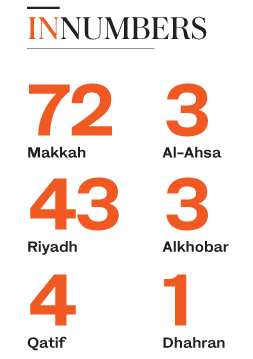
The city-wise breakdown of the new cases of coronavirus is Makkah (72), Riyadh (43), Qatif (4), Al-Ahsa (3), Alkhobar (3), Dhahran (1) and Dammam (1).


Deals worth $8bn signed at World Defense Show 2026

Updated 5 sec ago
Follow

Deals worth $8bn signed at World Defense Show 2026

  • Five-day event brought together 1,486 exhibitors from 89 countries and attracted 137,000 visitors

RIYADH: More than 60 military and defense deals worth SR33 billion ($8.8 billion) were signed at the third edition of the World Defense Show, which ended on Thursday in Riyadh.

The flagship defense exhibition is part of Saudi efforts to expand its military industries sector.

Organized by the General Authority for Military Industries, the five-day event brought together 1,486 exhibitors from 89 countries and attracted 137,000 visitors, according to official figures announced at the closing media briefing on Thursday.

Ahmad Al-Ohali, governor of the General Authority for Military Industries, said the event reflects broader efforts to localize defense spending under Vision 2030.

“When we started in 2018, the percentage of military spending from within the Kingdom of Saudi Arabia was 4 percent of total spending; by the end of 2024, it jumped to 25 percent,” he said.

Al-Ohali added that number of national cadres working in the sector increased from 25,000 male and female employees in 2020 to 34,000 — a rise of 40 percent.

Beyond attendance and displays, the exhibition served as a venue for commercial and government agreements.

The number of agreements signed reached 220, including 93 government-to-government agreements and 127 partnership agreements with companies.

Al-Ohali said the deals include technology transfer and local manufacturing projects aimed at strengthening domestic supply chains.

Aerial and static displays included 63 aircraft, alongside more than 700 pieces of military equipment exhibited across indoor and outdoor platforms. Maritime and unmanned systems were also showcased through dedicated demonstration areas.

Andrew Pearcey, CEO of the World Defense Show, said that planning for the next edition had already begun.

“So, what we do is we take stock of our successes, so we’re now starting to see what worked, and we also learned that some things that didn’t work,” Pearcey told Arab News.

“Over time, one of the key things is to try and grow; the demand for this show is huge, so we want to try and accommodate that.

“So, we need to try and build more space. Then we look at ways we brought new features to this show. So, we look at the industry and the trends, and see other new features that we can bring to the show.”

The event also introduced a “Future Talent Program” during its final two days, inviting students aged 16 to university level to explore career opportunities in the defense sector.

“The future talent program is where we invite youngsters, so from 16 up to university level, to come and look at the show, understand what career opportunities there are in the defense industry, sit and do some content programs, and meet the exhibitors that want to demonstrate some of their things,” Pearcey said.

“So, we bring around 4,000 to 5,000 students to the show. So, that’s bringing that next generation through.”