As quarantine drags on, Saudis struggle to seek sustenance

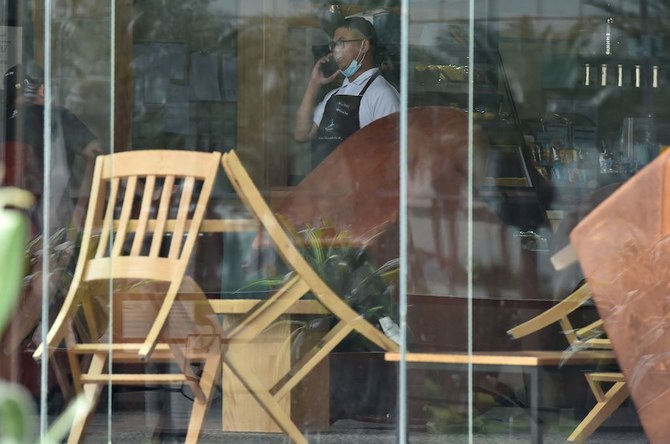
A picture taken March 18, 2020 shows a waiter speaking on his mobile phone inside a closed cafe in Riyadh amid measures to contain the novel COVID-19 coronavirus disease in the desert kingdom. (AFP)
Short Url
Updated 22 March 2020
Follow

As quarantine drags on, Saudis struggle to seek sustenance

  • Opinions are divided on whether food delivery is entirely safe or necessary

RIYADH: Saudi Arabia’s favorite pastime of going out to eat has become — at least for now — a thing of the past. With the country’s restaurants closed for dine-in customers and only open for delivery and takeout, the country’s food delivery apps have seen an unprecedented surge of customers.

From apps that have been around since the beginning, such as Talabat and HungerStation, to newer ones like Jahez, Carriage, and Lugmety, the appeal of having food delivered right to your door has never been stronger.

However, despite frequent reassurances from both the apps themselves and their partner restaurants, as well as the government clamping down on hygiene and safety practices in all restaurants, opinions are divided on whether food delivery is entirely safe or necessary.

Khawla Mukhtar, a mother of five, told Arab News that she never liked the idea of food delivery apps, and she likes it even less now.

“I was always skeptical of them because I don’t like the idea of so many strangers knowing my name and where I live. Now it’s even less safe, because you don’t know how many people they’ve already been delivering food to, or whom they’ve interacted with on their off time,” she said.

Mukhtar is doing her best to prepare all three of her family’s daily meals at home with ingredients she picks carefully at the supermarket.

“I shop once a week, and I don’t hoard or stockpile food. I just take what I need. I try not to get anything raw or exposed, only things that are sealed or foods I can cook at a high enough temperature to kill any viruses or bacteria, just in case,” she said.

Not everyone has the luxury of cooking at home, though. In some cases, such as that of university student Faisal Al-Rashed, not having a kitchen to begin with can mean that food delivery is the only option.

“I live in a very small apartment without a stove. I only have a microwave and a mini fridge. I’ve basically been eating out every day and going home to Al-Kharj to see my parents every other weekend or so. That’s the only time I get home-cooked food unless someone invites me to their house,” he said.

Al-Rashed told Arab News that he tries to make healthy choices to the best of his ability. If he is able to, he reheats the food in the microwave to be safe, but he called the experience “miserable” and prays that the quarantine ends soon.

“When this is over, I’m getting a hot plate and a toaster oven, and I’m going to see my mom for a month and have her teach me every recipe she knows,” he joked.

There are those who have tried to find a balance in the chaos, such as Amal Al-Dabbagh, who told Arab News that cooking three meals a day on top of homeschooling her kids and juggling work from home is “simply impossible.”

“Sometimes I’ll cave and let them get food from outside the house, but I won’t use a delivery app. I’ll send my own driver to the restaurant and have him pick up the food. I trust him enough to be careful and protect himself,” she said.

PARTICLE: Delivery apps you can make use of during the quarantine

Food:

  • HungerStation
  • Talabat
  • Jahez
  • Carriage
  • Lugmety
  • UberEats
  • Grocery delivery:
  • Nana Direct
  • Misc.:
  • Mrsool

Saudi Cabinet condemns ‘blatant’ Iranian aggression; affirms Kingdom’s right to respond to threats

Updated 50 min 19 sec ago
Follow

Saudi Cabinet condemns ‘blatant’ Iranian aggression; affirms Kingdom’s right to respond to threats

RIYADH: Saudi Arabia has warned it reserves the “full right” to respond to Iranian aggression following a series of “blatant and cowardly” strikes targeting the capital and the Eastern Province.

The warning came during a late-night Cabinet session on Tuesday, chaired by Crown Prince and Prime Minister Mohammed bin Salman via videoconference, according to the Saudi Press Agency (SPA).

During the session, the Cabinet “reaffirmed Saudi Arabia’s full solidarity with the brotherly countries whose territories were subjected to blatant Iranian aggression”, signaling a united front against regional threats.

The session followed a dramatic escalation of hostilities, including a direct drone attack on the US Embassy in Riyadh. 

Major General Turki al-Malki, spokesperson for the Ministry of Defense, confirmed that while air defenses intercepted multiple threats, the embassy compound sustained a “limited fire and minor material damage.”

General Al-Malki further announced that Saudi forces successfully intercepted and destroyed eight additional drones targeting the cities of Riyadh and Al-Kharj early Tuesday morning.

In a sharp rebuke of the embassy strike, the Saudi Ministry of Foreign Affairs (MOFA) cited a flagrant violation of the 1949 Geneva Convention and the 1961 Vienna Convention on Diplomatic Relations.

“The repetition of this flagrant Iranian behavior... will push the region toward further escalation,” the Ministry stated, underscoring that these provocations occurred despite Riyadh’s explicit policy of not allowing its airspace or territory to be used as a launchpad for strikes against Iran.

Global condemnation and solidarity

The Cabinet expressed deep appreciation for the wave of international support as world leaders condemned Tehran’s “indiscriminate” behavior.

In a joint show of force, the US and GCC member states (Bahrain, Kuwait, Qatar, Saudi Arabia and the UAE) along with Jordan stood united, labeling the strikes a “dangerous escalation” and reaffirming a collective right to self-defense.

Leaders from the United Kingdom, France, and India. — including Prime Minister Narendra Modi — voiced strong solidarity with the Kingdom. The UK government confirmed its forces are engaged in “defensive actions” to maintain regional stability.

Amid the heightened military tension, the Cabinet reviewed the Kingdom’s hospitality efforts for GCC citizens currently stranded at Saudi airports due to regional airspace closures. The crown prince reaffirmed that the state would mobilize all capabilities to support brotherly nations in any measures they take to restore regional peace and stability.