Australia announces nearly $40 billion in coronavirus relief

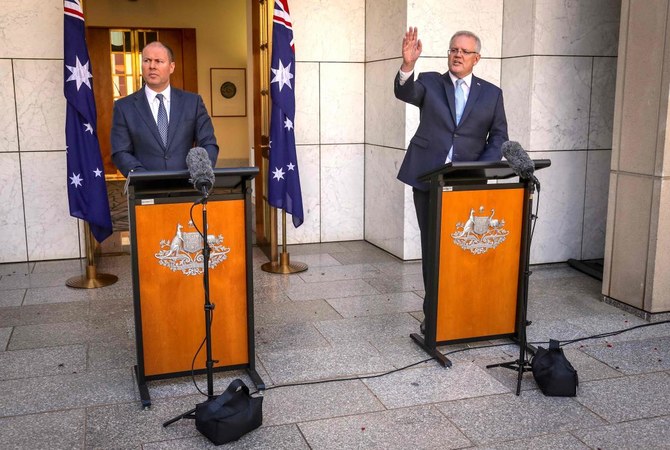
Australian Prime Minister Scott Morrison (R) speaks as he stands with the Australian Treasurer Josh Frydenberg during a press conference at Australia's Parliament House in Canberra on March 22, 2020. (AFP)
Short Url
Updated 22 March 2020
Follow

Australia announces nearly $40 billion in coronavirus relief

  • Workers whose income has fallen by at least 20 percent due to the coronavirus outbreak will be able to access their retirement funds early
  • The country appears poised to slip into recession as a result of the coronavirus outbreak after a record 29-year run of economic growth

SYDNEY: Australia on Sunday announced a $38 billion spending plan to limit the economic damage from the coronavirus pandemic, as citizens were told to cancel domestic travel plans to slow the virus spread.

Treasurer Josh Frydenberg said the latest Aus$66 billion announced Sunday brought government and central bank measures to support the economy to Aus$189 billion — or nearly 10 percent of gross domestic product (GDP).

“These extraordinary times require extraordinary measures and we face a global challenge like we have never faced before,” he told reporters in Canberra.

“Today’s announcement will provide hope and support for millions of Australians at a time when they need it most.”
Small businesses and non-profits will receive cash subsidies of up to Aus$100,000, unemployment payments will be temporarily doubled and pensioners will receive Aus$750 cash.

Workers whose income has fallen by at least 20 percent due to the coronavirus outbreak will be able to access their retirement funds early, with those facing hardship allowed to withdraw up to Aus$20,000 over two years.

Frydenberg said the economic shock was now expected to be “deeper, wider and longer” than was believed just 10 days ago and additional measures would be required.

The country appears poised to slip into recession as a result of the coronavirus outbreak after a record 29-year run of economic growth.
Australia has recorded more than 1,200 cases and seven deaths from COVID-19.

Prime Minister Scott Morrison said the government was also “moving immediately” to recommend against non-essential travel, warning stronger measures were imminent to deal with localized outbreaks.

He said work-related trips, the transport of essential supplies and travel on compassionate grounds could continue but people should cancel any other travel plans ahead of the upcoming Easter school holidays.

“More stronger measures will be coming and they will be coming in more localized areas to deal with outbreaks,” Morrison said.

“What that means is, what may be necessary in a part of Sydney may not be necessary at all in... other parts of the country.”

Australia has already sealed off its borders, putting in place an unprecedented ban on entry for non-residents in the hope of stemming the rise of COVID-19 infections.

Three Australian regions — the island state of Tasmania, South Australia state, and the Northern Territory — have also implemented a 14-day self-isolation period for all visitors.

New South Wales state on Sunday announced a shutdown of non-essential services, with supermarkets, pharmacies and petrol stations among those businesses that are exempt.

Morrison said political leaders would meet Sunday evening to consider stricter isolation rules.


Ukraine’s Zelensky: We have backed US peace proposals to get a deal done

Updated 13 February 2026
Follow

Ukraine’s Zelensky: We have backed US peace proposals to get a deal done

  • “The tactic we chose is for the Americans not to think that we want to continue the war,” Zelensky ‌told The Atlantic

Ukrainian President Volodymyr Zelensky said Kyiv ‌had sought to back US peace proposals to end the war with Russia as President Donald Trump seeks to resolve the conflict before ​November mid-term elections.
Zelensky, in an interview published by The Atlantic on Thursday, said Kyiv was willing to hold both a presidential election and a referendum on a deal, but would not settle for an accord that was detrimental to Ukraine’s interests.
“The tactic we chose is for the Americans not to think that we want to continue the war,” Zelensky ‌told the ‌US-based publication. “That’s why we started supporting their ​proposals in ‌any ⁠format ​that speeds ⁠things along.”
He said Ukraine was “not afraid of anything. Are we ready for elections? We’re ready. Are we ready for a referendum? We’re ready.”
Zelensky has sought to build good relations with Washington since an Oval Office meeting in February 2025 descended into a shouting match with Trump and US Vice President JD ⁠Vance.
But he said he had rejected a ‌proposal, reported this week by the ‌Financial Times, to announce the votes ​on February 24, the fourth ‌anniversary of Russia’s invasion. A ceasefire and proposed US security ‌guarantees against a future invasion had not yet been settled, he said.
“No one is clinging to power,” The Atlantic quoted him as saying. “I am ready for elections. But for that we need security, guarantees ‌of security, a ceasefire.”
And he added: “I don’t think we should put a bad deal ⁠up for a ⁠referendum.”
Russian President Vladimir Putin has said Zelensky is not a legitimate negotiating partner because he has not faced election since coming to power in 2019.
Zelensky has said in recent weeks that a document on security guarantees for Ukraine is all but ready to be signed.
But, in his remarks, he acknowledged that details remained unresolved, including whether the US would be willing to shoot down incoming missiles over Ukraine if Russia were to violate the peace.
“This hasn’t been fixed ​yet,” Zelensky said. “We have raised ​it, and we will continue to raise these questions...We need all of this to be written out.”