


‘Worse than 9/11’: Coronavirus threatens global airline industry

1 / 5
In this March 6, 2020, file photo, Cathay Pacific aircrafts line up on the tarmac at the Hong Kong International Airport. (AP)
2 / 5
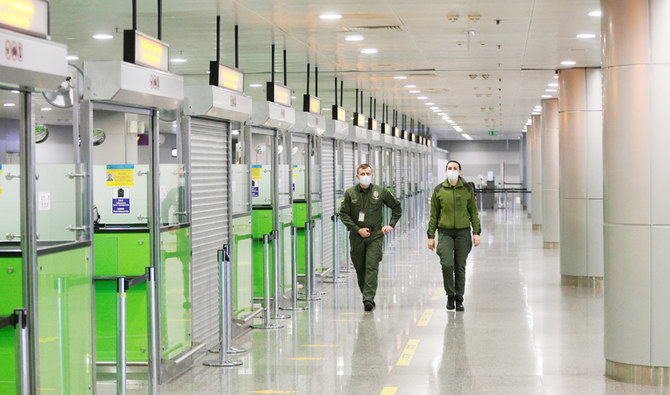
Officers of the State Border Guard Service walk at the empty arrival area of the Boryspil International Airport after Ukraine has suspended all passenger flights to and from the country, amid coronavirus (COVID-19) concerns, outside Kiev, Ukraine, March 17, 2020. (REUTERS)
3 / 5
Information board informs about cancelled flights at the airport, as the spread of the coronavirus disease (COVID-19) continues, in Frankfurt, Germany, March 17, 2020. (REUTERS)
4 / 5
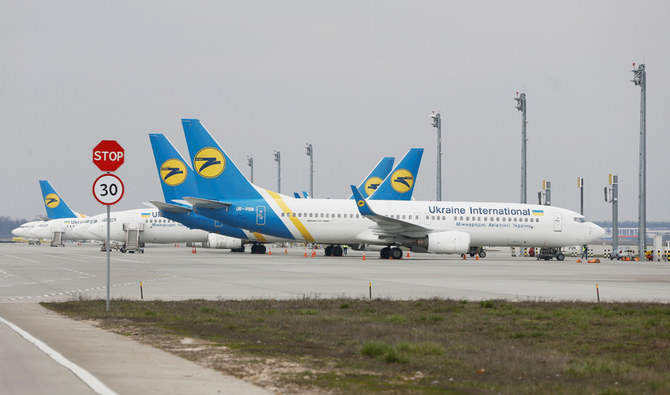
Planes of the Ukrainian International airlines are seen at the Boryspil International Airport after Ukraine has suspended all passenger flights to and from the country, amid coronavirus (COVID-19) concerns, outside Kiev, Ukraine, March 17, 2020. (REUTERS)
5 / 5
A passenger stranded at Tunis Carthage waits for a flight on March 16, 2020. (AFP)
Short Url
Updated 18 March 2020
Follow

‘Worse than 9/11’: Coronavirus threatens global airline industry

  • More airlines slashed flights Tuesday as millions of passengers canceled travel to self-quarantine and countries blocked arrivals to stem the spread of the COVID-19 infection

NEW YORK: Fears of massive bankruptcies and calls for emergency bailouts swept global airlines Tuesday as a top US official warned the coronavirus crisis threatens the industry even more than the September 11 attacks, which saw US airspace shut down entirely. 
Italy moved to take over insolvent Alitalia while Sweden and Denmark offered 275 million euros in guarantees to help prop up Scandinavian carrier SAS.
In the United States, airlines sought $50 billion in help from the government as the White House prepared a reportedly $850 billion plan to support the entire economy.
“This is worse than 9/11 for the airline industry — they are ground to a halt,” US Treasury Secretary Steven Mnuchin said.
Industry officials said most airlines face burning through their cash reserves in three months or less.
And airlines warned that vital air cargo could be impacted by the shutdown of 185,000 passenger flights around the world.
“Most airlines in the world will be bankrupt” by the end of May, Market intelligence firm CAPA warned.
“If the crisis will continue at that intensity, it’s clear we will see a consolidation,” Alexandre de Juniac, director general and CEO of the International Air Transport Association, said in Geneva.

More airlines slashed flights Tuesday as millions of passengers canceled travel to self-quarantine and countries blocked arrivals to stem the spread of the COVID-19 infection.
Belgium-based Brussels Airlines, a Lufthansa subsidiary which operates 48 aircraft, suspended all flights for at least a month on Tuesday. Lufthansa has already cut back flights by 90 percent.
In Australia, Qantas slashed international capacity by 90 percent early Tuesday, as the government required that anyone arriving from abroad needs to isolate themselves for 14 days to be sure they are not carrying the virus.
Italy’s government said it would take over Alitalia, the former flag carrier already mired in bankruptcy negotiations since 2017.
“At a time like this, a flag carrier gives the government more leeway,” said Deputy Economy Minister Laura Castelli. “We all saw the difficulties our compatriots faced in returning to Italy. Our decision stems from this.”
Even with the takeover, the plan was to furlough 4,000 of Alitalia’s 11,000 employees.
In Russia, Alexander Neradko, head of the federal agency Rosaviation, said their airlines, hit beginning in February with the shutdown of flights to China, the original epicenter of the virus, were also in trouble.
“There is a rising risk of bankruptcies by airlines that are in a tough financial situation,” Neradko said.
“The government is actively discussing how to support airlines,” said Kremlin spokesperson Dmitry Peskov.

Brian Pearce, economist of IATA, said their early March estimate of $113 billion in losses to the global industry now looks very low.
“Seventy-five percent of the airlines we have looked at have less than three months of cash to pay their fixed costs,” Pearce said.
Such numbers put aviation in perhaps the top position of industries requiring a bailout, like banks in the 2008 financial crisis.
“Connectivity is crucial,” said the IATA’s de Juniac.
“The world will get through this crisis,” he said. “And when it does it will need a functioning air transport sector. Without financial relief that is not guaranteed.”
Airports too said they were under threat. The Airports Council International Europe said they were bracing for a “near total collapse” of traffic, wiping out earnings while they hold high fixed costs.
ACI Europe president Jost Lammers called in a letter to the European Union Tuesday for urgent financial support.
“This funding needs to be available under similar conditions as those that will be considered for airlines,” Lammers wrote.
In the United States, however, some bristled at again, like in 2008, using taxpayer funds to rescue industries and well-paid executives who took excessive risks with their companies.
Critics said US airlines, rather than build up cash reserves, used nearly all their profits in recent years to buy back shares to prop up share prices.
According to Bloomberg, over the past decade US airlines used nearly 96 percent of their free cash flow to buy back shares, with American Airlines the most aggressive, paying out $12.5 billion.
“We cannot permit American and other airlines to use federal assistance, whether labelled a bailout or not, to weather the coronavirus crisis and then return to business as usual,” wrote Columbia Law School professor Tim Wu in The New York Times.


AI will never replace human creativity, says SRMG CEO 

Updated 30 January 2026
Follow

AI will never replace human creativity, says SRMG CEO 

  • Speaking to Maya Hojeij, senior business anchor at Asharq with Bloomberg, Jomana R. Alrashid expressed pride in SRMG platforms that had absorbed and adopted AI

RIYADH: Jomana R. Alrashid, CEO of Saudi Research and Media Group, highlighted how AI cannot replace human creativity during a session at The Family Office’s “Investing Is a Sea” summit at Shura Island on Friday. 

“You can never replace human creativity. Journalism at the end of the day, and content creation, is all about storytelling, and that’s a creative role that AI does not have the power to do just yet,” Alrashid told the investment summit. 

“We will never eliminate that human role which comes in to actually tell that story, do the actual investigative reporting around it, make sure to be able to also tell you what’s news or what’s factual from what’s wrong ... what’s a misinformation from bias, and that’s the bigger role that the editorial player does in the newsroom.”

Speaking on the topic of AI, moderated by Maya Hojeij, senior business anchor at Asharq with Bloomberg, the CEO expressed her pride in SRMG platforms that had absorbed and adopted AI in a way that was “transformative.”

“We are now translating all of our content leveraging AI. We are also now being able to create documentaries leveraging AI. We now have AI-facilitated fact-checking, AI facilities clipping, transcribing. This is what we believe is the future.”

Alrashid was asked what the journalist of the future would look like. “He’s a journalist and an engineer. He’s someone who needs to understand data. And I think this is another topic that is extremely important, understanding the data that you’re working with,” she said.

“This is something that AI has facilitated as well. I must say that over the past 20 years in the region, especially when it comes to media companies, we did not understand the importance of data.”


The CEO highlighted that previously, media would rely on polling, surveys or viewership numbers, but now more detailed information about what viewers wanted was available. 

During the fireside session, Alrashid was asked how the international community viewed the Middle Eastern media. Alrashid said that over the past decades it had played a critical role in informing wider audiences about issues that were extremely complex — politically, culturally and economically — and continued to play that role. 

“Right now it has a bigger role to play, given the role again of social media, citizen journalists, content creators. But I also do believe that it has been facilitated by the power that AI has. Now immediately, you can ensure that that kind of content that is being created by credible, tier-A journalists, world-class journalists, can travel beyond its borders, can travel instantly to target different geographies, different people, different countries, in different languages, in different formats.”

She said that there was a big opportunity for Arab media not to be limited to simply Arab consumption, but to finally transcend borders and be available in different languages and to cater to their audiences. 


The CEO expressed optimism about the future, emphasizing the importance of having a clear vision, a strong strategy, and full team alignment. 

Traditional advertising models, once centered on television and print, were rapidly changing, with social media platforms now dominating advertising revenue.

“It’s drastically changing. Ultimately in the past, we used to compete with one another over viewership. But now we’re also competing with the likes of social media platforms; 80 percent of the advertising revenue in the Middle East goes to the social media platforms, but that means that there’s 80 percent interest opportunities.” 

She said that the challenge was to create the right content on these platforms that engaged the target audiences and enabled commercial partnerships. “I don’t think this is a secret, but brands do not like to advertise with news channels. Ultimately, it’s always related with either conflict or war, which is a deterrent to advertisers. 

“And that’s why we’ve entered new verticals such as sports. And that’s why we also double down on our lifestyle vertical. Ultimately, we have the largest market share when it comes to lifestyle ... And we’ve launched new platforms such as Billboard Arabia that gives us an entry into music.” 

Alrashid said this was why the group was in a strong position to counter the decline in advertising revenues across different platforms, and by introducing new products.

“Another very important IP that we’ve created is events attached to the brands that have been operating in the region for 30-plus years. Any IP or any title right now that doesn’t have an event attached to it is missing out on a very big commercial opportunity that allows us to sit in a room, exchange ideas, talk to one another, get to know one another behind the screen.” 

The CEO said that disruption was now constant and often self-driving, adding that the future of the industry was often in storytelling and the ability to innovate by creating persuasive content that connected directly with the audience. 

“But the next disruption is going to continue to come from AI. And how quickly this tool and this very powerful technology evolves. And whether we are in a position to cope with it, adapt to it, and absorb it fully or not.”