LONDON: Britain said it would launch a £330 billion ($399 billion) lifeline of loan guarantees and provide a further £20 billion in tax cuts, grants and other help for businesses facing the risk of collapse from the spread of coronavirus.
Finance minister Rishi Sunak repeated his pledge to do “whatever it takes” including further action if needed to help sectors from retailers to bars and airports which are reeling from a near-shutdown of their businesses.
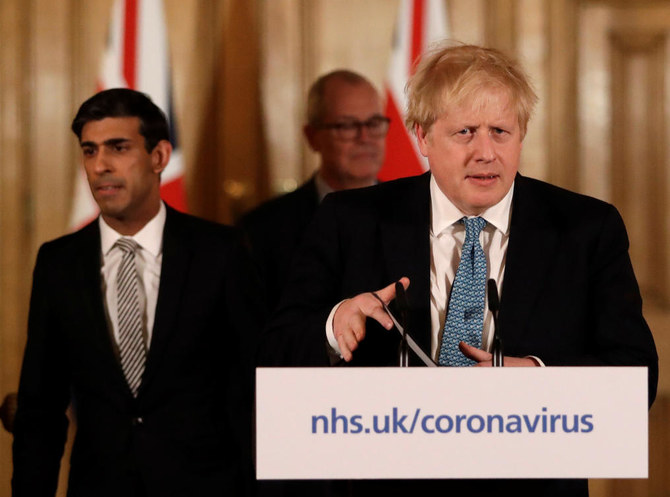
“This is not a time for ideology and orthodoxy,” Sunak said on Tuesday, speaking alongside Prime Minister Boris Johnson. “This is a time to be bold, a time for courage.”
Britain, criticized by some scientists for moving more slowly than other European countries to prevent the spread of the virus, ramped up its response on Monday when it told people to avoid pubs, clubs, restaurants, cinemas and theaters.
The coronavirus death toll in Britain rose by 16 to 71 on Tuesday.
Sunak said he was including all retail, hospitality and leisure businesses in the suspension of a property tax, alongside the new loan guarantee program which was equivalent to 15% of British economic output.
Companies from those sectors would be offered cash grants and the government would discuss a support package for airlines and airports.
Britain’s biggest airports including Heathrow and Gatwick have warned that they face the threat of a complete shutdown without government help.
Banks and lenders would offer a three-month mortgage holiday for people in difficulty, Sunak said.
He later told lawmakers, some of whom criticized the business focus of the plan, that the government would soon make a statement about support for renters.
Sunak described Tuesday’s package of measures as unprecedented, although Britain issued guarantees of around £1 trillion
during the global financial crisis.
The Institute for Fiscal Studies, a think-tank, said Sunak would need to “come back with more” and Allan Monks, a JP Morgan economist, said that excluding the loan guarantees, the size of Britain’s stimulus measures for this year was “likely to look small compared to the economic shock underway.”
The Bank of England said it would set up a new fund with the finance ministry to buy commercial debt with a term of up to one-year issued by investment-grade companies making a “material contribution” to Britain’s economy.
It added that the fund would be financed out of the creation of central bank reserves — in other words with new money, much like the BoE’s quantitative easing program.
Earlier on Tuesday, Britain’s budget forecasters said the scale of the borrowing needed to fight the coronavirus hit to the economy might resemble the country’s immense debt splurge during World War Two.
“Now is not a time to be squeamish about public sector debt,” Robert Chote, head of the Office for Budget Responsibility, told lawmakers.
“We ran during the Second World War budget deficits in excess of 20% of GDP five years on the trot and that was the right thing to do.”
On Monday, French President Emmanuel Macron said his government would guarantee 300 billion euros worth of loans, and promised that no French company would be allowed to collapse.
New Bank of England Governor Andrew Bailey promised “prompt action” on Monday, less than a week after an emergency rate cut by the BoE which took its benchmark rate to just 0.25%.
Investors are watching for another rate cut, possibly before the BoE’s next scheduled announcement on March 26.
The central bank is also expected to expand its £435 billion government bond buying program.


![]()

UK unveils $420 billion lifeline for firms hit by coronavirus
UK unveils $420 billion lifeline for firms hit by coronavirus
Latest updates


© 2026 SAUDI RESEARCH & PUBLISHING COMPANY, All Rights Reserved And subject to Terms of Use Agreement.