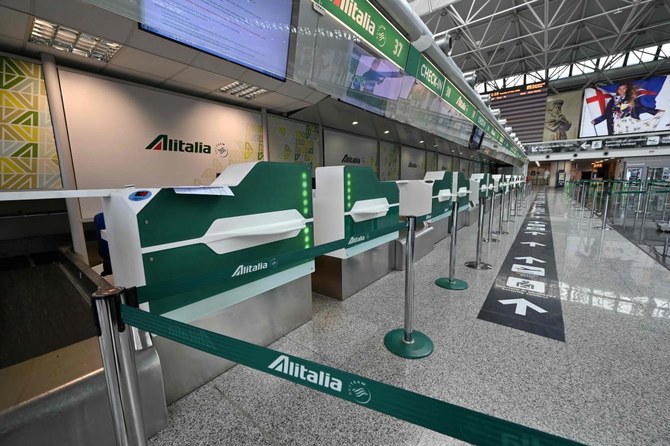
Italy to re-nationalize Alitalia in response to virus

Alitalia filed for bankruptcy in 2017 and looked doomed in January when it failed to secure rescues from either the Italian state railway or Germany’s Lufthansa. (AFP)
Short Url
Updated 17 March 2020
Follow

Italy to re-nationalize Alitalia in response to virus

  • Prime Minister Giuseppe Conte’s decision was revealed in a government decree published late Monday
  • Alitalia is currently 49-percent owned by Etihad Airways and 51-percent owned by the Italian management team

ROME: Italy’s government said Tuesday it will re-nationalize the bankrupt former national carrier Alitalia to make sure crises like the coronavirus pandemic never strand its compatriots abroad.
Prime Minister Giuseppe Conte’s decision was revealed in a government decree published late Monday after more than a week of debates.
It comes as part of a broader $28 billion (€25-billion) coronavirus response plan and will reportedly cost Italian taxpayers up to $670 million (€600 million).
The 74-year-old company filed for bankruptcy in 2017 and looked doomed in January when it failed to secure rescues from either the Italian state railway or Germany’s Lufthansa.
“At a time like this, a flag carrier gives the government more leeway,” Deputy Economy Minister Laura Castelli told Italian radio.
“We all saw the difficulties our compatriots faced in returning to Italy. Our decision stems from this.”
Transport Minister Paola De Micheli said a “national carrier was strategic for our country” at a time of crisis.”
Alitalia faced the threat of closure even before COVID-19 killed more than 2,100 people in the Mediterranean country and grounded the overwhelming majority of most airlines’ flights.
Market intelligence firm CAPA warned that “most airlines in the world will be bankrupt” by the end of May.
But how Conte’s government intends to save Alitalia — a member of the SkyTeam alliance that has been bleeding money for many years — remains unclear.
The government decree provides for the creation of “a new company wholly controlled by the ministry of economy and finance, or controlled by a company with a majority public stake, including an indirect one.”
Italy’s AGI news agency said the government was also setting up an €600-million fund to deal with the damage the pandemic was causing the aviation sector.
Some of the final details of the national economic rescue program are expected to be finalized next month.
Alitalia began to flounder with the emergence of budget fliers such as EasyJet and Ryanair in the 1990s.
But analyst believe that it is also too small — and has too many staff for the number of flights it operates — to compete with full-cost rivals.
It flew only 22 million passengers and saw its market share in Italy slip to 14 percent in 2018.
Lufthansa and the Atlanta-based Delta Airlines each carried around 180 million passengers that year.
Alitalia was privatized by a group of Italian investors for one billion euros in 2008 but went into administration when its staff rejected a proposal to cut jobs in 2017.
It is currently 49-percent owned by Abu Dhabi-based Etihad Airways and 51-percent owned by the Italian management team.
Etihad made no immediate comment.


Reforms target sustained growth in Saudi real estate sector, says Al-Hogail

Updated 26 January 2026
Follow

Reforms target sustained growth in Saudi real estate sector, says Al-Hogail

RIYADH: The Real Estate Future Forum opened its doors for its first day at the Four Seasons Riyadh, with prominent global and local figures coming together to engage with one of the Kingdom’s most prospering sectors.

With new regulations, laws, and investments underway, 2026 is expected to be a year of momentous progress for the real estate sector in the Kingdom.

The forum opened with a video highlighting the sector’s progress in the Kingdom, during which an emphasis was placed on the forum’s ability to create global reach, representation, as well as agreements worth a cumulative $50 billion

With the Kingdom now opening up real estate ownership to foreigners, this year’s Real Estate Future Forum is placing a great deal of importance on this new milestone and its desired outcomes and impact on the market. 

Aside from this year’s forum’s unique discussions surrounding those developments, it will also be the first of its kind to launch the Real Estate Excellence Award and announce its finalist during the three-day summit.

Minister of Municipalities and Housing and Chairman of the Real Estate General Authority Majed Al-Hogail took to stage to address the diverse audience on the real estate market’s achievements thus far and its milestones to come.

Of those important milestones, he underscored “real estate balance” as a key pillar of the sector’s decisions to implement regulatory tools “with the aim of constant growth which can maintain the vitality of this sector.” He pointed to examples of those regulatory measures, such as the White Land Tax.

On 2025’s progress, the minister highlighted the jump in Saudi family home ownership, which went from 47 percent in 2016 to 66 percent in 2025, keeping the Kingdom’s Vision 2030 goal of 70 percent by the end of the decade on track.

He said the opening of the real estate market to foreigners is an indicator of the sector’s maturity under the leadership of Crown Prince Mohammed bin Salman. He said his ministry plans to build over 300,000 housing units in Riyadh over the next three years.

Speaking to Arab News,  Al-Hogail elaborated on these achievements, stating: “Today, demand, especially local demand, has grown significantly. The mortgage market has reached record levels, exceeding SR900 billion ($240 billion) in mortgage financing, we are now seeing SRC (Saudi Real Estate Refinance Co.) injecting both local and foreign liquidity on a large scale, reaching more than SR54 billion”

Al-Hogail described Makkah and Madinah as unique and special points in the Kingdom’s real estate market as he spoke of the sector’s attractiveness.

 “Today, the Kingdom of Saudi Arabia has become, in international investment indices, one that takes a good share of the Middle East, and based on this, many real estate investment portfolios have begun to come in,” he said. 

Al-Ahsa Gov. Prince Saud bin Talal bin Badr Al-Saud told Arab News the Kingdom’s ability to balance both heritage sites with real estate is one of its strengths.

He said: “Actually the real estate market supports the whole infrastructure … the whole ecosystem goes back together in the foundation of the real estate; if we have the right infrastructure we can leverage more on tourism plus we can leverage more on the quality of life … we’re looking at 2030, this is the vision … to have the right infrastructure the time for more investors to come in real estate, entertainment, plus tourism and culture.”