ROME: Efforts to save loss-making Alitalia have reached an impasse after months of unsuccessful negotiations with potential buyers, leaving Italy’s government undecided on the next move.
The struggling carrier, which has been under special administration since 2017 and continues to burn through cash, is now at a standstill after a consortium of potential buyers failed to make an offer, and with little hope for one in sight.
“It’s evident that right now a business solution doesn’t exist,” Economy Minister Stefano Patuanelli said this week, addressing a Senate commission.
The company “has a dimension that the market has difficulty accepting,” he said.
The government has reportedly said it will provide a €400 million ($440 million) bridge loan to the struggling company — at the risk of running afoul of European Commission rules on state aid, after the 900 million provided already in 2017.
Patuanelli brushed off such concerns Friday, saying he was “not worried.” The government, he said, was exploring its options, which media reports said include replacing the commissioners running the airline, or outright nationalization.
The minister has said placing the beleaguered carrier in the state’s hands “would not necessarily be negative.”
Alitalia has been losing money for years, its business squeezed by competition from low-cost carriers, fuel price rises, and luxury airlines from the Middle East.
After months of negotiations and the expiration of the latest deadline for a binding bid, plans for a consortium of investors to save the airline fell through last week after Atlantia said the conditions had not yet been met to participate.
Atlantia, a major operator of toll expressways and airports controlled by the Benetton family, operates Rome’s airports and had already twice taken stakes in Alitalia.
Others making up the potential partnership were state railway Ferrovie dello Stato, US airline Delta and the Italian treasury.
Delta said earlier this month it was ready to invest up to €100 million in Alitalia in return for a 10 percent stake.
Lufthansa has its eye on the lucrative Italian market but has said it would only be interested in investing in a restructured Alitalia.
Patuanelli said Friday that Lufthansa at the moment was interested in “a commercial partnership, but with no equity investment.” The minister has said costs must be cut at the carrier, echoing Lufthansa’s demands for restructuring.
Unions have planned a December 13 strike, their worries mounting given the lack of a new plan in sight and uncertainty over how many jobs could be threatened under any restructuring.
“We are against any idea of cutting up Alitalia and losing our country’s heritage,” the secretary of the CGIL union said on Friday.
Alitalia was placed under special administration two years ago after workers rejected a restructuring plan that would have laid off 1,700 workers out of some 11,000.
Estimates are hard to come by on how much the state would have to spend to keep it afloat. The Sole 24 Ore daily put the sum at 8.7 billion euros, citing Italian investment bank Mediobanca.
The company’s best, or least bad, year in the past decade was 2011, when it lost some €69 million, a sum that swelled to €280 million the following year and to €580 million in 2014, according to Italian news agency AGI.
“The abnormality about Alitalia is that it loses money when it flies,” consumer’s rights association ADUC wrote on Thursday.
“With the money wasted on Alitalia, the government could have bought six airlines, namely Air France, KLM, Turkish Airlines, Norwegian, Finnair and SAS.”


![]()

Turbulent future for loss-making Alitalia after rescue stalls
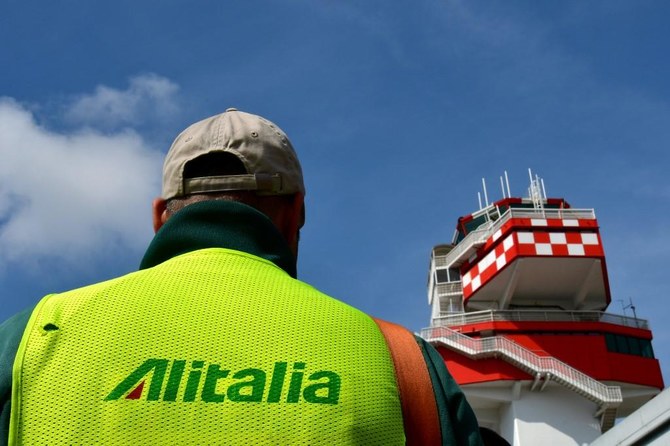
Turbulent future for loss-making Alitalia after rescue stalls
- Struggling carrier now at a standstill after a consortium of potential buyers failed to make an offer
- Alitalia has been losing money for years, its business squeezed by competition


Latest updates


© 2026 SAUDI RESEARCH & PUBLISHING COMPANY, All Rights Reserved And subject to Terms of Use Agreement.