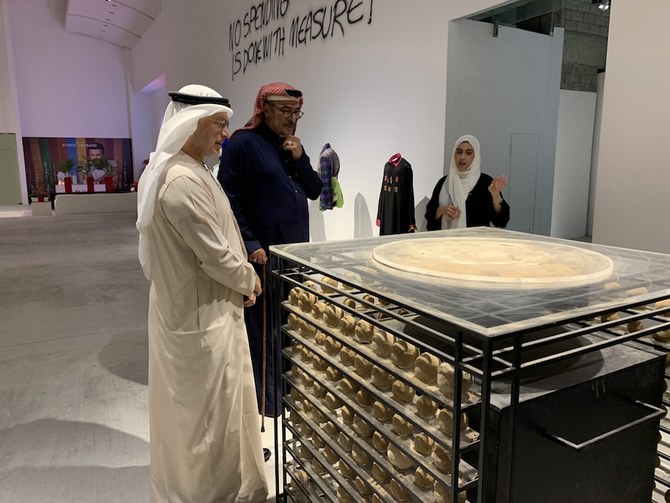
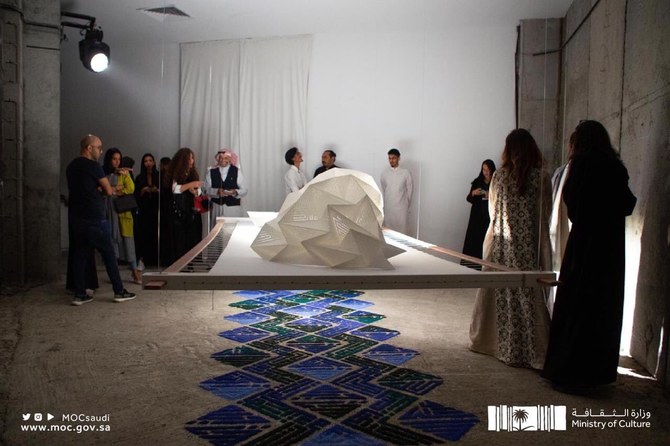

JEDDAH: Thousands of people have visited the Saudi Art Council’s flagship event in its first month.
21,39 Jeddah Arts — taken from the city’s latitude and longitude coordinates — features curated exhibitions, gallery openings, workshops and discussions aimed at building bridges between the Kingdom and the rest of the world through art.
The seventh edition, titled “I Love You, Urgently,” addresses and explores the global climate emergency through works of art that use scent, sculpture, sound, painting, drawing, installations and film as mediums of expression.
Hundreds of high-profile guests, including ministers from the UAE, as well as thousands of students have visited 21,39 Jeddah Arts since it opened on Jan. 28.
Last September Saudi Arabia said tourist visas would be issued for the first time to visitors from dozens of countries. Kickstarting tourism is one of the centerpieces of Crown Prince Mohammed bin Salman’s Vision 2030 reform program to prepare the biggest Arab economy for a post-oil era.
Saudi Art Council Director Nada Sheikh-Yasin said it was the first year that the festival's organizers had seen such an increase in visitor numbers.
“I think it’s due to the visas being easily accepted for the international audience to attend,” she told Arab News. “In the past, we’ve had many issues trying to get visas. I think this really helped with the opening of the exhibition to have this so easily accessible.”
She said the festival team was also pleased with the number of international students visiting the event and, while it was normal practice to welcome half a dozen local schools a day five days a week, there had been an uptick in foreign pupils going to 21,39. “So, on top of our six schools a day, we see an increase in our international students. Instead of having our six local schools a day, we tend to have 12 to 15 schools visiting us on a daily basis. It’s great that these numbers to an extent have increased with the introduction of international schools in particular.”
This year’s event has brought together more than 60 local and international artists, architects, designers and thinkers to pose questions around environmental sustainability and explore ways to inhabit the planet.
The workshops included the participation of creatives and thinkers such as Sami Angawi, Christina Dean, Francisco Carballo, Lina Qattan, Nourah Gabrah and Rana Bakash.
Topics discussed included architect and engineer Frei Otto’s current relevance to Saudi Arabia and the region as it moved forward in an environmentally unstable context; the impact of heavy urban and industrial development on the natural environment; the approach to environmental sustainability on Saudi Arabia’s Red Sea coast; the mass movement of people caused by climatic changes in the context of Saudi Arabia; the fashion industry’s challenge of finding new models of sustainability; and the role of art and artists in fighting climate change.
The three-month event aims to engage the public in the conversations taking place about the environment and sustainability, while encouraging an understanding of these debates within a local context.
Sheikh-Yasin said that the Kingdom’s focus on sustainability and environmental awareness was reflected in the exhibition’s core theme.
“We wanted our artists to find sustainable ways to improve and maintain the environment. They each responded to that in their artwork and part of the Saudi Art Council’s role is to raise awareness and to have our visitors think twice and improve their ways of helping the environment, whether that’s through recycling or giving to charity, using different elements just to bring awareness as a whole. We practice what we preach so given the fact that the main theme of the exhibition is that, we try to incorporate that theme in everything that we do in the exhibition.”
What made this year special was that the artists were asked to find ways to implement their work in real life, she added.
“Instead of the artists only producing or us commissioning the artist to produce the work, we’ve asked them to suggest ways to implement what they are producing. It’s not fully about them producing, but it’s about how they can take this forward in this artistic practice.”
The festival has so far been visited by Noura bint Mohammed Al-Kaabi, who is the UAE’s minister of culture and knowledge development, and Anwar Mohammed Gargash, who is a member of the UAE’s Federal Cabinet and minister of state for foreign affairs. Both expressed their admiration for the creativity of participating artists.
The Saudi Art Council’s base at the city’s Gold Moor Mall has been the venue for workshops, talks and other events aimed at the public and students.
Workshops for children and students have included origami, upcycling and mixed media art. Courses and workshops for adults include the fundamentals of motion graphics, Arabic typography elements, and weekly photo walks in Jeddah’s historic Al-Balad district.
The council has also hosted a book launch and showcased the work of Shaker Kashgari and Alex Domingo, who seek to enrich Islamic art by integrating it into the digital age.
21,39 Jeddah Arts runs until April 18.