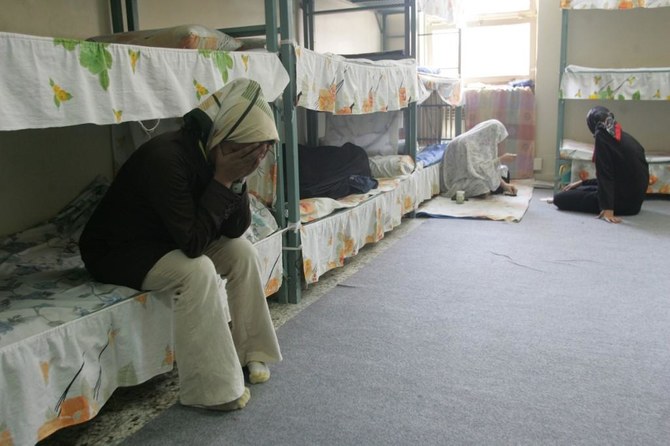
LONDON: Prisoners in Iran’s notorious Evin prison, including a British-Iranian national, are objecting to plans to transfer them to a ward that they believe has held up to three inmates infected with coronavirus.
Sherry Ashoori, wife of 65-year-old British-Iranian prisoner Anoosheh Ashoori, has told the UK’s Foreign and Commonwealth Office (FCO) of plans to move her husband and other inmates to ward 4.
Anoosheh has told his wife that the prisoners in ward 12 are refusing to be moved, but expect that they could be forced to do so.
Evin prison is where Iran keeps many of its political prisoners. Richard Ratcliffe — whose wife Nazanin Zaghari-Ratcliffe was jailed in the prison for five years — said he is “hoping the reports are not true.”
He added: “This highlights what a precarious position Nazanin and all the other prisoners are in — and the terrifying situation the whole country finds itself in due to lack of medicines, lack of management and most of all a lack of transparency.”
The FCO “asked us on Friday what message we wanted them to give to the Iranian authorities — it was going to be that the complacency with ordinary lives needs to end,” he said.
“Perhaps now it is (time) to work together to keep people safe. Those conversations about potential humanitarian supplies suddenly feel a lot more pressing.”
The FCO told Sherry that it is investigating claims of coronavirus in Evin prison, and that the British Ambassador to Iran Robert Macaire is aware of the reports.
It added that there was no independent confirmation of the prisoners’ claims. Arab News contacted the FCO for comment, but no statement was given.

Iranian prisoners fear transfer to coronavirus ward
https://arab.news/9enun
Iranian prisoners fear transfer to coronavirus ward
Syrian government, Kurds to extend truce: sources to AFP
- No official announcement has yet come from Damascus or SDF, but two sources said truce is to be extended by one month
DAMASCUS: The Syrian government and Kurdish forces have agreed to extend a ceasefire set to expire Saturday, as part of a broader deal on the future of Kurd-majority areas, several sources told AFP.
No official announcement has yet come from Damascus or the Kurdish-led Syrian Democratic Forces (SDF), but two sources said the truce is to be extended by one month.
On Tuesday, Damascus and the SDF agreed to a four-day ceasefire after Kurdish forces relinquished swathes of territory to government forces, which also sent reinforcements to a Kurdish stronghold in the northeast.
A diplomatic source in Damascus told AFP the ceasefire, due to expire on Saturday evening, will be extended “for a period of up to one month at most.”
A Kurdish source close to the negotiations confirmed “the ceasefire has been extended until a mutually acceptable political solution is reached.”
A Syrian official in Damascus said the “agreement is likely to be extended for one month,” adding that one reason is the need to complete the transfer of Daesh group militant detainees from Syria to Iraq.
All sources requested anonymity because they are not allowed to speak to the media.
After the SDF lost large areas to government forces, Washington said it would transfer 7,000 Daesh detainees to prisons in Iraq.
Europeans were among 150 senior IS detainees who were the first to be transferred on Wednesday, two Iraqi security officials told AFP.
The transfer is expected to last several days.
Daesh swept across Syria and Iraq in 2014, but backed by a US-led coalition, the SDF ultimately defeated the group and went on to jail thousands of suspected militants and detain tens of thousands of their relatives.
The truce between Damascus and the Kurds is part of a new understanding over Kurdish-majority areas in Hasakah province, and of a broader deal to integrate the Kurds’ de facto autonomous administration into the state.
Syrian President Ahmed Al-Sharaa’s Islamist forces toppled longtime ruler Bashar Assad in 2024.
The new authorities are seeking to extend state control across Syria, resetting international ties including with the United States, now a key ally.
The Kurdish source said the SDF submitted a proposal to Damascus through US envoy Tom Barrack that would have the government managing border crossings — a key Damascus demand.
It also proposes that Damascus would “allocate part of the economic resources — particularly revenue from border crossings and oil — to the Kurdish-majority areas,” the source added.
Earlier this month, the Syrian army recaptured oil fields, including the country’s largest, while advancing against Kurdish forces.


