

Archaeologists unveil possible shrine to Rome’s first king

1 / 3
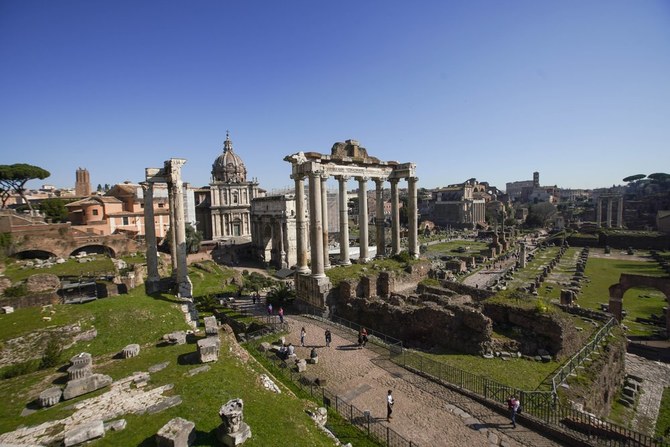
Archaeologists said on Friday they had discovered an ancient cenotaph that almost certainly commemorated the legendary founder of Rome, Romulus, buried in the heart of the Italian capital. (AFP)
2 / 3
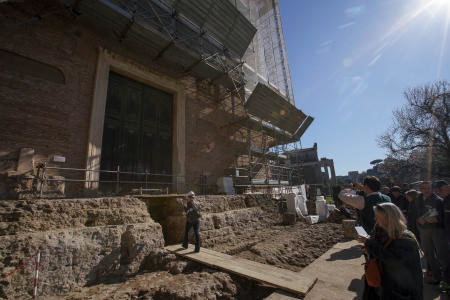
The 1.4.-meter wide sarcophagus does not contain the body of Romulus, who is said to have vanished into the sky following his death. (AP)
3 / 3
Originally discovered at the start of the last century, the significance of the find has only just become clear. (AP)
Short Url
Updated 21 February 2020
Follow

Archaeologists unveil possible shrine to Rome’s first king

  • Possible shrine to Romulus is found at the heart of Rome, on the site of the old Roman forum
  • The founder of Rome was abandoned by the banks of the river Tiber, before being nursed back to health by a she-wolf

ROME: Archaeologists said on Friday they had discovered an ancient cenotaph that almost certainly commemorated the legendary founder of Rome, Romulus, buried in the heart of the Italian capital.
The small chamber containing a simple sarcophagus and round stone block was originally found at the start of the last century beneath the Capitoline Hill inside the old Roman forum.
However, officials say the significance of the find has only just become clear following fresh excavations and new research.
Alfonsina Russo, the head of the Colosseum Archaeological Park, said the site probably dated back to the sixth century BC, and was located in the most ancient part of the city which was directly linked in historical texts to Rome’s first king.
“This area is highly symbolic. This surely cannot be Romulus’ tomb, but it is a place of memory, a cenotaph,” Russo told Reuters TV.
The shrine is buried beneath the entrance to the Curia, one of the meeting places for Roman senators which was subsequently converted into a church — a move that protected it from being dismantled for its stones as happened to other forum buildings.

The underground chamber was also located close to the “Lapis Niger,” an antique slab of marble that was venerated by Romans and covered a stone column that was dedicated to “the King” and appeared to curse anyone who thought to disturb it.
Russo said the Roman poet Horace and ancient Roman historian Marcus Terentius Varro had related that Romulus was buried behind the “rostra” — a tribune where speakers addressed the crowd in the forum. “The rostra are right here,” she said.
No body was found in the sarcophagus, which was made of volcanic tuff rock, but according to at least one legend, Romulus vanished into the sky following his death to become the God Quirinus, meaning that possibly he never had a tomb.
According to the myth, Romulus and his brother Remus, the sons of the god Mars, were abandoned by the banks of the river Tiber where a she-wolf found them and fed them with her milk.
The brothers are said to have founded Rome at the site in 753 BC and ended up fighting over who should be in charge. Romulus killed Remus.


Sotheby’s to bring coveted Rembrandt lion drawing to Diriyah

Updated 18 January 2026
Follow

Sotheby’s to bring coveted Rembrandt lion drawing to Diriyah

DUBAI: Later this month, Sotheby’s will bring to Saudi Arabia what it describes as the most important Rembrandt drawing to appear at auction in 50 years. Estimated at $15–20 million, “Young Lion Resting” comes to market from The Leiden Collection, one of the world’s most important private collections of 17th-century Dutch and Flemish art.

The drawing will be on public view at Diriyah’s Bujairi Terrace from Jan. 24 to 25, alongside the full contents of “Origins II” — Sotheby’s forthcoming second auction in Saudi Arabia — ahead of its offering at Sotheby’s New York on Feb. 4, 2026. The entire proceeds from the sale will benefit Panthera, the world’s leading organization dedicated to the conservation of wild cats. The work is being sold by The Leiden Collection in partnership with its co-owner, philanthropist Jon Ayers, the chairman of the board of Panthera.

Established in 2006, Panthera was founded by the late wildlife biologist Dr. Alan Rabinowitz and Dr. Thomas S. Kaplan. The organization is actively engaged in the Middle East, where it is spearheading the reintroduction of the critically endangered Arabian leopard to AlUla, in partnership with the Royal Commission for AlUla.

“Young Lion Resting” is one of only six known Rembrandt drawings of lions and the only example remaining in private hands. Executed when Rembrandt was in his early to mid-thirties, the work captures the animal’s power and restless energy with striking immediacy, suggesting it was drawn from life. Long before Rembrandt sketched a lion in 17th-century Europe, lions roamed northwest Arabia, their presence still echoed in AlUla’s ancient rock carvings and the Lion Tombs of Dadan.

For Dr. Kaplan, the drawing holds personal significance as his first Rembrandt acquisition. From 2017 to 2024, he served as chairman of the International Alliance for the Protection of Heritage, of which Saudi Arabia is a founding member.

The Diriyah exhibition will also present, for the first time, the full range of works offered in “Origins II,” a 64-lot sale of modern and contemporary art, culminating in an open-air auction on Jan. 31 at 7.30 pm.