Gem of history, Diriyah is ‘gateway’ to future of Saudi Arabia

Behind the scenes: The ladies taking a commemorative photo in Diriyah. Diriyah Gate Development Authority’s employees feel a sense of pride, nurturing their county and showcasing its history. (AN photo)
Short Url
Updated 21 February 2020
Follow

Gem of history, Diriyah is ‘gateway’ to future of Saudi Arabia

  • Danielle Atkins: ‘If you want to see Vision 2030 in 2020 just come to my office. DGDA really does embody Vision 2030 in 2020’

One of Saudi Arabia’s giga-projects and most beloved sites is the home of the founding fathers, Diriyah. 

In one year, it has played host to Russian President Vladimir Putin, numerous delegates and was the prime location for Formula E, but behind all the glitz and glamour, a team of Saudis are working hard to make it a major tourist destination.

Diriyah Gate Development Authority (DGDA), is going local with its employees — 278 out of 355 are Saudi, with 45 from Diriyah. The employees feel a sense of pride, nurturing their county and showcasing its history.


Established in July 2017, the DGDA aims to preserve the culture of Diriyah, celebrate its community, and make it a landmark that celebrates Saudi Arabia. 


Considered one of the Kingdom’s most important historical sites and the capital of the first Saudi state, Diriyah is home to the UNESCO World Heritage site of At-Turaif, a mud-brick city that stands as the birthplace of the first Saudi state.

 “Diriyah has a special place in my heart because it’s the home of my forefathers. It’s an honor for me to add to their legacy and to improve upon this cartel of history that is so full of meaning,” said Princess Al-Johara Al-Saud, the DGDA’s branded content and collaboration officer, to Arab News. “I am privileged to be part of a team that’s sole focus is to give Diriyah its proper place as the jewel of the Kingdom.” 


FASTFACTS

  • Diriyah Gate Development Authority was established in July 2017 to preserve Diriyah’s culture, celebrate its community and make Diriyah known globally as a landmark that celebrates Saudi culture and history.
  • Diriyah highlights the architectural, diplomatic and artistic legacy of Saudi Arabia.
  • Diriyah is home to the UNESCO World Heritage site of At-Turaif, a mud-brick city that stands as the birthplace of the first Saudi state.

Merging past, present, and future, “Diriyah is the gateway of the future of Saudi Arabia,” said Danielle Atkins, chief of marketing and communications officer at the DGDA. She said that the team were all young and Saudi, and “if you want to see vision 2030 in 2020 just come to my office. The DGDA really does embody Vision 2030 in 2020.”

Al-Johara was one of Atkins’ first hires. “I feel empowered and supported, working alongside so many prominent women in the marketing team,” she said. “We all feel so proud to be contributing to the preservation and promotion of Diriyah, under the umbrella of Vision 2030 and the leadership of Crown Prince Mohammed bin Salman. His mission to enable women in Saudi Arabia has driven us to push forward and to play an instrumental role in making the vision a reality in 2020.”

 The marketing team at DGDA, headed by Atkins, is composed of 31 employees, 18 of whom are women. Atkins’ goal is to empower Saudi women and to have them as confident leaders taking the reins.

 One of the DGDA’s initiatives is its graduate program. Launched in November 2019, 19 people enrolled, 79 percent of whom were females. The students are expected to complete the program by November 2020, with the possibility of joining the DGDA as full-time team members.
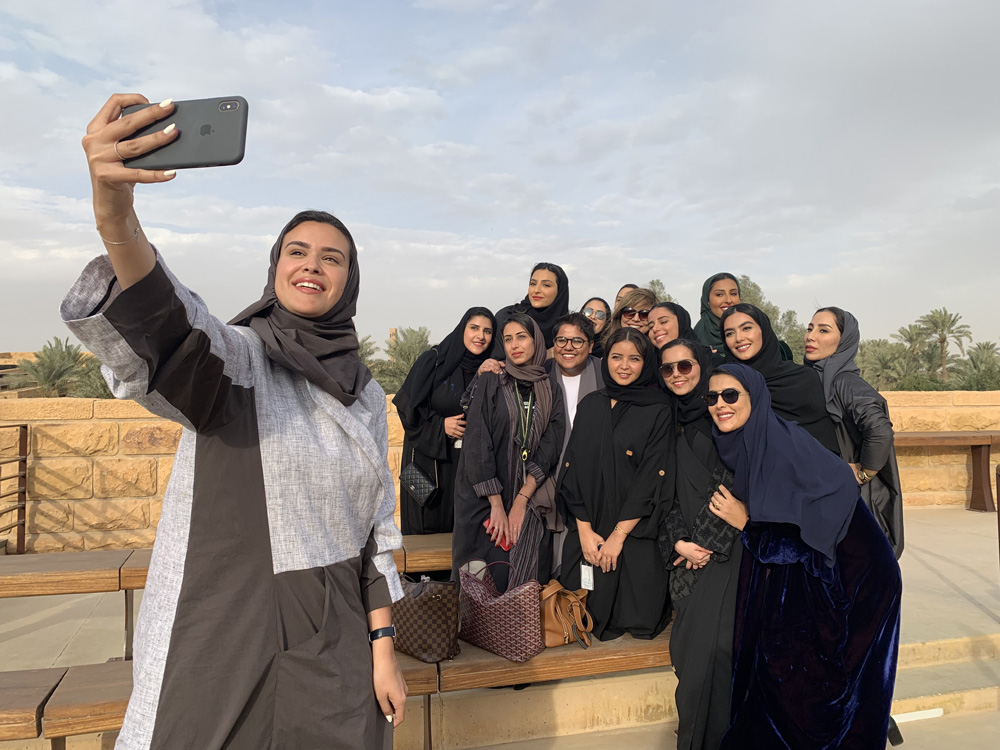


Behind the Scenes: the ladies taking a commemorative photo in Diriyah. (AN photo)


 Haifa Al-Ruwaished is currently in the graduate program, and being from Diriyah, she says it was an honor to be able to work alongside passionate and enthusiastic members serving both her county and country.

 Jerry Inzerillo, CEO of the DGDA, said: “This is such an inspiring time for Saudi youth, especially women, and we are proud to play our part. We are passionate about giving back to the communities of Diriyah and knew that we needed to start with the talent of tomorrow. The graduates from Diriyah that have become part of the DGDA are already stars and I’m confident they will take important roles in shaping the future of the Kingdom. We are especially proud that a majority of the graduates who have joined are women.” 


ALSO READ: The French agency helping Saudi Arabia realize AlUla’s potential


 “As a local from Diriyah, I am honored to join the entity that is tasked with benchmarking my county as the premier culture and lifestyle hub in the heart of Saudi Arabia,” said Munirah Binhalwan, executive assistant to the chief of marketing and communications officer. “Being part of the team that is making history and breaking ground fills my heart with joy, as I am finally honoring my community.” 

 The positive work atmosphere and teamwork amongst the members of the DGDA is setting an example and providing a platform for growth to many of the members.

 “It’s an honor to be a part of the change that’s developing Diriyah as a county. To work hand in hand with everyone. We are learning and experiencing new things that are furthering our knowledge and expertise,” Maram Al-Nemer, media production senior officer at the DGDA, told Arab News. 

 With a goal set to help change the Kingdom’s perception in the world, a quite ambitious goal, Atkins believes her role is to act as a catalyst to “show what a unique and special place this is and also to see the young women in my team become confident leaders. That’s what success looks like for me.” 


CNN suggests ‘false information’ could be behind UAE-KSA tensions

Updated 10 min 23 sec ago
Follow

CNN suggests ‘false information’ could be behind UAE-KSA tensions

  • Abu Dhabi mobilized STC after being falsely informed that Riyadh asked for sanctions on UAE

RIYADH: Tensions between Riyadh and Abu Dhabi could have been sparked by false information provided to the UAE about the Saudi Crown Prince’s recent visit to Washington, CNN has reported.

The American news channels says it has learned from its sources that Saudi Arabia believes Abu Dhabi mobilized the separatist Southern Transitional Council (STC) forces, which it backs, in provinces bordering the kingdom after being falsely informed that Saudi Crown Prince Mohammed bin Salman had asked US President Donald Trump during a White House visit in November to impose sanctions on Abu Dhabi over its alleged support for a warring party in Sudan’s civil war.

CNN’s reporting also suggests that Riyadh has reached out to the UAE to explain that it made no such request.

Meanwhile, the American channel says the UAE official who spoke to it on the condition of anonymity didn’t directly address the matter when asked about the false information claims.

During the November visit, President Trump did publicly announce that he had instructed his government to intervene in a bid to resolve the ongoing, bloody conflict in Sudan, based on a request from the Saudi Crown Prince.

However, neither the statements of the president, the crown prince, nor any reports published by Saudi or US media made any reference to the UAE at the time.

On Dec. 30, Riyadh launched airstrikes on what it says was a UAE military equipment shipment to Yemen, which was uncoordinated with the Coalition.

The Kingdom also backed the Yemeni government’s call for UAE forces to leave the country, which Abu Dhabi has agreed to honor, issuing a statement that insinuates it has done so of its own will.

The UAE statement also claimed an unwavering commitment on the part of Abu Dhabi to Saudi Arabia’s security and sovereignty, rejecting any actions that could threaten the Kingdom or undermine regional stability.

Meanwhile, CNN said it also understands that further Saudi strikes targeting the STC remain on the table should the separatists not withdraw. After the UAE pulled its troops from Yemen last week, the STC moved toward secession, but under intense military pressure from Riyadh and its local allies, it lost territory, and it now claims it is happy to enter a dialogue with other Yemeni parties.

The Kingdom, for its part, has reaffirmed numerous times its belief that the Southern cause is a just one and has called for it to be discussed among the various parties at the negotiation table and away from the battlefield. Saudi Arabia has called for a dialogue to occur in Riyadh to discuss the Southern separation issue, and its call has been welcomed by the Yemeni government, various Yemeni factions — including the STC itself, as mentioned — and the majority of Arab and Muslim countries.

A problematic figure in the equation is Aidarous Al-Zubaidi, President of the STC, who is believed to have dual citizenship, and many Yemenis on social media have been posting images of his UAE passport and renouncing him as unfit for governing, claiming he serves a foreign agenda. Others also posted videos of him making statements that he would be happy to establish ties with Israel, should Southern Yemen gain its independence. Most recently as well, a post by Yemen’s Media Minister Moammar Eryani has accused the STC of allowing the theft and spread of weapons in Eastern provinces.

Eryani added that the STC has been deliberately causing chaos and “using Al Qaeda as a scarecrow to achieve its own political gains at the expense of Yemeni people”. CNN also says it has learned that

Saudi concerns extend beyond UAE involvement in Yemen and Sudan. Riyadh, according to the report, is also wary of the UAE’s policies in the Horn of Africa and in Syria, where it believes Abu Dhabi has cultivated ties with elements of the Druze community, some of whose leaders have openly discussed secession.

While no Saudi source was mentioned in the reporting, CNN’s narrative is in line with several public Saudi statements, which have objected to the recent Israeli recognition and endorsement of Somaliland’s separation from Somalia, Israeli attempts to undermine and attack the new Syrian government, and any attempt to impose a Southern Yemeni state by military means.

Israel maintains a close relationship with Abu Dhabi and an even closer one since the signing of the 2020 Abraham Accords, while Saudi Arabia has refused normalization with Tel Aviv until it recognizes a Palestinian State and adheres to a credible and irreversible path to achieving a Two-State Solution. This Saudi position has been reiterated yet again during the Crown Prince’s November visit to Washington.