


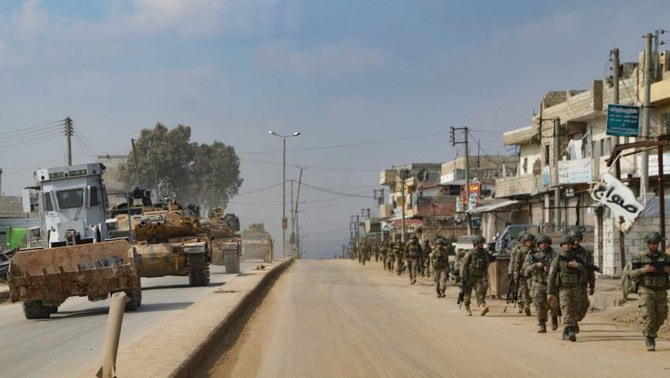

ANKARA: Turkey launched a military operation on Thursday to push back Syrian government forces in northwest Syria, defying warnings by Russia that an armed response would be “a worst-case scenario.”
The offensive by Turkish troops and National Liberation Front fighters targeted Assad regime forces near the village of Neirab, a strategic center southeast of the rebel-held city of Idlib.
Two Turkish soldiers were killed and five others wounded during the operation after an airstrike hit Turkey’s troops.
The offensive came a day after Turkish President Recep Tayyip Erdogan warned of an imminent military operation in Idlib despite Russian warnings.
Neirab is located on a major highway linking the city of Latakia with the Iraqi border and is about 10 km from Idlib city center. Regime forces seized the village two weeks ago.
Syrian troops supported by Russian aircraft and special forces have been battling since December to eradicate the last rebel strongholds in Idlib and Aleppo provinces in what could be one of the final chapters of the nine-year civil war.
Opinion
This section contains relevant reference points, placed in (Opinion field)
Emre Kursat Kaya, a researcher with Istanbul-based think tank EDAM, said the risk of a direct clash between Turkish and Syrian army forces is now “extremely high.”
“Reports suggest that in contrast with previous opposition counter-offensives, Turkish commando units and mechanized artillery units are actively present in the zones of operation,” he told Arab News.
Troops loyal to Syrian President Bashar Assad have captured one-fifth of the territory in Idlib.
About 15,000 Turkish troops are believed to be stationed in northwest Syria. Turkey has given the Assad regime until the end of the month to withdraw behind a demarcation line agreed under the 2018 Sochi deal.
However, Moscow and Ankara disagree in their interpretation of the agreement for de-escalation in Idlib. While Turkey insists on maintaining a cease-fire in and around Idlib, Russia focuses on fighting terrorism and eradicating jihadi elements on the ground.
Shortly after Turkey launched its offensive on Thursday, the Russian Reconciliation Center for Syria, a peace monitoring unit founded by Turkey and Russia in 2016, accused the Turkish military of backing “terrorists” in Syria, and called on Ankara to stop providing arms and support to terror groups.
Talks between Turkish and Russian delegations in the past two weeks failed to reach a compromise.
Kaya warned of a growing risk of clashes between Turkish forces and Russian mercenaries in the region amid mounting tension between the two countries.
The analyst said that he anticipated “a limited but intense opposition counter-offensive backed by Turkish forces, while Turkey will continue to use diplomatic channels with Russia.”
He said: “So far, a broad military operation does not seem to be part of Turkey’s plans. Ankara’s main objective in Idlib will continue to be to force the hand of Russia as much as it can while avoiding a larger conflict.”
But, according to Kaya, Turkey’s military deployment in Idlib sends a clear message to the Kremlin: “While we can agree on some issues, we also have red lines and it is time that you acknowledge them.”
As the three guarantor states, Turkey, Russia and Iran are set to meet in Tehran early next month to discuss the Syrian conflict.
Oytun Orhan, coordinator of Syria studies at the Ankara-based think tank ORSAM, said Neirab was a “psychological frontier” for Turkey during the fighting because the next step was to capture Idlib city center.
However, he said that if it was shown that Turkish soldiers had been killed by the airstrikes conducted by Russian warplanes, it could lead to direct conflict between Turkey and Russia, with Ankara “hitting back hard.”
“So far both countries have managed the process through their proxy forces. They were abiding by some rules without confronting each other directly. But if Russia claims responsibility for the attack killing the Turkish soldiers, the message is clear: I can target you and more serious costs might incur,” he said.


