

Parents in KP stage hunger strike, demand severe punishment for pedophiles

Asjid Khan, father of seven-year-old Hooz Noor who was raped and murdered in Nowshera last month, is sitting far right during a hunger strike in Peshawar on Feb. 19, 2020, to demand provincial lawmakers pass regulation to protect children from sexual abuse. (AN photo)
Short Url
Updated 20 February 2020
Follow

Parents in KP stage hunger strike, demand severe punishment for pedophiles

  • The protest comes after two recent child rape and murder cases in the province
  • Incidents of reported child rape are on the rise, police data shows

PESHAWAR: The parents of child sexual abuse victims staged a hunger strike in front of the Khyber Pakthunkhwa (KP) Assembly in Peshawar on Wednesday to demand protection, strict regulation, and law enforcement amid an increasing number of cases reported in the province. 

“For months we’ve been coming to the streets,” Shehnam Khan, the protest organizer, told Arab News, adding that there has been no reaction. “Because of this unethical behavior of our legislature and authorities, we decided to go on a hunger strike.” Until their demands are fulfilled. 
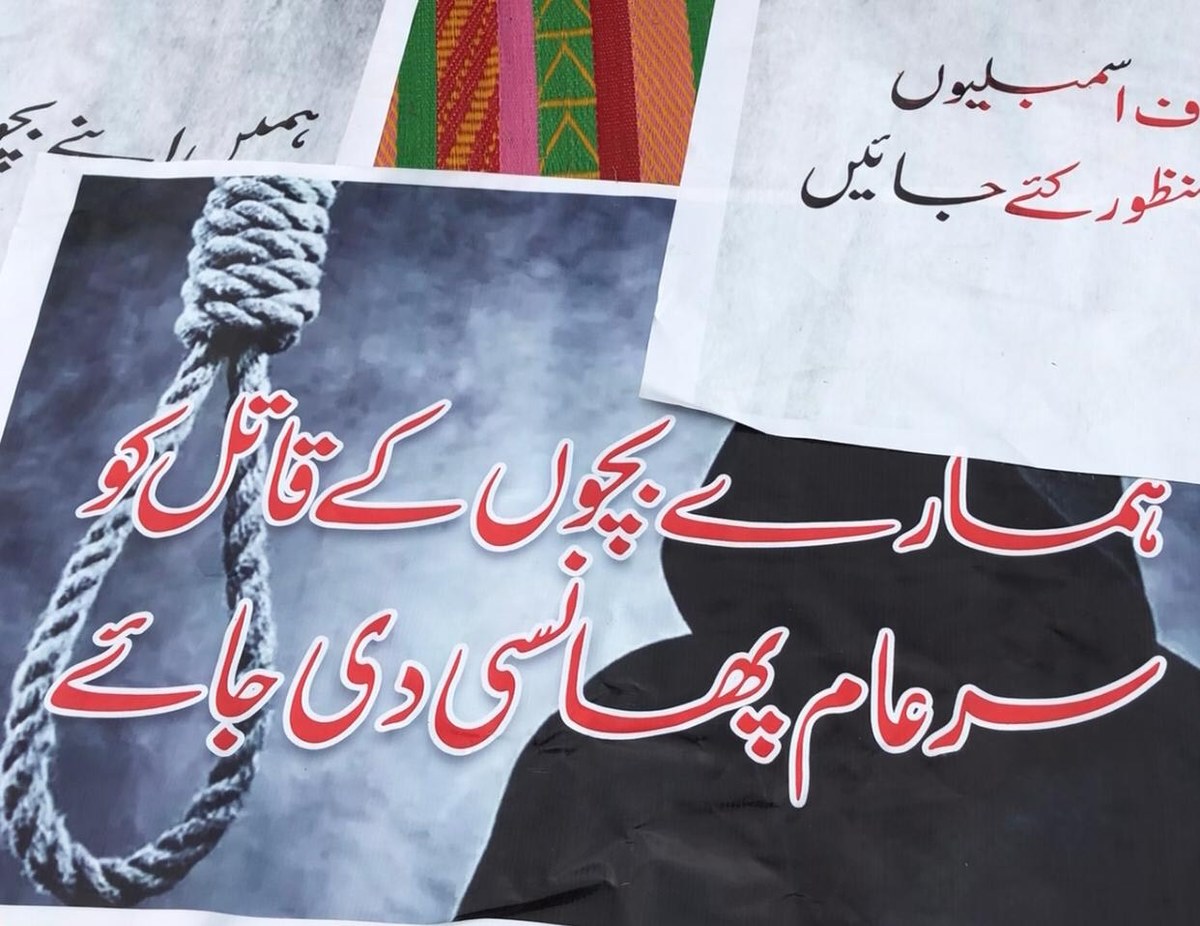


"Publicly hang the killers of our children," reads one of the banners brought by parents protesting in front of the provincial assembly building in Peshawar on Feb. 19, 2002. (Supplied)

The protest comes days after a girl identified as Madiha, reportedly aged seven, was raped and murdered in the province’s Hangu district, and weeks after another seven-year-old, Hooz Noor, was raped and drowned in a water tank in Nowshera.

Noor’s father, Asjid Khan, 34, is among the protesting parents. “I know it will not return Hooz Noor to us. But to protect many more children, to save the country’s future, the government has to have a plan,” he said. “I know parents have their responsibilities, but we can’t stay at home all the time.”

According to police data, cases of child rape are on the rise. In 2019, 188 incidents were processed in the province, more than triple the number in 2015. Three children were raped and murdered last year. As in all cases, only two people were convicted – none for the murders – the protesting parents demand that the government finally act against impunity. “We demand protection for our children,” “Publicly hang the killers of our children,” read the banners they held. 

Child rights activist Imran Takkar told Arab News parents it is obvious that parents are in despair if they have resorted to coming to Peshawar to mourn and tell lawmakers how dire the situation is in the province.

“There are sufficient sections in the KP Child Protection Act, but sloppy investigation and jirgas (councils of tribal elders), which reconcile offenders and victim families, prevent them from being implemented,” Takkar said.

“To contain further damage, not the parents but the state has to act against criminals and also provide legal, medical, and social support to victim families,” he said, adding that many cases remain unreported because of taboos and stigmatization. 

Ijaz Muhammad, deputy chief of the Khyber Pakhtunkhwa Child Protection and Welfare Commission, said the government is aware of the increase of child sexual abuse cases and in working on changes to the law. “Everyone has children and that’s why all segments of the government machinery are working to end this menace.” 

“To protect children, both government and opposition members of the provincial assembly are working on stricter law and in the next session its draft will be passed,” he added. 


Pakistan plans 3,000 EV charging stations as green mobility push gathers pace

Updated 10 sec ago
Follow

Pakistan plans 3,000 EV charging stations as green mobility push gathers pace

  • Roadmap unveiled by energy efficiency regulator and a private conglomerate amid early-stage EV rollout
  • New EV Policy and related plans aim to install 3,000 EV stations by 2030, including 240 stations in current fiscal year

ISLAMABAD: Pakistan’s energy efficiency regulator and a private conglomerate have unveiled an approved roadmap to establish 3,000 electric vehicle (EV) charging stations across the country, state-run Associated Press of Pakistan (APP) reported on Tuesday.

The announcement comes as Pakistan looks to build out basic EV charging infrastructure, which remains limited and unevenly distributed, largely concentrated in major cities. Despite policy commitments to promote electric mobility as part of climate and energy-efficiency goals, the absence of a nationwide charging network has slowed broader EV adoption.

Pakistan’s EV ecosystem is still at a formative stage, with progress constrained by regulatory approvals, grid connectivity issues and coordination challenges among utilities, regulators and fuel retailers. Expanding charging infrastructure is widely seen as a prerequisite for scaling electric transport for both private and commercial use.

According to APP, the roadmap was presented during a meeting between Malik Group Chief Executive Officer Malik Khuda Baksh and National Energy Efficiency and Conservation Authority Managing Director and Additional Secretary Humayon Khan.

“Baksh ... in a meeting with Khan, unveiled the approved roadmap for establishing 3,000 electric vehicle charging stations across Pakistan,” APP reported. “Khan reaffirmed the authority’s full institutional backing and pledged to expand the initiative to 6,000 EV charging stations nationwide.”

The discussion reviewed hurdles delaying the rollout, including EV charger imports, customs duties, regulatory documentation and inter-agency coordination.

APP said Khan welcomed the proposal and sought recommendations for “internationally compliant EV charger brands,” while asking for a detailed “issue-and-solutions report within three days” to facilitate timely implementation of the national green mobility initiative.

Despite the issuance of 13 licenses by NEECA and the arrival of five EV charging units at designated sites, progress has been slowed by procedural bottlenecks, officials said. These include delays in electricity connections, prolonged installation of separate meters and pending no-objection certificates from power distribution companies and oil marketing firms, which continue to stall operational readiness.

Pakistan’s electric vehicle ecosystem is still in its early stages, with charging infrastructure far behind levels seen in more advanced markets. The government’s New Energy Vehicle Policy and related plans aim to install 3,000 EV charging stations by 2030, including 240 stations planned in the current fiscal year, but actual deployment remains limited and uneven, mostly clustered in major cities and along key urban corridors.

Despite regulatory backing, including the 2024 Electric Vehicles Charging Infrastructure and Battery Swapping Stations framework, progress has been slow. Many proposed stations have yet to become operational due to delays in grid connections and approvals, and public maps of nationwide charging coverage are not yet available.

Private players are beginning to install more chargers, and there are over 20 public EV charging points reported in urban centers, offering both slower AC chargers and faster DC options. However, such infrastructure is still sparse compared with the growing number of electric vehicles and the government’s long-term targets.