

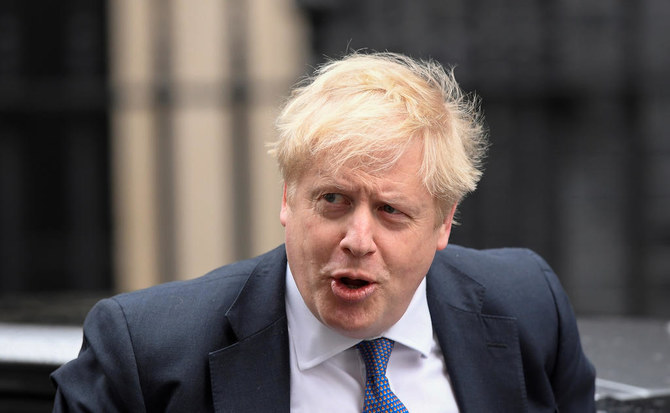
Corbyn slams Johnson government’s ‘contradictory’ stance on Trump peace plan

The leader of the UK’s opposition Jeremy Corbyn has criticized Prime Minister Boris Johnson’s “contradictory” stance on the Middle East peace plan revealed by US President Donald Trump last month. (Reuters)
Short Url
Updated 18 February 2020
Follow

Corbyn slams Johnson government’s ‘contradictory’ stance on Trump peace plan

  • Corbyn said Johnson’s stance on the deal “flew in the face of reality”
  • Outgoing Labour Party leader tweeted letter sent to him from UK PM

LONDON: The leader of the UK’s opposition Jeremy Corbyn has slammed Prime Minister Boris Johnson’s “contradictory” stance on the Middle East peace plan revealed by US President Donald Trump last month.

The outgoing Labour Party leader tweeted on Monday a letter sent to him earlier this month from Johnson in which the prime minister said the plan should be given “genuine and fair consideration.”

In the days after the deal was announced in January, Johnson backed the plan, saying during a call with Trump that it “could prove a positive step forward” in the Israeli-Palestinian issue and benefit the wider region.

But in his response to a letter from Corbyn, which raised concerns about the plan immediately after its unveiling, Johnson said the UK government’s position on the conflict remained unchanged.

Despite Trump’s plan allowing Israeli annexation of key parts of the West Bank, including the Jordan Valley, Johnson wrote: “The UK’s position on Israeli settlements in the occupied West Bank is clear and has not changed. These settlements are illegal under international law, present an obstacle to peace, and threaten the physical viability of a two-state solution.”

Part of Trump’s policy on Palestine included pulling funding last year for the UN Relief and Works Agency for Palestine Refugees in the Near East (UNRWA).

The right of return for refugees expelled during the creation of Israel in 1948, as well as during the conflicts since, would also be denied.

But Johnson said the UK would continue to fund UNRWA, and London would remain committed to a “just, fair, agreed and realistic” approach to the two-state solution, with Jerusalem as a shared capital.

In his tweet, Corbyn said Johnson’s stance on the deal “flew in the face of reality.” Corbyn added: “Palestinians unanimously rejected the plan, and Johnson’s letter shows the UK government’s own positions contradict it. So the PM can’t seriously claim Trump’s plan offers a route to genuine peace talks.”

The plan was rejected by Palestinians, the Arab League and the Organization of Islamic Cooperation. It was also heavily criticized by the EU and the international community.


Israel’s Netanyahu says it would be a ‘mistake’ to hold elections now

Updated 6 sec ago
Follow

Israel’s Netanyahu says it would be a ‘mistake’ to hold elections now

  • Failure to pass the budget by March 31 would trigger early elections

JERUSALEM: Israeli Prime Minister Benjamin Netanyahu said on Tuesday that holding elections now would be a “mistake,” as he faces the possibility of a snap vote should he fail to pass a national budget.
The budget will have its first reading on Wednesday in Israel’s parliament, where Netanyahu’s coalition is only able to exercise a majority thanks to the uncertain cooperation of a former ally.
“Of course I’m concerned... I think we’re in a very sensitive situation,” Netanyahu said at a televised press conference.
Failure to pass the budget by March 31 would trigger early elections.
“I think the last thing we need right now is elections. We’ll have elections later on this year, but I think it’s a mistake to have them now” he said.
Elections are due to be held by November.
The leader of Likud, Israel’s main right-wing party, Netanyahu holds the record for the longest time served as Israel’s premier — more than 18 years in total over several stints since 1996 — and has already said he intends to run again.
In the last elections, Likud won 32 seats in the Knesset, its ultra-Orthodox allies 18, and a far-right alliance 14.
Some of Netanyahu’s ultra-Orthodox allies formally left his government last year, but for now refuse to bring it down.
However, they are reluctant to vote for the budget until the premier makes good on a promise to pass a law allowing their community to avoid military conscription.
Netanyahu’s current term began with a controversial judicial overhaul plan that sparked months of mass protests, with tens of thousands of Israelis taking to the streets almost daily.