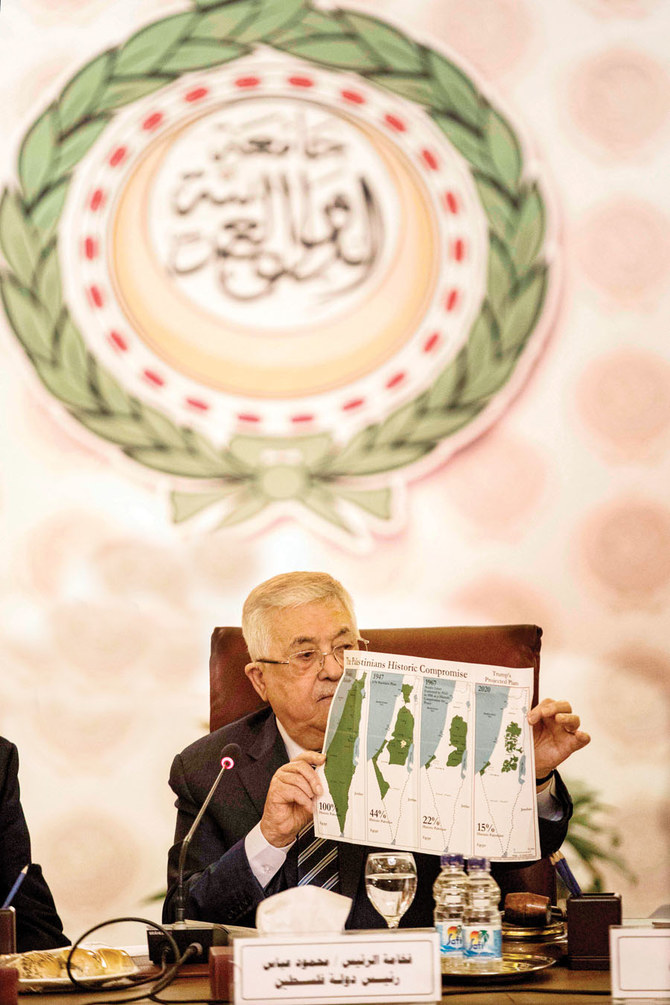

CAIRO/AMMAN: Palestinian President Mahmoud Abbas was urged on Saturday to take part in talks based on a new Middle East peace plan rather than reject it out of hand.
“It is important … to come out with a constructive stance, a realistic stance and a positive strategy that goes beyond just condemnation,” UAE Minister of State for Foreign Affairs Anwar Gargash said.
He spoke as Arab League foreign ministers meeting in Cairo rejected the new plan, announced last week by US President Donald Trump. They said it was unfair to the Palestinians and would not lead to a comprehensive and just peace.
Abbas himself not only condemned the Trump plan, but withdrew security cooperation with Israel in the occupied West Bank. “We’ve informed the Israeli side ... that there will be no relations at all with them and the US, including security ties,” Abbas told the meeting.
Israel and the Palestinian Authority’s security forces have long cooperated in policing areas of the occupied West Bank that are under Palestinian control. The PA also has intelligence cooperation agreements with the CIA, which continued even after the Palestinians began boycotting the Trump administration in 2017.
Abbas also said he had refused to discuss the plan by with Trump by phone, or to receive even a copy of it to study it. “Trump asked that I speak to him by phone but I said ‘no,’ and that he wants to send me a letter ... but I refused it.”
Abbas said he did not want Trump to be able to say that he had been consulted.
The Trump peace plan, enthusiastically supported by Israeli Prime Minister Benjamin Netanyahu, calls for the creation of a demilitarized Palestinian state that excludes Jewish settlements built in occupied territory and is under near-total Israeli security control. It also proposes US recognition of Israeli settlements on occupied West Bank land and of Jerusalem as Israel’s indivisible capital, along with Israeli annexation of the Jordan valley.
The Arab League foreign ministers meeting in Cairo said the plan would not lead to a comprehensive and just peace, and that the League would not cooperate with the US in implementing it.
The ministers affirmed Palestinian rights to create a future state based on the land captured and occupied by Israel in the 1967 Middle East war, with East Jerusalem as capital, the final communique said. They said there could be no peace without recognising Palestinian rights and a comprehensive solution, based on the 2002 Arab peace initiative.
The Saudi delegation was led by the Minister of Foreign Affairs, Prince Faisal bin Farhan, who reaffirmed the Kingdom’s support “for the Palestinian people and their just cause.”
Abbas has threatened to withdraw security cooperation before and it was unclear whether he would carry it out, analysts told Arab News.
“If he does, then he might finally have some leverage to negotiate a better deal with the Israelis,” said Fadi Elsalameen of the Foreign Policy Institute at The Johns Hopkins School of Advanced International Studies. “I am very skeptical about his ability to carry this through.”
Hanna Issa, secretary-general of the Islamic-Christian committee to support Jerusalem and the holy sites, and a member of the Fatah revolutionary council, told Arab News the total suspension of security coordination would mean the end of the Oslo accords. “This will need time unless the Palestinian side wants to dissolve the Palestinian Authority and therefore make Israel responsible legally, politically, and financially as an occupying power,” he said. “A vacuum will happen if this is decided and it is not clear how it will be filled.”
Wadie Abunassar, director of the International Centre for Consultations, said the Palestinian president’s statement was“vague,” and due to a lack of alternatives. “It is a warning, hinting that dissolving the Palestinian Authority might be an option, despite knowing that such an option might be bad for him in particular, and Palestinians in general.”
Ofer Zalzberg, senior analyst with the International Crisis Group, said the US plan amounted to coercive diplomacy, with the Trump administration signaling to Palestinians that the cost of avoiding compromise was high and increasing.
“This coercive effort encounters two major obstacles: First, it pushes on several elements standing at the core of Palestinian identity, notably regarding Al-Aqsa Mosque and refugees’ rights, which Palestinians deem non-negotiable. Such pressure backfires, only increasing resistance to the US plan.
“Second, not only Palestinian nationalism requires Palestinian statehood, so does Israeli-Jewish nationalism, to the extent that it seeks to maintain both a Jewish majority and a democratic system of governance.”
Zalzberg said the combination of these two seemed to lead the Palestinian leadership to favor pursuing calculated escalation, “loosening security coordination in order to demonstrate the Palestinian Authority’s utility to Israel in curbing violence while counting on Israeli self-interest to rein in the kind of annexation measures that would render a genuine two-state agreement impossible.”
Mohammad Masharqa, head of the Center for Arab Progress in London and former adviser to the Palestinian embassythere, told Arab News it was unlikely that security coordination would end soon.
“The security coordination is the last wall left of the Oslo Accords and if it falls it must be replaced by a new form of struggle,” he said. “Ending security coordination and dissolving the Palestinian Authority requires a new strategy that would require time and national unity between all aspects of the Palestinian people, inside and outside.”
Jamal Dajani, former head of communications at the Palestinian prime ministry, said Abbas was left with no option but to end all cooperation with Israel based on the Oslo agreement. “President Trump did not offer a peace plan, he outlined a one-sided proposal in order to pave the way for Israel to annex large areas of the West Bank and lock up Palestinians in bantustans,” he said.
“I don’t think, however, that Palestinians should sever ties with the US, as Trump’s deal does not reflect the sentiment of the American people or US Congress. In fact, it has been condemned by many prominent people and politicians in the US.”