

World must fight anti-vaccine drive, says Women in Science winner from Bangladesh

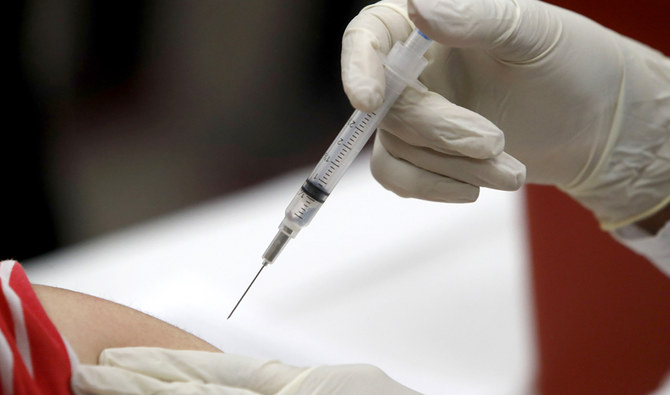
Misinformation campaigns result in “vaccine hesitancy,” which leads to outbreaks of otherwise preventable diseases. (AP)
Short Url
Updated 18 February 2020
Follow

World must fight anti-vaccine drive, says Women in Science winner from Bangladesh

  • In different countries, misinformation campaigns have different shapes and consequences

DHAKA: People around the world need to fight against misinformation campaigns that hamper vaccination efforts, Bangladeshi immunologist Dr. Firdausi Qadri told Arab News in an exclusive interview, as her efforts were honored during the 22nd edition of the L’Oreal-UNESCO for Women in Science Awards last week.

“In many countries — not only in developing countries, in developed ones too — there is a new sentiment that vaccination will cause some diseases in children,” Qadri said at her office at the International Center for Diarrheal Disease Research, Bangladesh in Dhaka.

These misinformation campaigns result in “vaccine hesitancy,” which leads to outbreaks of otherwise preventable diseases.

The 22nd L’Oreal-UNESCO for Women in Science Awards recognized five female scientists from different regions of the world in the field of life sciences.

Qadri’s award is for her outstanding work to understand and prevent infectious diseases affecting children in developing countries and promote early diagnosis and vaccination.

“Before launching any vaccine, we do trials in different phases to detect their adverse effects, if there are any. Even after the vaccine is launched, we monitor its impacts,” she said, stressing that raising awareness on the importance of immunization is essential and should be directed by governments.

In different countries, misinformation campaigns have different shapes and consequences. In developed nations, they can lead to outbreaks of diseases such as measles and mumps, which the World Health Organization identified as one of the top 10 global health threats in 2019.

In countries like Pakistan, vaccine hesitancy in certain areas is related to cultural norms. “Sometimes doctors are not allowed into homes because they are males,” Qadri said. “There are only few countries in the world which are not polio-free, Pakistan is one of them … many people in Pakistan are not very aware about the benefits of vaccinations.”  

In Bangladesh, which is also a developing country, immunization awareness is much higher, but self-sufficiency is still lacking and can affect the country’s efforts to eradicate diseases such as cholera.

“We need to concentrate on cholera vaccines. According to the national cholera control plan, we will require almost 180 million doses of oral cholera vaccine in the next five years to eliminate it. Nobody can give us that vaccine if it’s not produced locally,” she said.

While Bangladesh has obtained the cholera vaccine license and is expected to start producing it soon, Bangladeshi scientists have no equipment to develop the country’s biological preparations.

“When we want to do very high-quality research, the problem is not lack of knowledge but of equipment and reagents which must arrive in the right condition. Their cold chain must be maintained and they need to come quickly,” Qadri said.  

“When people don’t have the facilities, they don’t feel the urge to do good research,” she said, explaining that scientific culture needs to be promoted and financially supported in developing countries.

Qadri has dedicated her award to 500 young researchers who work with her, hoping that the recognition will encourage more Bangladeshi women to choose scientific careers.

“It sets an example for women. We are lacking in the field of science, technology, electronics and mathematics. There is a gender imbalance. I hope with my achievement, the situation will improve to some extent,” she said.

The award, she added, will also people make realize that research is being done in Bangladesh.

Regarding her ongoing research, Qadri explained she is working on the problem of malnourishment in immunization effectiveness.

Malnourished children react differently to vaccines. “They don’t respond like a child in a developed country like in the UK, US or Sweden.

“The burden of pathogens in our system is so high and there are so many infections one after another, which gives rise to enteropathy, making it difficult for a child to respond to a vaccine properly,” she explained.

She is working on it. “Children should grow up to be healthy adults,” the mother of three said, revealing what guides her work and efforts.


Trump says US could run Venezuela and its oil for years

Updated 58 min 2 sec ago
Follow

Trump says US could run Venezuela and its oil for years

  • US president made the comments less than a week after Washington seized Maduro in a raid on Caracus
  • Oil has emerged as the key to US control over Venezuela, which has the world’s largest proven reserves

WASHINGTON: The United States could run Venezuela and tap into its oil reserves for years, President Donald Trump said in an interview published Thursday, less than a week after toppling its leader Nicolas Maduro.
“Only time will tell” how long Washington would demand direct oversight of the South American country, Trump told The New York Times.
But when asked whether that meant three months, six months or a year, he replied: “I would say much longer.”
The 79-year-old US leader also said he wanted to travel to Venezuela eventually. “I think at some point it’ll be safe,” he said.
US special forces snatched president Maduro and his wife in a lightning raid on Saturday and whisked them to New York to face trial on drug and weapons charges, underscoring what Trump has called the “Donroe Doctrine” of US hegemony over its backyard.
Since then Trump has repeatedly asserted that the United States will “run” Venezuela, despite the fact that it has no boots on the ground.
Venezuela’s interim leader Delcy Rodriguez insisted that no foreign power was governing her country. “There is a stain on our relations such as had never occurred in our history,” Rodriguez said of the US attack.
But she added it was “not unusual or irregular” to trade with the United States now, following an announcement by state oil firm PDVSA that it was in negotiations to sell crude to the United States.

‘Tangled mess’

Oil has in fact emerged as the key to US control over Venezuela, which has the world’s largest proven reserves.
Trump announced a plan earlier this week for the United States to sell between 30 million and 50 million barrels of Venezuelan crude, with Caracas then using the money to buy US-made products.
On the streets of Caracas, opinions remain mixed about the oil plan.
“I feel we’ll have more opportunities if the oil is in the hands of the United States than in the hands of the government,” said Jose Antonio Blanco, 26. “The decisions they’ll make are better.”
Teresa Gonzalez, 52, said she didn’t know if the oil sales plan was good or bad.
“It’s a tangled mess. What we do is try to survive, if we don’t work, we don’t eat,” she added.
Trump, who will meet oil executives on Friday, is also considering a plan for the US to exert some control over Venezuela’s PDVSA, the Wall Street Journal reported.
The US would then have a hand in controlling most of the oil reserves in the Western Hemisphere, as Trump aims to drive oil prices down to $50 a barrel, the paper reported.
Vice President JD Vance underscored that “the way that we control Venezuela is we control the purse strings.”
“We tell the regime, ‘you’re allowed to sell the oil so long as you serve America’s national interest,’” he told Fox News host Jesse Watters in an interview broadcast late Wednesday.

‘Go like Maduro’

Vance, an Iraq veteran who is himself a skeptic of US military adventures, also addressed concerns from Trump’s “Make America Great Again,” saying the plan would exert pressure “without wasting a single American life.”
The US Senate is voting Thursday on a “war powers” resolution to require congressional authorization for military force against Venezuela, a test of Republican support for Trump’s actions.
Caracas announced on Wednesday that at least 100 people had been killed in the US attack and a similar number wounded. Havana says 32 Cuban soldiers were among them.
Trump’s administration has so far indicated it intends to stick with Rodriguez and sideline opposition figures, including Nobel Peace Prize winner Maria Corina Machado.
But Rodriguez’s leadership faces internal pressures, analysts have told AFP, notably from her powerful Interior Minister Diosdado Cabello and Defense Minister Vladimir Padrino Lopez.
“Her power comes from Washington, not from the internal structure. If Trump decides she’s no longer useful, she’ll go like Maduro,” Venezuela’s former information minister Andres Izarra told AFP in an email.
The US operation in Venezuela — and Trump’s hints that other countries could be next — spread shockwaves through the Americas, but but he has since dialed down tensions with Colombia.
A day after Colombia’s leftist President Gustavo Petro spoke with Trump on Wednedsday, Bogota said Thursday it had agreed to take “joint action” against cocaine-smuggling guerrillas on the border with Venezuela.