



MUNICH: An arms embargo aimed at curbing fighting in Libya has become meaningless because of violations, and it is imperative that those who breach it are held to account, a senior UN official said on Sunday.
“The arms embargo has become a joke. We all really need to step up here,” UN Deputy Special Representative to Libya Stephanie Williams said after a meeting to follow up on a summit in Berlin last month that agreed to uphold the embargo. Fighting has continued despite a call for a truce.
A fragile existing truce “is holding only by a thread, with numerous — over 150 violations,” she said.
Germany and the UN, which co-hosted the summit, gathered foreign ministers and other officials from a dozen countries on the sidelines of the Munich Security Conference to try to bolster a drive to cut off outside military support for Libya’s warring parties.
The countries involved include the five permanent members of the UN Security Council (Britain, China, France, Russia and the (US) along with Italy, Turkey and the United Arab Emirates. Sunday’s meeting formally launched an international follow-up committee on Libya. Italy will co-chair the next meeting, in Rome in March.
At the Berlin summit, participants agreed to respect the arms embargo, hold off on military support to Libya’s warring parties and push them to reach a full cease-fire.
But UN Secretary-General Antonio Guterres says that agreement has been repeatedly violated by continuing arms deliveries and an escalation in fighting.
Sunday’s meeting formally launched an international follow-up committee on Libya. Italy will co-chair the next meeting, in Rome in March.
“It’s complicated because there are violations by land, sea and air, but it needs to be monitored and there needs to be accountability,” Williams told a news conference, adding that Libya was now awash with advanced weapons.
“The situation on the ground remains deeply troubling. The truce is holding only by a thread ... The economic situation continues to deteriorate.”

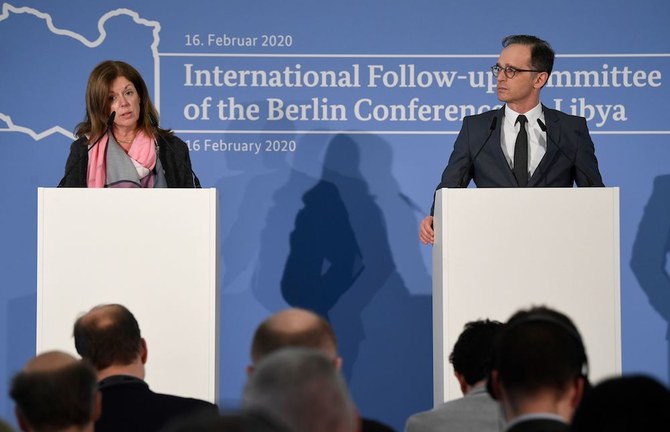
German Foreign Minister Heiko Maas (R) and the Deputy Special Representative of the UN Secretary-General for Political Affairs in Libya, United Nations Support Mission in Libya (UNSMIL) Stephanie Williams give a press statement at the end of a follow-up meeting on Libya, on the sidelines of the 56th Munich Security Conference (MSC) in Munich, southern Germany, on Feb. 16, 2020. (AFP)
A joint statement issued on Sunday by the 13 countries involved in Libya said there had been a discussion on the “deplorable” arms embargo violations, and “renewed determination to contribute to its thorough implementation.” But there was no mention of how the embargo would be monitored or enforced, or whether there would be any consequences for violating it.
German Foreign Minister Heiko Maas said he wanted EU foreign ministers to make a decision on Monday on their role in monitoring the embargo.
“Everyone needs to know that if they violate the embargo in future, then they violate a UN resolution and that this can’t remain without consequences,” Maas said, without elaborating.
Libya has been in turmoil since 2011, when a civil war toppled longtime dictator Muammar Qaddafi, who was later killed.
A weak UN-recognized administration that now holds the capital of Tripoli and parts of the country’s west is backed by Turkey, which recently sent thousands of soldiers to Libya, and to a lesser degree Qatar and Italy as well as local militias.
On the other side is a rival government in the east that supports eastern commander Gen. Khalifa Hafter, whose forces launched an offensive to capture Tripoli last April. They are backed by the United Arab Emirates, Egypt, France and Russia.
United Arab Emirate’s Minister of Foreign Affairs Anwar Gargash said the UAE is working with other partners to reach a political solution in Libya, which would also curb extremism.
Since the Berlin summit, the rival Libyan military factions have met in Geneva in a UN-led effort to forge a lasting truce. A first round of talks ended without officials signing an agreement, but Maas said a second round will begin in Geneva on Tuesday.
On Wednesday, the UN Security Council endorsed the Berlin summit conclusions, including a 55-point road map for ending the war in Libya and condemned the recent increase in violence in the oil-rich North African country.
The European Union, which will discuss Libya in Brussels on Monday, has been arguing about possibly having naval ships enforce the UN arms embargo against Libya.
Maas, however, stressed the need to enforce the weapons embargo by sea, air and land, given that arms find their way to the warring parties by different routes. He said EU ships may not be needed in the Mediterranean Sea “because sea routes, air routes and land routes can be monitored from the air.”


