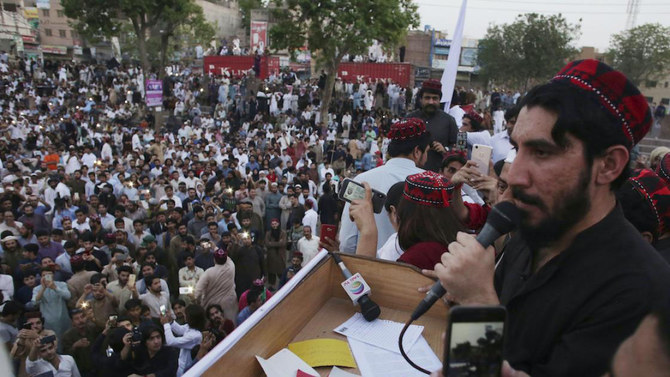
PESHAWAR: A Pakistani court Saturday ordered the release of a Pashtun rights leader critical of the military, his lawyer said, weeks after he was arrested on sedition charges.
Manzoor Pashteen, chief of the Pashtun Protection Movement (PTM), was arrested last month on charges of sedition, hate speech, incitement against the state, and criminal conspiracy.
His lawyer Saeed Akhtar told AFP that he had already been bailed on three of five complaints against him.
"Today the court has granted him bail in the remaining two, against surety bonds of one hundred thousand rupees ($650) each," Akhtar said.
He added that he hoped Pashteen would be released from jail later Saturday. A government prosecutor also confirmed the bail to AFP.
Pashteen, a former veterinary student, and the PTM have rattled Pakistan's military since 2018 with calls to end alleged abuses by security forces targeting ethnic Pashtuns in the restive tribal areas along the border with Afghanistan.
Once plagued by militancy and unrest, the region is where Washington believes Pakistan provides safe haven to militant groups including the Afghan Taliban and Haqqani Network.
The army has carried out many operations in the region, and security across Pakistan has dramatically improved in recent years.
But the PTM claim the operations came at a heavy price because of alleged abuses -- including enforced disappearances and targeted killings.
The movement remains peaceful, but has been notable for its direct verbal attacks on the armed forces in a country where such criticism is largely seen as a red line.
Islamabad and the military have repeatedly denied the claims and arrested PTM activists.
A far-reaching media blackout has kept news and images of peaceful PTM rallies off TV screens and front pages nationwide.
An opinion piece written by Pashteen in the New York Times in 2019 was censored in Pakistan.
Pashtuns are a fiercely independent ethnic group that straddles both sides of the border between Pakistan and Afghanistan.
They account for roughly 15 percent of Pakistan's population, with a majority of the 30 million-strong group living in the northwest.


Pakistan court orders release of Pashtun rights leader
https://arab.news/yp2e7
Pakistan court orders release of Pashtun rights leader

- Chief of Pashtun Protection Movement was arrested last month on charges of sedition, hate speech and conspiracy
- The movement has been notable for its criticism of Pakistan’s armed forces

Pakistan telecom regulator urges restraint on social media amid regional tensions
- PTA warns against sharing unverified content, says legal action may follow ‘fake news’
- Advisory comes as Pakistan strikes targets in Afghanistan and Iran faces US, Israeli attacks
ISLAMABAD: Pakistan’s telecom regulator on Saturday urged citizens to avoid sharing “unverified or inflammatory” content online, warning that legal action could be taken against those spreading misinformation amid what it described as a “sensitive national situation.”
The advisory from the Pakistan Telecommunication Authority (PTA) comes as Islamabad says it is targeting militant positions inside Afghanistan following a recent flareup between the two neighbors, while Iran is under attack by the United States and Israel in an escalating regional conflict that has heightened security concerns across South and West Asia.
“In view of the prevailing sensitive national situation, Pakistan Telecommunication Authority (PTA) urges all citizens to be responsible while using social media and digital platforms,” the regulator said in a statement posted on X.
The PTA advised citizens “not to share, disseminate, forward, or upload any unverified, inflammatory, or misleading information/content that may directly or indirectly harm the national interest, public order, or state institutions.”
It said people should instead rely on authentic information based on official sources and refrain from spreading rumors and “fake news.”
“Sharing any fake news/information is liable to legal action in accordance with applicable laws,” the authority said, calling on citizens to act with “caution, maturity, and a strong sense of national responsibility” to help maintain stability and public confidence.
Pakistan in recent years has witnessed increasingly stringent implementation of the Prevention of Electronic Crimes Act (PECA), a cybercrime law that has drawn criticism from rights groups, with journalists and activists arrested and prosecuted under its provisions.


