

Rohingya boat capsizes in Bay of Bengal; at least 15 dead

1 / 2
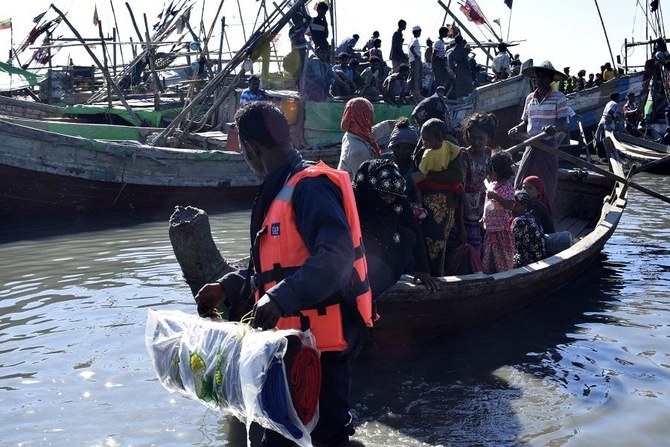
People stand around the bodies of victims of a boat capsize at St. Martin's Island, Bangladesh, Tuesday, Feb. 11, 2010. (AP)
2 / 2
Many of the 700,000-plus Rohingya who fled a military crackdown in Myanmar in 2017 have tried to leave overcrowded refugee camps in Bangladesh’s Cox’s Bazar district on boats headed for Malaysia. (File/AFP)
Short Url
Updated 13 February 2020
Follow

Rohingya boat capsizes in Bay of Bengal; at least 15 dead

  • Some 130 people were packed on the fishing trawler that was trying to get across the Bay of Bengal to Malaysia
  • Coast guard spokesman Hamidul Islam said the boat was one of two vessels that was making the hazardous journey

SAINT MARTIN's ISLAND, BANGLADESH: At least 15 women and children drowned and more than 50 others were missing after a boat overloaded with Rohingya refugees sank off southern Bangladesh as it tried to reach Malaysia Tuesday, officials said.
Some 138 people — mainly women and children — were packed on a trawler barely 13 meters (40 feet) long, trying to cross the Bay of Bengal, a coast guard spokesman told AFP.
“It sank because of overloading. The boat was meant to carry maximum 50 people. The boat was also loaded with some cargo,” another coast guard spokesman, Hamidul Islam, added.
Nearly one million Rohingya live in squalid camps near Bangladesh’s border with Myanmar, many fleeing the neighboring country after a 2017 brutal military crackdown.
With few opportunities for jobs and education in the camps, thousands have tried to reach other countries like Malaysia and Thailand by attempting the hazardous 2,000-kilometer journey.
In the latest incident, 71 people have been rescued including 46 women. Among the dead, 11 were women and the rest children.
Anwara Begum said two of her sons, aged six and seven, drowned in the tragedy.
“We were four of us in the boat... Another child (son, aged 10) is very sick,” the 40-year-old told AFP.
Fishermen tipped off the coast guard after they saw survivors swimming and crying for help in the sea.
The boat’s keel hit undersea coral in shallow water off Saint Martin’s Island, Bangladesh’s southernmost territory, before it sank, survivors said.
“We swam in the sea before boats came and rescued us,” said survivor Mohammad Hossain, 20.
Coast guard commander Sohel Rana said three survivors, including a Bangladeshi, were detained over human trafficking allegations.
An estimated 25,000 Rohingya left Bangladesh and Myanmar on boats in 2015 trying to get to Thailand, Malaysia and Indonesia. Hundreds drowned when overloaded boats sank.

Begum said her family paid a Bangladeshi trafficker $450 per head to be taken to Malaysia.
“We’re first taken to a hill where we stayed for five days. Then they used three small trawlers to take us to a large trawler, which sank,” she said.
Shakirul Islam, a migration expert whose group works with Rohingya to raise awareness against trafficking, said desperation in the camps was making refugees want to leave.
“It was a tragedy waiting to happen,” he said.
“They just want to get out, and fall victim to traffickers who are very active in the camps.”
Islam said in the past two months dozens of Rohingya reported approaches from traffickers to his OKUP migration rights group.
“Human smuggling and trafficking in the Bay of Bengal is particularly difficult to address as it requires concerted effort from multiple states,” the Bangladesh head of UN agency the International Organization for Migration, Giorgi Gigauri, told AFP.
“The gaps in coordination are easily exploited by criminal networks.”
Since last year, Bangladeshi authorities have picked up over 500 Rohingya from rickety fishing trawlers or coastal villages as they waited to board boats.
Trafficking often increases during the November-March period when the sea is safest for the small trawlers used by traffickers.
Bangladesh and Myanmar signed a repatriation deal to send back some Rohingya to their homeland, but none have agreed to return because of safety fears.
The charity Save the Children called on Myanmar to “take all necessary steps to ensure the Rohingya community can return to their homes in a safe and dignified manner.”
“The tragic drowning of women and children... should be a wake-up call for us all,” the group’s Athena Rayburn said in a statement.


Campaigning starts for Bangladesh’s first national election after Hasina’s ouster

Updated 3 sec ago
Follow

Campaigning starts for Bangladesh’s first national election after Hasina’s ouster

DHAKA: Campaigning began Thursday for Bangladesh’s first national elections since the 2024 uprising that ousted longtime Prime Minister Sheikh Hasina.
The major political parties held campaign rallies in the capital, Dhaka, and elsewhere ahead of Feb. 12 election, which is seen as the most consequential in Bangladesh’s history as it follows Hasina’s ouster and is being held under an interim government with voters also deciding on proposed political reforms.
The interim government led by Nobel Peace Prize laureate Muhammad Yunus has pledged to hold a free and fair election, but questions were raised after his administration banned Hasina’s former ruling Awami League party. The Awami League and the Bangladesh Nationalist Party have historically dominated the country’s electorate.
There are also concerns about the country’s law and order situation, but the government says they will keep the voting peaceful.
Yunus assumed office three days after Hasina left the country for India on Aug. 5, 2024, following the deaths of hundreds of protesters and others in a violent crackdown.
With the Awami League excluded from the election, a 10-party alliance led by Jamaat-e-Islami, an Islamist party, is seeking to expand its influence. Jamaat-e-Islami has long faced criticism from secular groups who say its positions challenge Bangladesh’s secular foundations. A new party formed by student leaders of the uprising, the National Citizen Party, or NCP, is also part of the alliance.
Tarique Rahman, BNP chairman and the son of former Prime Minister Khaleda Zia, is widely seen as a leading contender for prime minister. His party has drawn strong support rooted in the political legacy of his mother, who died last month. Rahman returned to Bangladesh last month after 17 years in exile in the United Kingdom.
Rahman launched his campaign in the northeastern city of Sylhet with an address to thousands of supporters at a rally Thursday. He is scheduled to visit several other districts in the coming days.
In Sylhet, Rahman criticized the Jamaat-e-Islami party for using religious sentiment to get votes. He said that if elected, he would uphold national sovereignty and work for women and young people.
“Now we must establish the right to vote, rebuild the nation, and make it economically self-reliant,” he said.
Jamaat-e-Islami and the NCP began their campaigns in the capital, Dhaka.
“There are terrorism (crimes), extortion, corruption and forcible possession, (our fight) is against them to establish a just Bangladesh, and alongside to build a safe Dhaka for women and children,” said Nasiruddin Patwari, a leader of the National Citizen Party.
The election will also include a referendum on a national charter, with the interim government seeking voter support for what it describes as a new political course built on reforms. The charter was signed last year by 25 of the country’s 52 registered political parties. The Awami League opposed the idea and several other parties declined to sign the document.
Rahman’s return has reenergized his supporters.
“Under his leadership, in the coming time we want to see a self-reliant Bangladesh and organizing this country through a democratic process,” said Ali Akbar Rajan, a BNP supporter, at Rahman’s rally in Sylhet. “He will emerge as a successful statesman, that is what we hope for,“
The July National Charter, named after the uprising that began in July 2024 and led to the fall of Hasina, is currently nonbinding. Supporters of the charter say a referendum is needed to make it legally binding and a part of the constitution. Only Parliament can change the constitution in Bangladesh.
The interim government says the charter would bring more checks and balances to avoid authoritarian administrations, including by giving the presidency more authority to balance what had been a powerful prime minister position. It also proposes term limits for legislators, and measures to prevent conflicts of interest, money laundering and corruption.